
Now Reading: ‘Dancing’ jets erupting from a cannibalistic black hole have the power of 10,000 suns
-
01
‘Dancing’ jets erupting from a cannibalistic black hole have the power of 10,000 suns

‘Dancing’ jets erupting from a cannibalistic black hole have the power of 10,000 suns

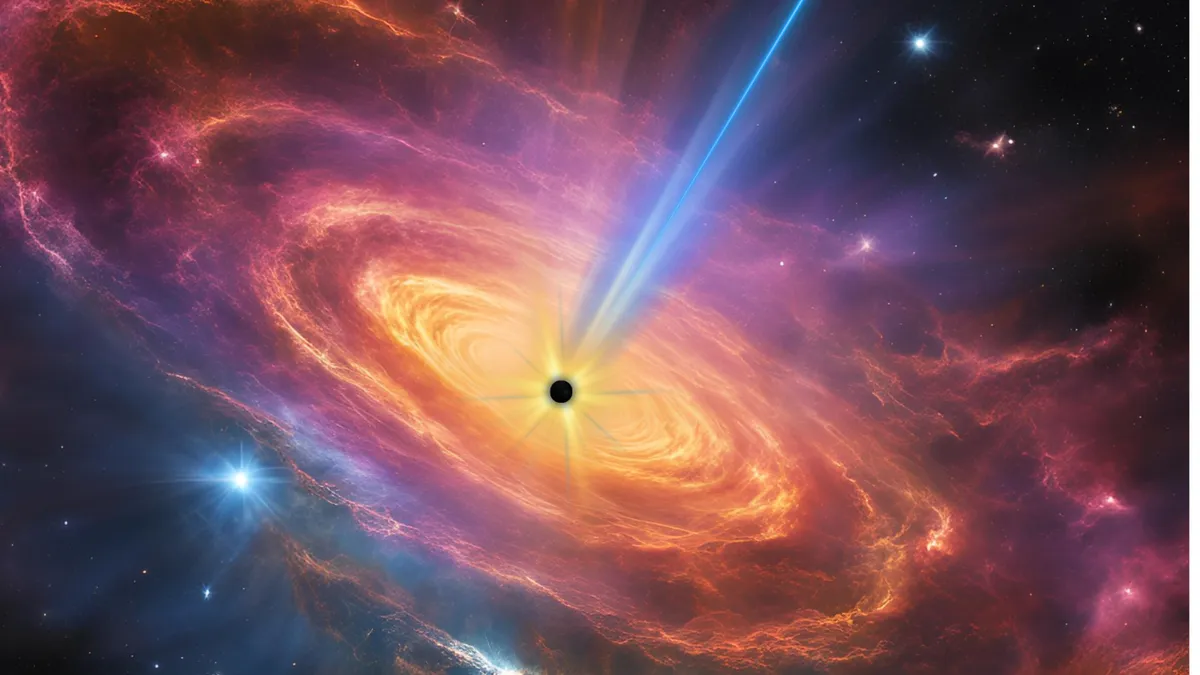
Astronomers watched as jets blasting from a black hole cannibalized a blue supergiant companion star. Data from the Square Kilometre Array Observatory (SKA) radio telescope allowed the team to measure the power of these outbursts, finding them as powerful as the output of 10,000 suns, which could help to reveal how they shape entire galaxies around them.
The system studied by the team is known as Cygnus X-1 (Cyg X-1), located 7,000 light-years away and one of the brightest sources of X-rays in the sky. Cyg X-1 is thought to consist of a stellar-mass black hole estimated to have around 21 times the mass of the sun, which is feeding from a blue supergiant star.
The blue supergiant star is supplying the Cyg X-1 black hole with material via powerful stellar winds blowing from it. This matter can’t fall straight to the black hole, though, as it has angular momentum, or spin. Instead, it forms a flattened swirling cloud called an accretion disk that gradually feeds the black hole.
The immense gravity of the black hole heats the accretion disk, causing the powerful X-ray emissions associated with Cyg X-1.
Not all of this matter finds its way into the black hole, though. Some is channeled to the poles of the black hole from where it is blasted out as powerful jets. Astronomers were not only able to determine the power of these jets, but also determined that they travel at around 336 million miles per hour (150,000 km/s), about half the speed of light.
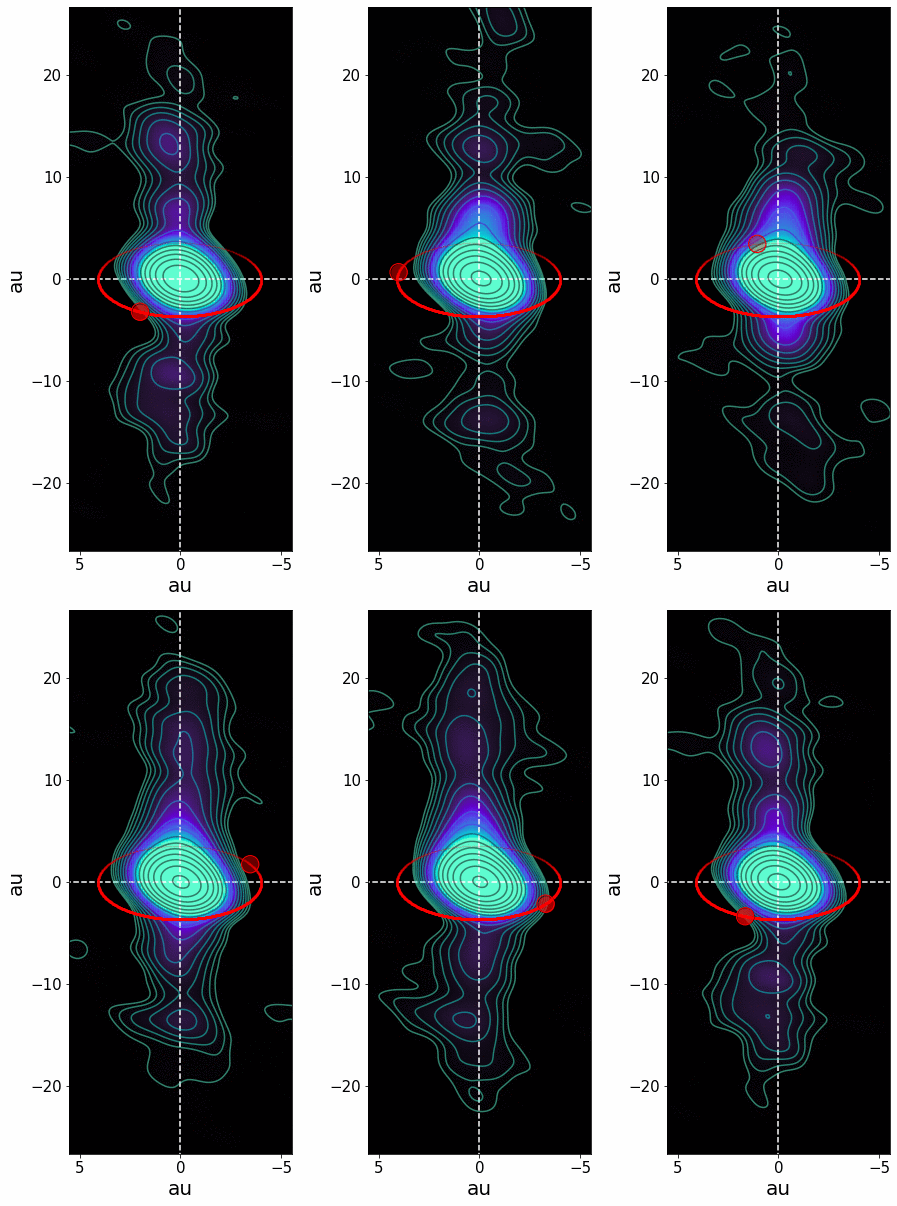
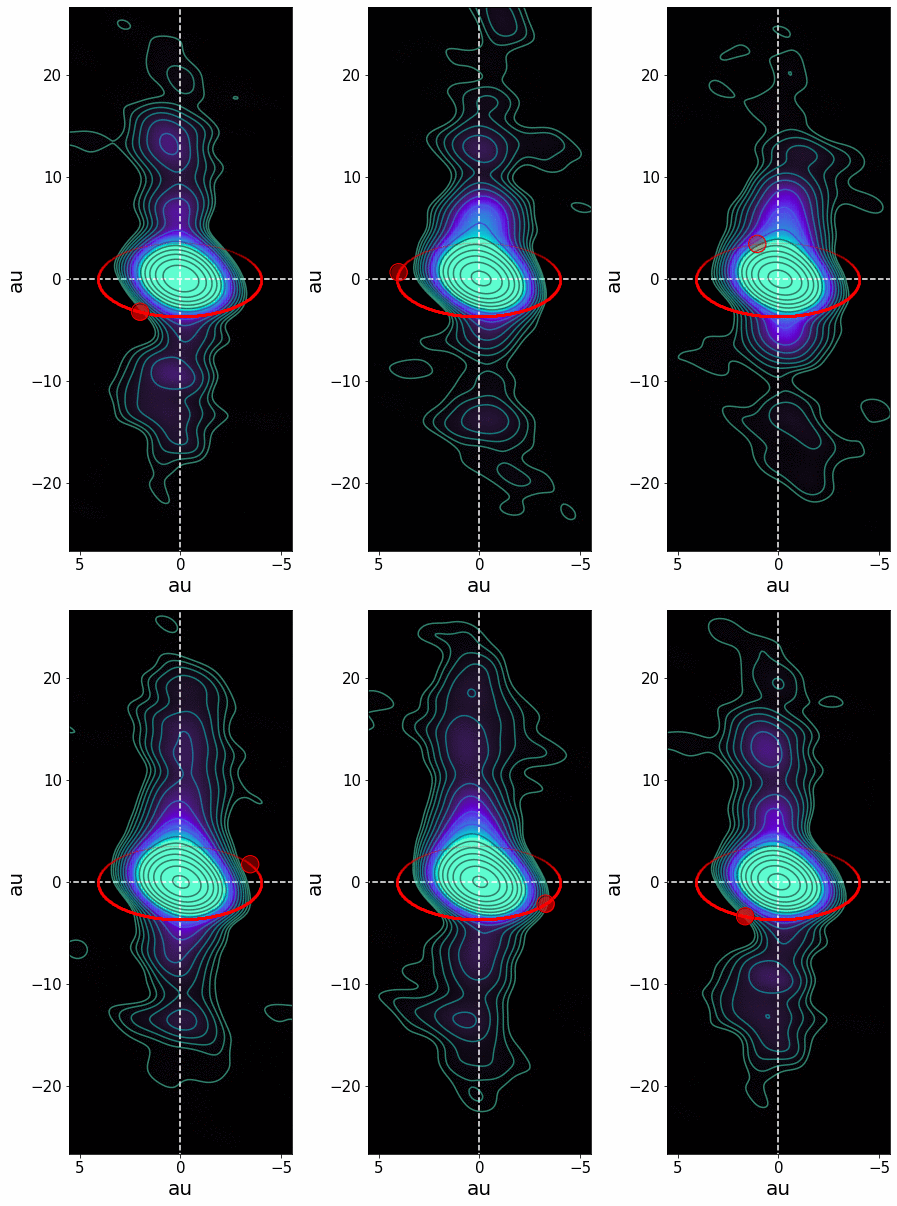
Team leader Steve Prabu of the University of Oxford described the movement of the jets in a series of SKA images as them “dancing.” This referred to the fact that the Cyg X-1 jets seemed to be getting deflected in different directions as the star and black hole orbited each other. Prabu and colleagues determined that it was the stellar winds blowing from the star pushing on the black hole jets that are powering their “dance.”
The findings give scientists a better idea of the amount of energy black hole jets release into their environments.
“A key from this research is that about 10% of the energy released as matter falls in towards the black hole is carried away by the jets,” Prabu said. “This is what scientists usually assume in large-scale simulated models of the universe, but it has been hard to confirm by observation until now.”
What is even more exciting about this research is that it gives scientists a way to measure the energy of jets blasting from other black holes, including much larger supermassive black holes that sit at the heart of all large galaxies and possess masses millions or billions of times that of the sun.
“Because our theories suggest that the physics around black holes is very similar, we can now use this measurement to anchor our understanding of jets, whether they are from black holes 10 or 10 million times the mass of the sun,” team member James Miller Jones of the Curtin Institute of Radio Astronomy (CIRA) said.
“With radio telescope projects such as the Square Kilometre Array Observatory currently under construction in Western Australia and South Africa, we expect to detect jets from black holes in millions of distant galaxies, and the anchor point provided by this new measurement will help calibrate their overall power output.
“Black hole jets provide an important source of feedback to the surrounding environment and are critical to understanding the evolution of galaxies.”
The team’s research was published on Thursday (April 16) in the journal Nature Astronomy.










Related Posts


Stay Informed With the Latest & Most Important News
Previous Post
Next Post





Advertisement
-
 01Two Black Holes Observed Circling Each Other for the First Time
 -
 02From Polymerization-Enabled Folding and Assembly to Chemical Evolution: Key Processes for Emergence of Functional Polymers in the Origin of Life
 -
 03Astronomy 101: From the Sun and Moon to Wormholes and Warp Drive, Key Theories, Discoveries, and Facts about the Universe (The Adams 101 Series)
 -
 04True Anomaly hires former York Space executive as chief operating officer
 -
 05Φsat-2 begins science phase for AI Earth images
 -
 06Hurricane forecasters are losing 3 key satellites ahead of peak storm season − a meteorologist explains why it matters
 -
 07Binary star systems are complex astronomical objects − a new AI approach could pin down their properties quickly