
Now Reading: Black hole Cygnus X-1 has fast, powerful dancing jets
-
01
Black hole Cygnus X-1 has fast, powerful dancing jets


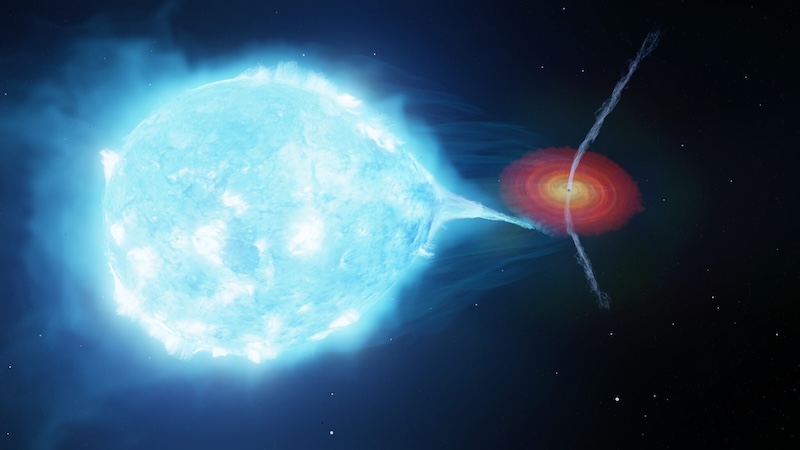
An animation of the interaction between the Cygnus X-1 black hole and its large companion star. The force of stellar winds from the star bends the jets from Cygnus X-1. Video via the International Center for Radio Astronomy Research (ICRAR).
- The black hole Cygnus X-1 has strong jets. And the stellar winds from its companion star bend the jets, which causes them to “dance” in different directions.
- The jets travel at half the speed of light and produce 10,000 times the energy output of our sun.
- These jets help scientists understand galaxy evolution, because the physics of stellar black holes mirrors that of supermassive black holes at galactic centers.
Cygnus X-1 black hole jets are perturbed by stellar winds
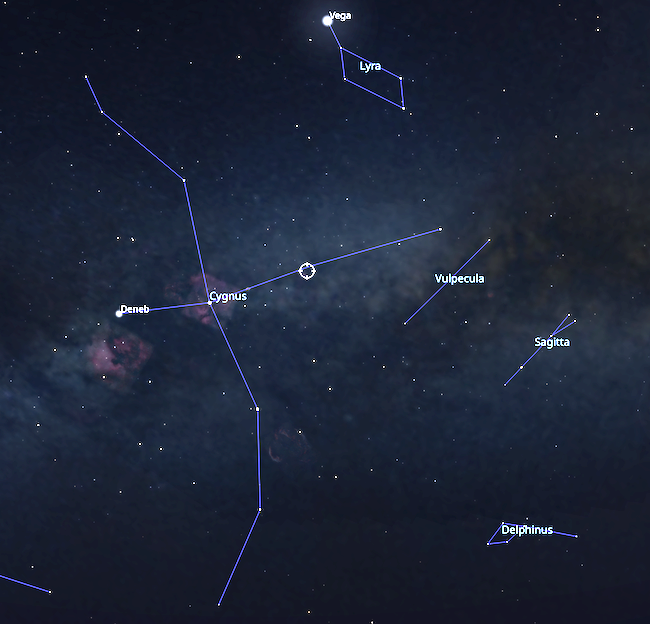
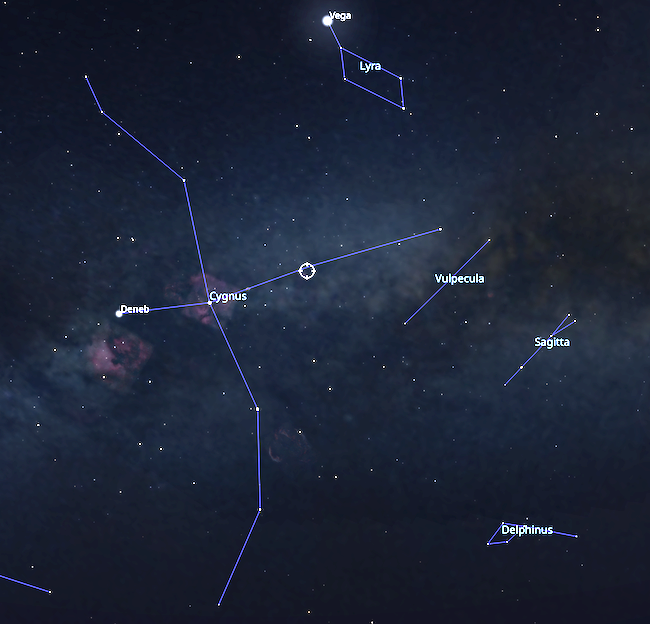
Cygnus X-1 has a special place in the history of astronomy. In 1971, astronomers confirmed it as the first known black hole. Now, on April 16, 2026, astronomers from the International Centre for Radio Astronomy Research (ICRAR) in Australia said that winds from a large companion star buffet the jets emitted by Cygnus X-1. These observations enabled them to calculate the jets’ power output. It was an astounding 10,000 times that of our sun. Plus, the jets were traveling at half the speed of light! These findings are significant because even though Cygnus X-1 is a stellar black hole, studying its jets ultimately helps astronomers understand the evolution of galaxies.
The black hole Cygnus X-1, about 7,200 light-years away and 21 times the mass of our sun, has a companion. It’s a large blue supergiant star, called HDE 226868, about 40 solar masses. The two objects orbit about their center of gravity every 5.6 days.
Lead author Steve Prabu at Oxford University described the jets as dancing jets. That’s because they’re deflected in different directions by stellar winds as the black hole and companion star move in their orbit.
The researchers published their findings in the peer-reviewed journal Nature Astronomy on April 16, 2026.
Black hole jets
Some black holes eject jets of plasma – ionized gases and electrons – along their rotation axis at very high speeds. In fact, such jets appear in systems where the black hole pulls matter from a nearby companion star. Consequently, the spinning black hole ejects some of that matter as jets.
Astronomers are interested in knowing the instantaneous power released by black hole jets for several reasons. That’s because it shows them how the black hole itself grows. Previous methods could only measure the average jet power over thousands or even millions of years. In addition, the energy of these jets drives large-scale shocks across the interstellar medium, as well as distributes gases, cosmic rays and magnetic fields into its neighborhood. They also create large cavities in gas clouds.
The physics of supermassive black holes with jets, which reside in the hearts of some galaxies, are the same as stellar black holes with jets. However, supermassive black holes affect their environment on a much bigger intergalactic scale. Therefore, jets in stellar black holes can, in fact, contribute to our understanding of galaxy evolution.
Determining the power in Cygnus X-1 jets
In the past, astronomers did not quite grasp how the energy from black hole jets affected their surrounding environment. That’s because they could not determine the instantaneous power of those jets. Until now.
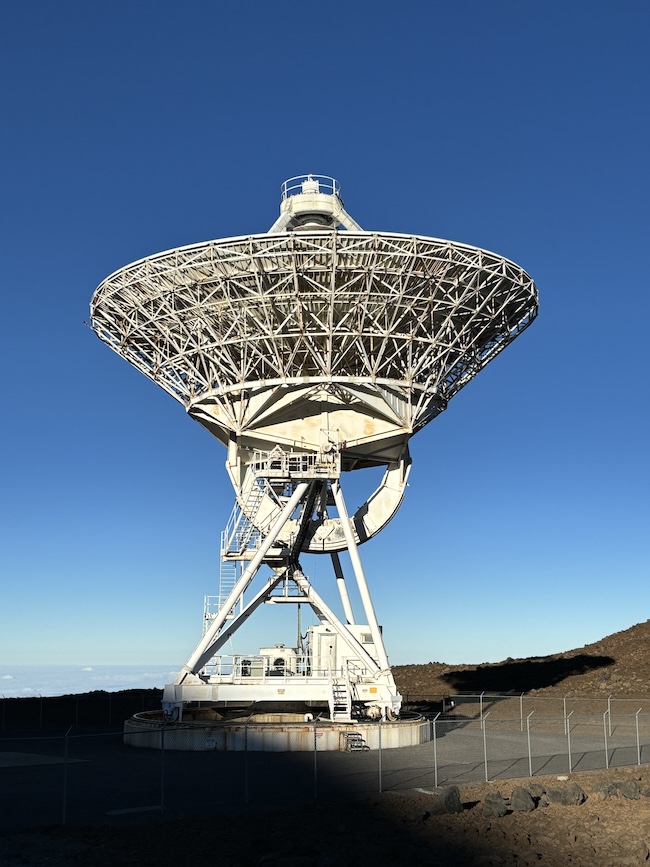
The team studied x-rays emitted by the Cygnus X-1 jets using high-resolution radio images they collected over 18 years. They used radio telescopes spaced over vast distances across the world, using an observation technique called very long baseline interferometry. As the black hole and its companion star moved in their orbit, the astronomers were able to see patterns of motion in the black hole jets, thanks to the stellar winds from the companion star deflecting the jets. In addition, they also knew the power of the stellar winds streaming out of the star.
So the astronomers entered the observed sequences of jet deflections and the known stellar wind power into mathematical models. As a result, they were able to calculate the instantaneous power released by the jets. They discovered that these jets emitted the power output of 10,000 suns. In addition, they traveled blazingly fast at half the speed of light (93,000 miles per second or 150,000 km per second).
How Cygnus X-1 helps us understand how galaxies evolve
Prabu said:
A key finding from this research is that about 10% of the energy released as matter falls in towards the black hole is carried away by the jets.
This is what scientists usually assume in large-scale simulated models of the universe, but it has been hard to confirm by observation until now.
James Miller-Jones of Curtin University is a paper co-author. He added:
And because our theories suggest that the physics around black holes are very similar, we can now use this measurement to anchor our understanding of jets, whether they are from black holes 10 or 10 million times the mass of the sun.
With radio telescope projects such as the Square Kilometer Array Observatory currently under construction in Western Australia and South Africa, we expect to detect jets from black holes in millions of distant galaxies, and the anchor point provided by this new measurement will help calibrate their overall power output.
Black hole jets provide an important source of feedback to the surrounding environment and are critical to understanding the evolution of galaxies.
Bottom line: The Cygnus X-1 black hole emits strong jets. The stellar winds from a companion star bend these jets, and this has enabled astronomers to calculate the jets’ power.
Source: A jet bent by a stellar wind in the black hole X-ray binary Cygnus X-1
Via International Centre for Radio Astronomy Research (ICRAR)
Read more: How the world came to understand black holes
Read more: Black hole belches radiation long after eating a star
The post Black hole Cygnus X-1 has fast, powerful dancing jets first appeared on EarthSky.










Related Posts
Stay Informed With the Latest & Most Important News
Previous Post
Next Post





Advertisement
-
 01Two Black Holes Observed Circling Each Other for the First Time
 -
 02From Polymerization-Enabled Folding and Assembly to Chemical Evolution: Key Processes for Emergence of Functional Polymers in the Origin of Life
 -
 03Astronomy 101: From the Sun and Moon to Wormholes and Warp Drive, Key Theories, Discoveries, and Facts about the Universe (The Adams 101 Series)
 -
 04True Anomaly hires former York Space executive as chief operating officer
 -
 05Φsat-2 begins science phase for AI Earth images
 -
 06Hurricane forecasters are losing 3 key satellites ahead of peak storm season − a meteorologist explains why it matters
 -
 07Binary star systems are complex astronomical objects − a new AI approach could pin down their properties quickly