
Now Reading: The Dark And Featureless Surface Of Rocky Exoplanet LHS 3844 b From JWST Mid-infrared Spectroscopy
-
01
The Dark And Featureless Surface Of Rocky Exoplanet LHS 3844 b From JWST Mid-infrared Spectroscopy

The Dark And Featureless Surface Of Rocky Exoplanet LHS 3844 b From JWST Mid-infrared Spectroscopy

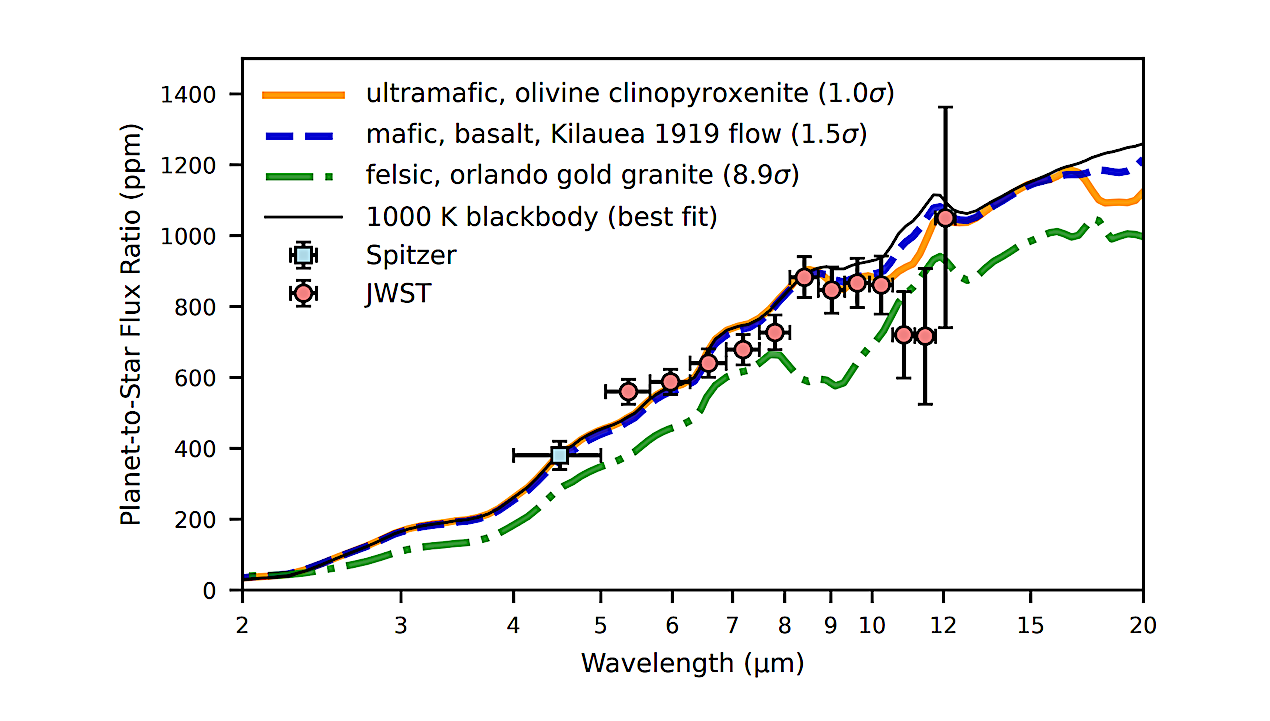
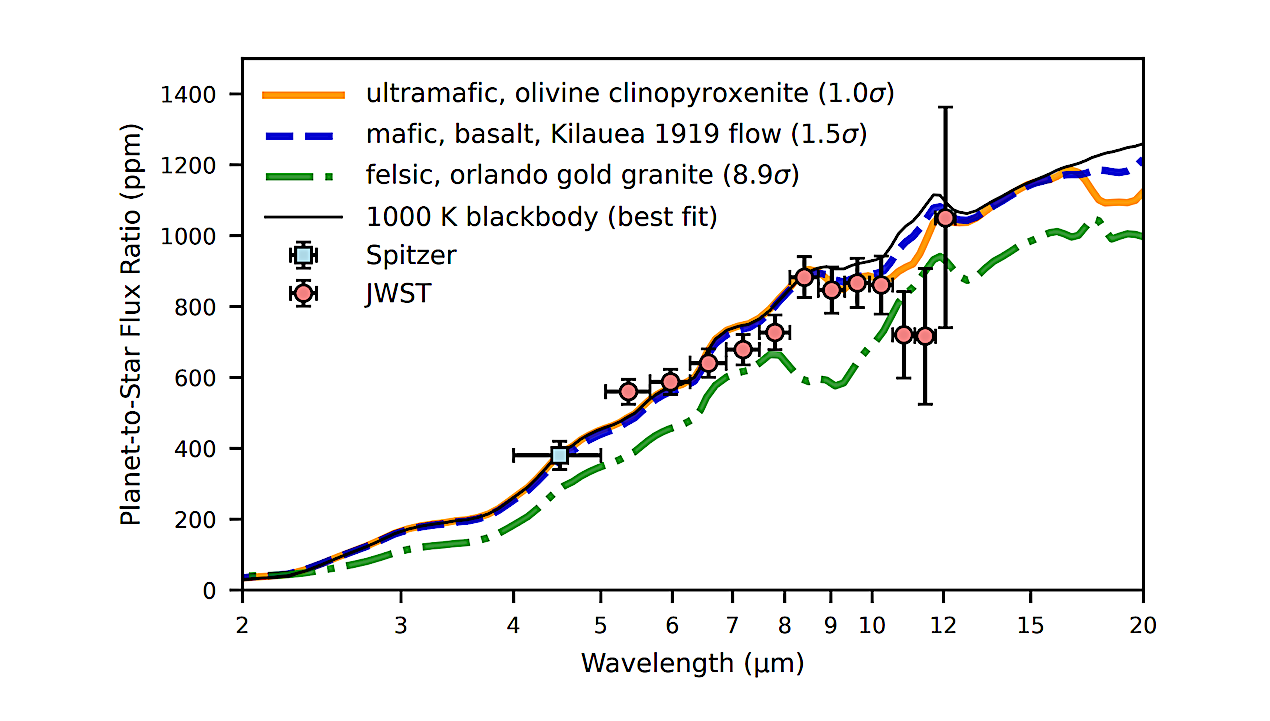
The measured planet-to-star flux ratio as a function of wavelength compared to a range of solid slab surfaces. The observations were taken using Spitzer (blue square-shaped marker) and JWST (red circle-shaped markers). The error bars on the data are 1σ. A selection of models, taken from Ref. [12], represent solid slab surfaces with varying compositions. Solid orange line: an ultramafic, olivine clinopyroxenite EG-19-63 sample (∼ 47 wt% SiO2) recovered from Emigrant Gap, California, USA, which shows good agreement with the observations. Dashed blue line: a mafic, basaltic sample from the 1919 Kilauea eruption in Hawaii, USA (∼ 51 wt% SiO2) that is also consistent with the data. Dashed, dotted green line: a felsic sample representing the highest SiO2 content model (∼ 73 wt% SiO2) published in Ref. [12]. The legend lists the rejection significances of these models. With a solid black line, we also show a 1000 K black body curve for the planet, which is the best fit value using the combined Spitzer and JWST dataset. — astro-ph.EP
JWST has opened a new era in the study of rocky exoplanets, enabling direct characterization of their surfaces with mid-infrared spectroscopy. Different types of rock have distinct spectral features that are diagnostic of the chemical composition and other physical properties like surface texture.
Measurements of these features can provide valuable clues about a planet’s geologic history and interior processes. Here we report a JWST 5-12 micron thermal emission spectrum for the rocky exoplanet LHS 3844 b. It is best matched by a dark, low-silica surface, such as basalt or other olivine-rich materials.
The spectrum rules out fresh powder surfaces; however, space weathering can darken the powders and make them more consistent with the data. The data also disfavor trace concentrations of CO2 or SO2 gas (with 5-sigma and 3-sigma upper limits of 100 mbar and 10 microbar, respectively).
Taken together, these results are well fit by an old, space-weathered surface with no evidence of accumulated volcanic gases.
Sebastian Zieba, Laura Kreidberg, Brandon P. Coy, Aaron Bello-Arufe, Kimberly Paragas, Xintong Lyu, Renyu Hu, Aishwarya Iyer, Edwin S. Kite, Daniel D.B. Koll, Kay Wohlfarth, Emerson Whittaker, Heather Knutson, Robin Wordsworth, Caroline Morley, Laura Schaefer
Comments: Accepted for publication in Nature Astronomy on April 8, 2026. 49 pages, 18 figures, 7 tables. The arXiv version corresponds to the original submitted manuscript and will be updated with a post-acceptance version at a later time
Subjects: Earth and Planetary Astrophysics (astro-ph.EP)
Cite as: arXiv:2605.00100 [astro-ph.EP] (or arXiv:2605.00100v1 [astro-ph.EP] for this version)
https://doi.org/10.48550/arXiv.2605.00100
Focus to learn more
Related DOI:
https://doi.org/10.1038/s41550-026-02860-3
Focus to learn more
Submission history
From: Sebastian Zieba
[v1] Thu, 30 Apr 2026 18:00:08 UTC (21,544 KB)
https://arxiv.org/abs/2605.00100
Astrobiology, Astrogeology, Astronomy, exoplanet,










Related Posts
Stay Informed With the Latest & Most Important News
Previous Post
Next Post

Advertisement
-
 01Two Black Holes Observed Circling Each Other for the First Time
 -
 02From Polymerization-Enabled Folding and Assembly to Chemical Evolution: Key Processes for Emergence of Functional Polymers in the Origin of Life
 -
 03Astronomy 101: From the Sun and Moon to Wormholes and Warp Drive, Key Theories, Discoveries, and Facts about the Universe (The Adams 101 Series)
 -
 04True Anomaly hires former York Space executive as chief operating officer
 -
 05Φsat-2 begins science phase for AI Earth images
 -
 06Hurricane forecasters are losing 3 key satellites ahead of peak storm season − a meteorologist explains why it matters
 -
 07Binary star systems are complex astronomical objects − a new AI approach could pin down their properties quickly