
Now Reading: Rescue mission for NASA’s $500 million space telescope passes key testing milestone
-
01
Rescue mission for NASA’s $500 million space telescope passes key testing milestone

Rescue mission for NASA’s $500 million space telescope passes key testing milestone

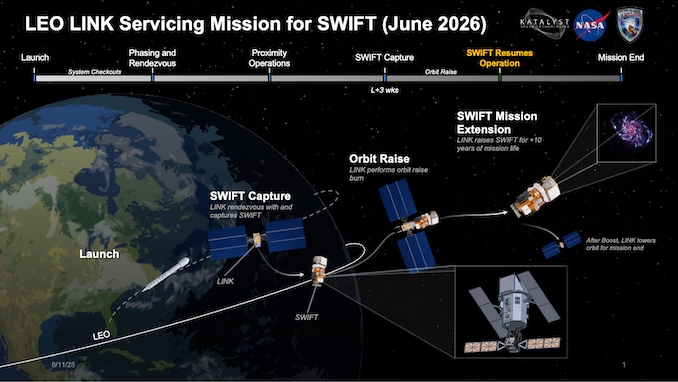
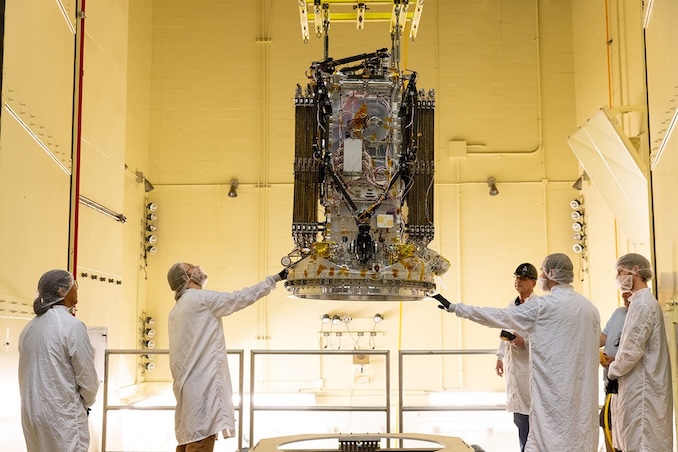
A mission to prevent a $500 million NASA space observatory from meeting a fiery demise just passed a notable prelaunch testing milestone. The Neil Gehrels Swift Observatory, a spacecraft launched in 2004, is at risk of falling back through the atmosphere and burning up without intervention.
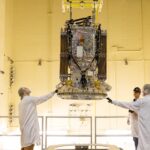
On Friday, NASA announced that the Link spacecraft, manufactured by Katalyst Space Technologies to intervene before Swift’s fate is sealed, completed its slate of environmental testing at the agency’s Goddard Space Flight Center in Greenbelt, Maryland. Testing in the Space Environment Simulator concluded on Monday, May 4, and the spacecraft returned to Katalyst’s facilities in Broomfield, Colorado, for additional, prelaunch testing.
“The Swift boost attempt is a fast, high-risk, high-reward mission,” said John Van Eepoel, Swift’s mission director at NASA Goddard, in a NASA press release. “Swift will likely re-enter the atmosphere sometime later this year if we don’t attempt to lift it to a higher altitude. Katalyst has gotten to this point in just eight months, and we’re glad they were able to use NASA’s facilities to test Link and draw on our expertise to help tackle questions that popped up along the way.”
Swift doesn’t have it’s own onboard propulsion system and would naturally decay in orbit over time. However, increased solar activity in recent years accelerated the lowering timeline for the observatory, dropping it from about 600 km to 400 km, with anticipated reentry in late 2026 without intervention.
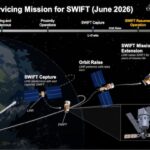
That’s why in September 2025, NASA awarded Katalyst a $30 million contract to develop a spacecraft capable of docking with Swift and boosting its orbit.
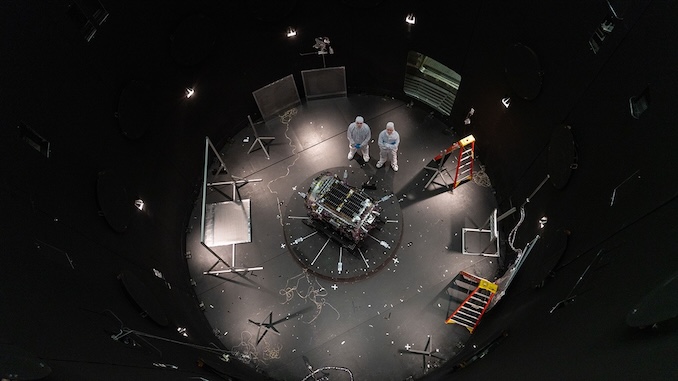
“Given how quickly Swift’s orbit is decaying, we are in a race against the clock, but by leveraging commercial technologies that are already in development, we are meeting this challenge head-on,” said Shawn Domagal-Goldman, acting director, Astrophysics Division, NASA Headquarters, at the time.
“This is a forward-leaning, risk-tolerant approach for NASA. But attempting an orbit boost is both more affordable than replacing Swift’s capabilities with a new mission, and beneficial to the nation — expanding the use of satellite servicing to a new and broader class of spacecraft.”
“We’re in an unusual situation where the schedule dictates how much risk we’re willing to accept, rather than the other way around,” said Kieran Wilson, Link’s principal investigator at Katalyst. “The clock is ticking on Swift’s descent, so we have to find a balance between testing and problem solving that gives the mission the best chance of success.”
Swift is in an orbit inclined 20.6 degrees from the equator, which is why Katalyst selected Northrop Grumman’s Pegasus XL air-launched rocket in November to fly the mission.
“The versatility offered by Pegasus’ unique air-launch capability provides customers with a space launch solution that can be rapidly deployed anywhere on Earth to reach any orbit,” said Kurt Eberly, Director of Space Launch for Northrop Grumman. “The stringent mission requirements necessary to save the Swift observatory, including the unique low-inclination orbit and the tight mission timeline, all pointed to Pegasus being the perfect choice.”
The mission is set to launch in June. Link will first integrate with the Pegasus rocket at NASA’s Wallops Flight Facility in Virginia early in the month and then the company’s L-1011 aircraft will deploy the spacecraft from the Marshall Islands later in the month.










Related Posts
Stay Informed With the Latest & Most Important News
Previous Post
Next Post
Advertisement
-
 01Two Black Holes Observed Circling Each Other for the First Time
 -
 02From Polymerization-Enabled Folding and Assembly to Chemical Evolution: Key Processes for Emergence of Functional Polymers in the Origin of Life
 -
 03Astronomy 101: From the Sun and Moon to Wormholes and Warp Drive, Key Theories, Discoveries, and Facts about the Universe (The Adams 101 Series)
 -
 04True Anomaly hires former York Space executive as chief operating officer
 -
 05Φsat-2 begins science phase for AI Earth images
 -
 06Hurricane forecasters are losing 3 key satellites ahead of peak storm season − a meteorologist explains why it matters
 -
 07Binary star systems are complex astronomical objects − a new AI approach could pin down their properties quickly