
Now Reading: Life Is But a Stream: The Distribution Of Planetary Systems Along Stellar Streams And Their Properties
-
01
Life Is But a Stream: The Distribution Of Planetary Systems Along Stellar Streams And Their Properties

Life Is But a Stream: The Distribution Of Planetary Systems Along Stellar Streams And Their Properties

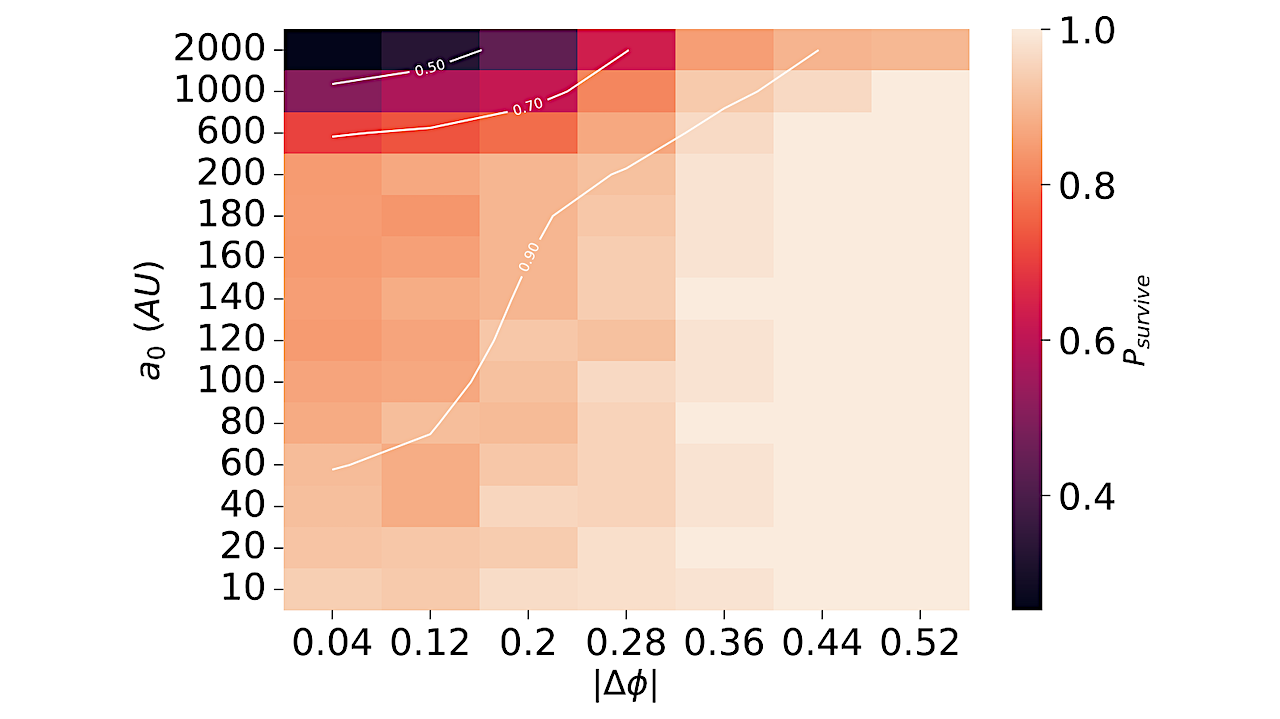

Probability of a planet with initial semi major axis a0 remaining bound to its host star after the birth cluster dissolves as a function of absolute value of the angular separation |∆ϕ| from the centre of the stream. Contours of Psurvive are determined after applying a multidimensional Gaussian filter to the dataset with a standard deviation of 1. Stars close to the centre of the stream are less likely to host planets at any a0, with outer planets more likely to be stripped from their host star than inner planet. Stars near the edges of the stream are more likely to retain planets out to 2000 au. — astro-ph.EP
The majority of discovered exoplanets have been observed orbiting field stars as opposed to within a star cluster. To determine whether the lack of observed exoplanets in star clusters is due to gravitational perturbations or observational limitations, we consider the possibility of studying exoplanets in stellar streams.
We present the results of direct N-body simulations of planetary systems around stars that orbit within a star cluster. Our simulations demonstrate that stars with early cluster escape times tend to retain all their planets as they spend most of their time orbiting in the cluster’s low-density outskirts.
Alternatively, stars with later escape times can have a wide range of survival fractions as they are subjected to a range of local densities and encounter types. With respect to the stellar stream that forms as the result of the cluster’s dissolution, stars near the edge of the stream are therefore more likely to have unperturbed planetary systems.
Conversely, stars near the centre of the stream have a higher chance of having planets pushed to eccentric orbits, inclined orbits, or stripped from the system entirely. From our suite of simulations, we provide an estimate of the probability that a star will host a planet with a given initial semi-major axis a0 based on the star’s location along a stellar stream Δϕ.
Jeremy J. Webb, Milica Ivetic, Maxwell X. Cai, Simon Portegies Zwart, Daniella Morrone
Comments: 12 pages, 9 figures, Accepted for Publication in ApJ
Subjects: Earth and Planetary Astrophysics (astro-ph.EP); Astrophysics of Galaxies (astro-ph.GA)
Cite as: arXiv:2605.05293 [astro-ph.EP] (or arXiv:2605.05293v1 [astro-ph.EP] for this version)
https://doi.org/10.48550/arXiv.2605.05293
Focus to learn more
Submission history
From: Jeremy Webb J
[v1] Wed, 6 May 2026 18:00:00 UTC (1,096 KB)
https://arxiv.org/abs/2605.05293
Astrobiology, exoplanet,










Related Posts


Stay Informed With the Latest & Most Important News
Previous Post
Next Post



Advertisement
-
 01Two Black Holes Observed Circling Each Other for the First Time
 -
 02From Polymerization-Enabled Folding and Assembly to Chemical Evolution: Key Processes for Emergence of Functional Polymers in the Origin of Life
 -
 03Astronomy 101: From the Sun and Moon to Wormholes and Warp Drive, Key Theories, Discoveries, and Facts about the Universe (The Adams 101 Series)
 -
 04True Anomaly hires former York Space executive as chief operating officer
 -
 05Φsat-2 begins science phase for AI Earth images
 -
 06Hurricane forecasters are losing 3 key satellites ahead of peak storm season − a meteorologist explains why it matters
 -
 07Binary star systems are complex astronomical objects − a new AI approach could pin down their properties quickly