
Now Reading: A Direct View of the Chemical Properties of Water from Another Planetary System: Water D/H in 3I/ATLAS
-
01
A Direct View of the Chemical Properties of Water from Another Planetary System: Water D/H in 3I/ATLAS

A Direct View of the Chemical Properties of Water from Another Planetary System: Water D/H in 3I/ATLAS

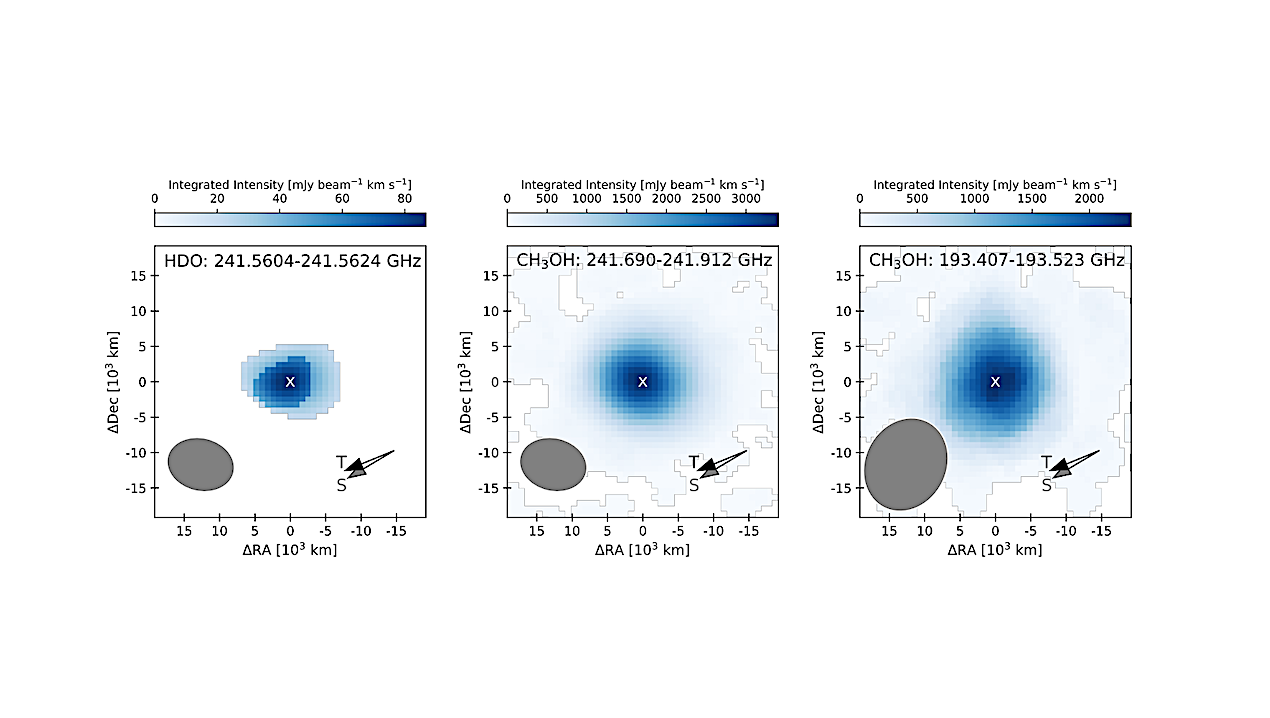
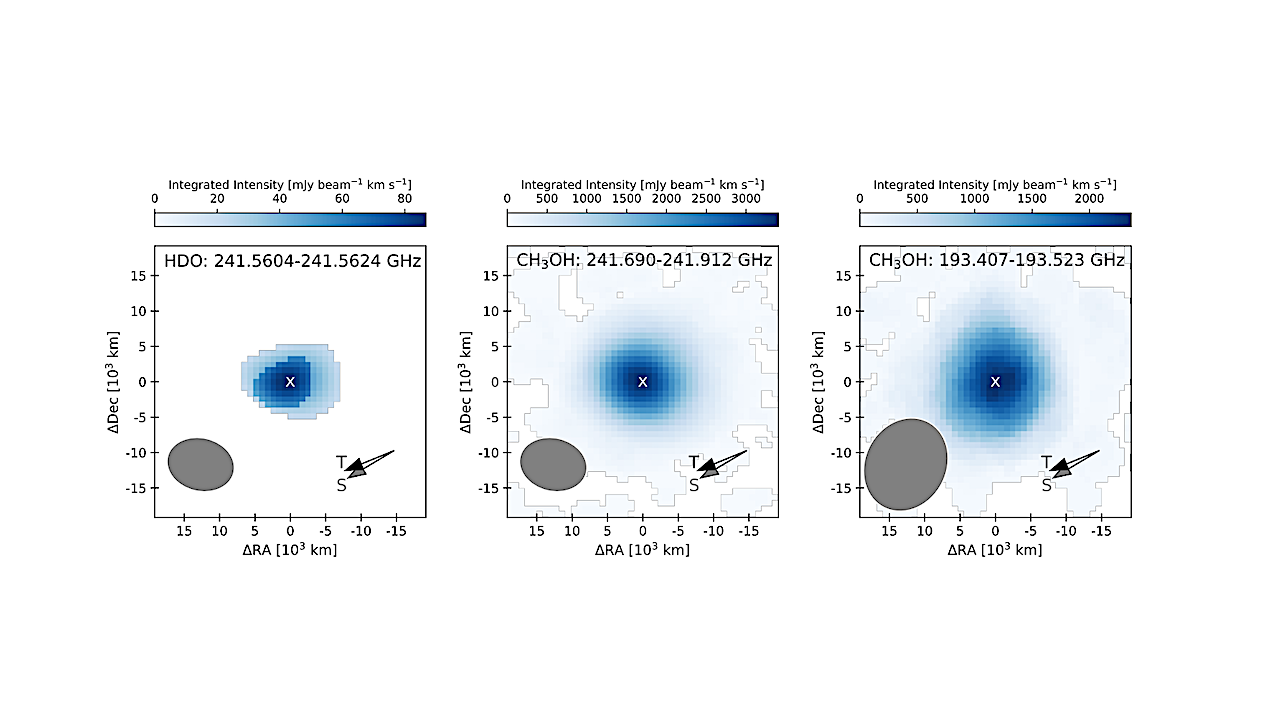
Integrated intensity (moment 0) maps of the detected species. From left to right, HDO, CH3OH in Band 6 and CH3OH in Band 5. For each image, the ellipse in the bottom left shows the size of the ALMA beam and in the bottom right, the direction of the Sun and comet trail are signaled with the corresponding arrows. The white cross marks the location of the comet nucleus. — astro-ph.EP
All detected water reservoirs in the solar system exhibit a deuterium enrichment that links back to the physical environment at the time of stellar birth.
Gas-phase and ice-grain D-enrichments occur through chemical processes that operate at low temperatures (<~30~K) pointing towards an origin in the pre-stellar molecular cloud or in the outer parts of the protoplanetary disk.
However, not all stars are born in environments similar to our Sun, nor do their subsequent evolutionary histories follow the same path. These environmental differences can be traced by the water D/H ratio.
Here we use ALMA observations of the interstellar comet 3I/ATLAS to constrain the water D/H ratio in extrasolar cometary material. With a water D/H value of [D/H]H2O>6.6×10−3, 3I/ATLAS shows a deuterium enrichment exceeding Earth’s ocean value by more than a factor of ≳40 and typical Solar System cometary values by more than a factor of ≳30.
The elevated deuterium enrichment points to water that formed under colder, less irradiated conditions and from less thermally processed material, consistent with an origin in a planetary system that formed under different physical and chemical conditions than our own.
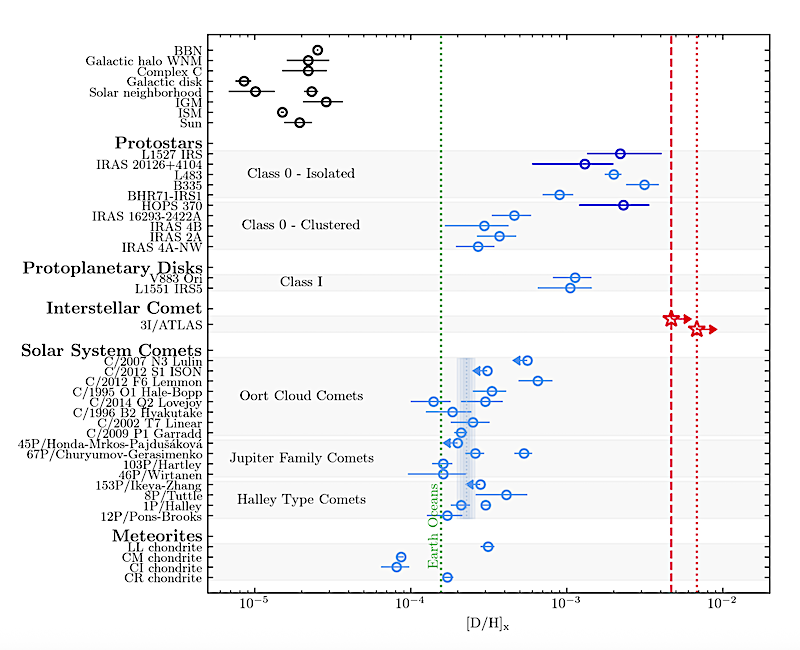
Comparison of D/H values across the Galaxy from atomic or molecular hydrogen, and water D/H values measured in protostars, protoplanetary disks, Solar System comets, meteorites, and 3I/ATLAS. Bulk atomic/molecular D/H measurements are shown as black points. Gas-phase water D/H measurements in different star- and planet-forming environments are shown in blue, while water D/H measurements in protostars derived from ice (dust-grains) observations are shown in dark blue. Meteorite D/H values are derived from hydrated minerals. Error bars denote reported 1σ uncertainties (see Methods for sources). This work constrains the gas-phase water D/H ratio in the interstellar comet 3I/ATLAS (red) from ALMA observations near perihelion. The red star with a dashed vertical line shows the lower limit obtained from the joint HDO+H2O+CH3OH fit, which yields a model-dependent determination of the water production rate. The red star with a dotted vertical line shows the lower limit derived using the upper limit on the water production rate from a fit to the H2O and HDO datasets. — astro-ph.EP
Luis E. Salazar Manzano, Teresa Paneque-Carreño, Martin A. Cordiner, Edwin A. Bergin, Hsing Wen Lin, Dariusz C. Lis, David W. Gerdes, Jennifer B. Bergner, Nicolas Biver, Dominique Bockelée-Morvan, Dennis Bodewits, Steven B. Charnley, Jacques Crovisier, Davide Farnocchia, Viviana V. Guzmán, Stefanie N. Milam, John W. Noonan, Anthony J. Remijan, Nathan X. Roth, John J. Tobin
Comments: Submitted to Nature Astronomy. 3 Figures, 2 Extended Data Tables, 3 Extended Data Figures, 1 Supplementary Table, and 4 Supplementary Figures
Subjects: Earth and Planetary Astrophysics (astro-ph.EP); Astrophysics of Galaxies (astro-ph.GA); Solar and Stellar Astrophysics (astro-ph.SR)
Cite as: arXiv:2603.07026 [astro-ph.EP](or arXiv:2603.07026v1 [astro-ph.EP] for this version)
https://doi.org/10.48550/arXiv.2603.07026
Focus to learn more
Submission history
From: Luis Salazar Manzano
[v1] Sat, 7 Mar 2026 04:11:37 UTC (5,055 KB)
https://arxiv.org/abs/2603.07026
Astrobiology, Astrochemistry,










Related Posts
Stay Informed With the Latest & Most Important News
Previous Post
Next Post
Advertisement
-
 01Two Black Holes Observed Circling Each Other for the First Time
 -
 02From Polymerization-Enabled Folding and Assembly to Chemical Evolution: Key Processes for Emergence of Functional Polymers in the Origin of Life
 -
 03Astronomy 101: From the Sun and Moon to Wormholes and Warp Drive, Key Theories, Discoveries, and Facts about the Universe (The Adams 101 Series)
 -
 04True Anomaly hires former York Space executive as chief operating officer
 -
 05Φsat-2 begins science phase for AI Earth images
 -
 06Hurricane forecasters are losing 3 key satellites ahead of peak storm season − a meteorologist explains why it matters
 -
 07Binary star systems are complex astronomical objects − a new AI approach could pin down their properties quickly