
Now Reading: A fireside chat with Space Force Gen. Shawn Bratton
-
01
A fireside chat with Space Force Gen. Shawn Bratton


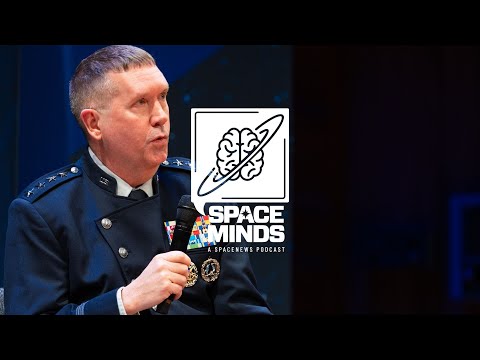

In this episode of Space Minds, SpaceNews senior staff writer Sandra Erwin sits down with Gen. Shawn Bratton, vice chair of space operations for the U.S. Space Force for a fireside chat at the Johns Hopkins University Bloomberg Center. In the next installment of the Center’s Discovery Series, they explored where the Space Force is headed for 2040, the debate over refueling satellites and how Bratton came to join the military.
Show notes and transcript
Click here for Notes and Transcript
Transcript
This transcript has been edited for clarity.
Mike Gruss: I’d like to invite SpaceNews senior staff writer Sandra Erwin and Space Force’s General Shawn Bratton, vice chief of space operations, to the stage. Please give them a round of applause.
Sandra Erwin: Hello. Hello everyone. Thanks for being here and it’s great to have General Bratton here to talk with us talk about Space Force 2040, the future fight. So first I would like to welcome General Sean Bratton vice chief of space operations for the U.S. Space Force the services second highest ranking officer. He helps guide how the Space Force organizes trains and equipment forces and prior to becoming vice chief general Bratton served as deputy chief of space operations for strategy plans programs and requirements. What we’re seeing the services strategy for design and resources. So before we get into the Space Force I don’t think a lot of you know General Bratton’s story I mean wouldn’t journey you’ve had, General Bratton. Given you know your story you left college you thought you’d be a musician but then you went back to college you joined the military did you ever imagine that you you would be vice chief of the Space Force.
Gen. Shawn Bratton: No. Sandra, first great to see you always glad to be on stage with you know thanks for sitting out with me and hey everybody how’s it going up there are we the are we the end I saw the previous panel always intimidating to go after Dennis and John Plum and Suzanne I mean that was really good discussion I could have I could have listened to those guys for another 40 minutes and so I if there’s people here I know I can’t see you but hey good to see again. And and for the people I don’t know great to meet you you know it’s it’s not a personal interaction kind of thing but I’m I’m super humbled and honored to be here thanks coming out I don’t know if it’s mandatory for somebody to be here. You can judge me the whole time and and if you if you chose to come here thanks coming out we you know appreciate the advocacy not just for the Space Force but for the whole for talking about space for those of you in the business thanks what you’re doing I mean it’s incredible every day what’s going on so just sort of rambling opening comment.
To get to sort of your question yeah it has been a crazy journey for me to end up on stage with you tonight you know I started just as a young 18 year old I went to college right out of high school in Phoenix Arizona went to Arizona State University and I was I was not prepared the high school prepared me well academically but maturity wise as a 18 year old boy I was not I was not there and I really did think I’d be a great musician. Or maybe I was a mediocre musician I thought it’d be great playing a band tenant bar which school didn’t found out you didn’t know and really cared if you went to school when you’re in college I dropped out of school for a little while Arizona State was actually good with that based on my grades they thought that was a good idea too. And and my dad had served in the military and he you know I was my first semester right out and I knew that report card was coming home and they were paying for my tuition that ended pretty quick and I knew I had to get a plan I didn’t know what to do and and so I knew enough about the military and I ended up joining the National Guard to cut the chase and as a 18 year old you know E1 the most junior rank you can have in the military I went off to basic training.
And it was just like all the movies you know guys yelling at me on the bus to get off and pick up your bag and from that you know it really shaped me and I went out and I came back and I got my degree and was still sort of part time in the military top high schools actually high school teacher degree and education. But the military kept pulling me back in and pulling me back in eventually I went full time and you know through a whole bunch of good fortune and hard work ended up putting on my 4 star probably six months ago now. And when General Saltzman was putting me back in the military. But definitely there was there was not a plan there at any point in my life it was you know just head down working on the job that I had just like just like you guys do every day and people really open indoors from the end. So it’s great yeah it’s fun being a 4 star general. Not every day on the Pentagon brings me joy but it’s pretty good it’s pretty cool and I’m super super proud and humbled to serve and I really feel like my job is open doors for people. Help lift them up just like my leaders did for me and so yeah that’s how I got here pretty crazy.
Sandra Erwin: And that’s a terrific story thanks for sharing and very inspirational. So I guess I know the panel before us they spoke a little bit about the Space Force but it’s really always good to remind people that a lot of what the Space Force does is not visible day to day. But it underpins almost everything that the US military and the global economy rely on which is this awarding communications intelligence GPS. So I think with that as context John Bratton maybe I wonder if you can look at the big picture and talk about how you see space fitting into today’s national security environment. When you look at the threat environment how does space fit into the broader national security picture and maybe can you share a little bit of a historical perspective about the roles that space plays in our national security and how that role has evolved.
Gen. Shawn Bratton: Yeah that’s a lot. There’s a lot in there. I guess maybe a way to tackle something that big is sort of what are we thinking about now and I did listen carefully to the team that was out here in front of me. So what are we thinking about now? What are the problems we’re trying to solve? I mean there is this change that we’re all feeling that’s happened over several years that part of which was the establishment of the Space Force. So there’s certainly we’re in it what feels like a sort of pivotal area for a couple years inflection point was the the term in both that we use. I mean we really are in this there’s a lot going on both in commercial in civil space in military space. And so in the Space Force piece of that. We’ve sort of got our legs under us through the establishment stuff like we’ve got most of the organizations we’ve figured out trading I mean there’s a couple years there are just you know how many buttons are going to be on the inform oh we should have six why six let’s have meeting about that. And by the way it’s because we’re the sixth branch of the military that’s why there’s six buttons. But you know we didn’t just decide that like that John poem was probably key to that. That was a policy question. No but we’re through all that we’re through the burden of the Space Force there’s still more to do but much of that work is behind us and really that enables you know time for thinking and time for discussion about things like dynamic space operations. What does the Space Force look like in 2040 and what are the challenges there are many not that we must take on but which ones are we do we have the capacity to take on of all the things that we could or should do. And so right now that discussion I mean we’re really really folks on the war fighting piece I mean space superiority we publish some great I think some great doctrine this past year. In on space war fighting how we think about space superiority the activities needed to gain and maintain space superiority the space control mission area the equipment we need to do that how we do trade just all the straight military war fighting stuff tons of work on that.
Really really proud of what’s going on there now we’re now we’re infusing that down to the lowest levels we sort of got our minds around what is the spite look like how do we think about key terrain. What is a fight in lower orbit how is that different from you know combat effects in geo and those are those are two very different activities lots more to do but the war fighting piece we’ve really. We’ve really put a lot of energy and prioritize that obviously because it’s the military I think that has been a very threat driven you know body of work we’re we’re responding to what we’re seeing and what the joint force the army the Navy forces demanding from the Space Force and in some ways they have been the other services have really pushed us to go faster to more I mean the Navy may be more than anybody even even our. Parents in the air force the Navy has really realized that the threat and how they’re held at risk by being observed from space and they have really demanded from the Space Force capabilities and we’re fighting. It’s not a capacity that it didn’t exist before so they can be successful in their mission they understand that dependency I think in some some ways better than the Space Force does the and so. So a lot of work in the war fighting piece a lot of work in how does the Space Force fit into that joint force what is the space contribution to the fight not as a support mechanism providing. I saw our communications or navigation timing but how is the adversary using space to find Navy ships of sea and what can we do about that so that is the that is the right now work that I feel good about that that we’re that we make good progress on.
When I look at what we’re not doing because we’re focused on that it’s I mean that list is long you know the more on dynamic space operations where are we going with your feeling how does we’re. We’re fueling what is the military advantage for refueling what is the civil and commercial advantage for fueling I mean that’s it’s a very different. Refueling space very different than refueling an aircraft so you can fly further it’s it’s a totally different thing going on there more about I would argue life extension then you know combat advantage in the fight. So ships and planes refueling that means it means a very different the many would argue that point with me by the way.
But we’re not you know thinking about more about that where are we going with this lunar what are we doing beyond geo what is the demand signal out there what do we need to be doing right now to prepare for that future operating environment that is beyond geo we’re thinking about that a little bit but we should be thinking about it a lot right now. And some of that is just capacity we’re we’re small and we’re focused on you know first first things first keep the main thing the main thing I keep telling us that. And that is you know delivering combat capability so but we should be thinking about some really hopefully like you guys are all thinking about system that when you’re here at Johns Hopkins or in academia or those of you you know who are in the Space Force who are going to school here you should be thinking about this while we’re paying you thank. And and bring that back to the service right bring that back to service those you in industry you were who are you know there’s a lot of companies going to the moon right now. What is the national security implications of your work and what do we need what do we get some day from the Space Force we started to demand that or at least help us think through. You know beyond this lunar we’re not thinking about that law in the Space Force the we’re not thinking about and I really wish we were we’re not thinking a lot about humans in space and the impacts of that on the war fight. The I there’s some corners where people are writing small papers about it you know what is I heard I heard maybe in the previous panel a brief mention of sort of you know military astronauts where we go with that.
The answer is I don’t I don’t have an answer to that we it’s on the to do list we haven’t got there do we need to put you human you know guardians in space. It would be tragic if that didn’t happen some day is that day 2030, 2040, 2050 I don’t know the answer but we owe work on that but again we’re we’re we’re very focused right now on the near term the near term body work in space. So there’s some things out there there’s there’s probably more they were not addressing but in the what are we doing right now really focused on space security. The equipment training people we need what do we need to be doing coming up all those things I mentioned probably probably maybe more than I haven’t even began to scratch a service.
Sandra Erwin: I mean that’s a huge portfolio of things that you have to do not just to support the joint force but also to compete with China and other rival powers. I guess maybe I’d like to ask you about resources which I saw the new but the funding bill drop yesterday or the Department of Defense and the Space Force in Congress seems to really support the Space Force and all your goals however. Do you think the Space Force is sufficiently resource to do everything that you know the priorities not not necessarily the wishful thinking stuff but the stuff that you have to do now are you sufficiently resource for that and you know what would it what are some areas that maybe you would like to see some growth.
Gen. Shawn Bratton: Yeah I think it would been doing well you know if the measure is did you get more money this year last year we’re doing well on an upward trend. I think I’m more and for a while our narrative very much was we need to double the Space Force budget I worry more now about the people and infrastructure side of that equation that I do just the you know how much is in the appropriations bill for the Space Force. And those are those are tied together you know you have people you have to pay them so so all eventually comes back to budget but I worry more about we’re bringing on a lot of work do I have the program offices on the acquisition side to be able to develop that those capabilities and field of we have the test training infrastructure.
Do I really bring those capabilities out do I have the operational not only just the number of guardians do I have the places to operate it from what can we automate how do we go faster and so I worry more about the infrastructure personnel side of the. But resourcing these days then I do the you know what it what’s in their probes bill and how do we do. I think we I think we’re well supported when we present a plan that makes sense to Congress to OSW to OMB. I think our planning on the personnel interest are shining we have a ton of work this I’ve really been driving this this year it looks out five years 10 years 15 years. You know what how big is the Space Force in 2040 what do we think we’re going to be flying how much of that do you know what we automate away if we automate away how do I develop a junior workforce into a senior workforce because our entry level jobs are flying spacecraft and so you know we’re working through some of those I think the personal piece we’re pretty good shape I do think you know we will double the size the number of people with the Space Force in you know I’m not.
Not while I’m still in but within the next five to 10 year time or as you know we’re 10,000 military today 5,000 civilians it doesn’t hurt my head all that those numbers would double. On the infrastructure side it’s you know we got to we have a lot more work to do there on what is the infrastructure we need to be able to operate all those capabilities to support and sustain those guarding. And so there’s work out of us on that front.
Sandra Erwin: So you mentioned the objective force looking 15 years are we going to see that I mean it’s something that you will release to the public and you share any insights on what we’re going to see in that document.
Gen. Shawn Bratton: Yeah the terminology just based on when the terminology we use a lot sort of common in the joint environment people talk about the objective force. Usually that’s 15 years out it’s the force you need in a given time so 15 years in this case against what you think the threat environment and the operating environment is going to look like so in 2040 what is the Space Force need. And usually people talk about that in terms of capabilities not you know how many tanks or planes or spacecraft but I need the ability to navigate you know in cis lunar to communicate in the cislunar environment.
I need to be able to command and control you know spacecraft beyond the moon those sorts of things would be in the in the 15 year time horizon. And then as we move that through sort of is it gets closer eventually yet to program and so we use the term the program force that’s what we actually are spending money on so the program force goes out it’s really like seven years from now so across the the fight up is the program force and then the building forces what you have and so.
General Saltzman has been talking a lot about the objective force hey what do we need 2040 we’re working hard with swat the space war fighting analysis center soon I think to be the space war fighting analysis command to elevate up with you know we talk about futures I think we we we have the plan now with secretary to bring that together and there on the hook to deliver this objective force in the meantime in my last job the bosses like until they show up. Sean you got it right this document and I failed completely to deliver that to him and then he promoted me so. But it’s the there’s a couple pieces to that that you that kind of feed into it one do you understand you have the intelligence and understand what the threat environment is. And that’s that’s inputs from you know all the across the IC that come in. Do you understand just the operating environment so what is commercial and civil look like. In the 15 year time horizon are we on the moon are we around the moon is there navigation you know what capabilities you know understanding sort of what that body of work is and then you know and then you can really start to get into the military piece of that and so.
When you start to wrap your hand to do that well takes takes time takes more people so we’re after for the boss and he’s very demanding that we got to deliver this we’re just not quite there yet. I think we’re starting to get a handle on that operating environment piece and that is sort of step one of this by the way it has to tie to what’s the Army Navy Air Force need from us in 2040 it’s not just space for space and so there’s there’s a lot of communication with those teammates. But we’re pulling it together I will see it in 26 I think you know or or you won’t see me on stage here next year for sure.
Sandra Erwin: Well a lot of people in the commercial space industry I guess are really interested in hearing more about that or seeing more details on that because a lot of the companies that are investing in space technology they maybe they don’t really understand what the military needs. So perhaps that objective force would give the industry a little bit of guidance and context as to what you really need from the private sector.
Gen. Shawn Bratton: Yeah I think it’s interesting because if you think if we went back 15 years and wrote an objective force document for 2026 it seems like you know if you go back 15 years it would have been totally different but most of the stuff we have today we had 15 years ago it’s not that different. And so if you build that assumption hey our force 15 years from now is probably going to be everything we got today and then some new things. But there’s not even our newest stuff isn’t that new you know the GCF 2007 you know time frame that that would have that’s like one of our one of our new I speak capabilities when you compared to missile warning and GPS. And so now we have we have we have iterated technology of missile warning and navigation and timing. And but it’s the same capability that we’ve always been providing so I’m trying to say we’re still going to be doing missile warning 15 years now. We’re still going to be doing satellite communications. We’re still going to be doing precision navigation and timing. I think we’ll be doing a lot more space superiority activities than we are today. I think how we do those things you know is the interesting discussion. What will satellite communications look like? Will we have you know direct to cell from lower orbit? Will we all be on laser comms? Well you know that that is the nuances of the well industry.
What do you where do you guys think we’re going to be or we’re going to be you know we’re going to all make that push over to laser comms is 5G from space going to deliver next year. The year after I mean certainly by 15 years from now will be well through that and onto the next thing. So I think a little bit of the messaging to us from bosses hey don’t make this too hard. We already know a lot of the answer because a lot of it is what we have today. It’s really these new fringe cases. What’s the new thing that comes in? I think for sure 15 years from now we have to we have to have this this lunar stuff up and running and going. Probably tough pretty good extent. That’s probably the newest in our sort of area of operations. We will expand to that. You know I think that seems pretty clear. I think refueling will be here in some way shape or form. I don’t know how much the military will lead that or be in trail. I’m on the one end of the spectrum I was doing and so I think it’s less likely that the military is the leader of that. But we’ll see. We’ll see.
Sandra Erwin: When you say you’re on one end of the spectrum meaning that you don’t really believe the military should take the lead on that.
Gen. Shawn Bratton: I can hear John Shaw yelling at me. Here’s how I think about refueling goes back to the airplane analogy. There’s a clear military utility to refueling an airplane. It extends the range so I could go further to fight. And it lets me come home and bring that pilot back if it’s a man and aircraft. That use case does not really apply to space. But you know satellites going around the earth whether you would regardless of the fuel state. And so I don’t so refueling doesn’t extend the range of a spacecraft. It extends the life of a spacecraft. Okay so that’s still good. But now put that in a war game and have a conflict where does life extension give me a military advantage over my adversary?
It may save me a lot of money and that may be the reason to do it. But if I put a refueling architecture up now I have to defend that. It also introduces risk and so I’m torn and I have not seen in war gaming the military advantage during conflict that refueling brings to space. And then you get into a great debate about dynamic space operations. I think the best use case I’ve heard is it does give you advantage if you start the fight and all your gas tanks are full for your maneuverable assets. I think that’s true. I haven’t seen the war gaming on it but it feels like for maneuvering if I can fill the gas on all my g-saps before we go to war that’s good. I don’t know if that alone warrants the investment and then the defensive requirements that are refueling architecture for the military would take. That’s my stance on it. I think there’s great points on the other side. And I’m not certain I’m right. That’s why I’m like show me the data on refueling. We have a really good hand on the cost curve of when it becomes economically beneficial to start refueling. Constellation has to do with the size of the constellation the cost of each spacecraft. And so we’re getting really good information on sort of when it makes sense for the economic reasons. I don’t know that that’s the exact same thing as military things.
Sandra Erwin: Well that’s going to be a very interesting. You guys help me figure that out. I really don’t know if I’m right and there’s a bunch of smart people here so run some more games. Let me know.
Gen. Shawn Bratton: Excellent. Well there’s a challenge for the smart people. Guardians? I know there’s a couple of you in here. Great. I don’t like tags. I wish I didn’t accomplish this.
Sandra Erwin: Well let’s pick up on. You talked about space superiority. You mentioned that a number of times here on the stage. You were involved in this. You mentioned the doctrines that the Space Force released in March 2025 that called the Space Force fighting a framework for planners. That was the document. And this was something that got a lot of attention because you are addressing offensive operations in space. Which I think the quote from you at the time when you spoke to us reporters you said you know the protect and defend. That was what typically you were doing before and you said we’re moving past protect and defend. And yeah we’re going to talk about offensive capabilities in space. So I guess I would like me for you to reflect on that. And what does offensive operations mean in space? And what do you want the audience here, the industry, everyone to understand better about war fighting in space and how the Space Force is thinking about it?
Gen. Shawn Bratton: Yeah we, over the years and for good reasons, we tied ourselves in knots to not say certain words. And so we used to say contested and congested. We still use that phrase a lot contested. I mean the congested part there’s a lot of stuff that they’re contested. We’re fighting over something. And then we came out when I said yes, we wanted to sort of move the needle a little bit. So we came up with protect and defend. There was an era where we were all brethren and say protect and defend. And still like us trying not to say offensive actions in space, weapons in space, any of the things. And then finally we just saw that we got over it and we said first up there’s just warfare in the domains. There’s not just war in space or war in the air. So there’s warfare and in warfare you have offensive and defensive actions. To gain and maintain space security we can chuck space control activities. Those activities are broken down into offensive and defensive activities.
Electronic warfare is the easiest thing to talk about. People jam our stuff all the time. We employ tactics to overcome that. We try and employ capabilities to deny their ability to use space on the offensive side. And so it’s just sort of the same thing the military does everywhere else. We’re trying to do it in the Space Force. But so it’s why do we need to do that? Two really two reasons. One is they’re coming after us in space and we got to defend our stuff. That really takes the defensive side. There’s a lot, you guys have read about it all, but directed energy, grappling arms, spacecraft, you know, potential nuclear weapons, all the things that they’re coming after us in space, to take away our space capability in a fight with the United States. But they’re also using space just like we are for satellite communications and navigation and timing. And this is warning to enhance their terrestrial forces just like we do. Air land and sea to make the, the adversaries air land and sea capabilities better. And the army and the Navy and the Air Force need us to do something about that.
They’re like, hey, we, you know, we’re going to fight in the air and the air, you know, the adversary air force is using space to gain an advantage and use Space Force. This is your job to do something about that, to take that advantage away. And you do that through offensive operations. And so if the adversary is using space to gain advantage in air land and sea, if they’re using space to negate our space capabilities, this is, I mean, this is the only reason to establish the Space Force. I mean, the military really exists just to fight or to have a military to prevent the fight from ever happening, you know, in the deterrence theory side of it. But that’s what it comes down to. And it’s, you know, kind of once put that out there, it just makes perfect sense. Well, of course, you would have offensive capabilities and defensive capabilities. What, otherwise, why else have a Space Force that’s part of the Department of War, you had to have that stuff. And so that, you know, that’s what we do.
Sandra Erwin: Do you, do you have, do you feel like the Space Force is investing now in offensive capabilities and give you reason to think that you’re prepared for a conflict?
Gen. Shawn Bratton: Yeah, I think we’re, you know, we’re looking at all the threats that we’re facing that we see that you guys have read about in open source. And we have to deliver or be able to deny that threat. Some of them are very, very difficult. And we’ll take a lot of effort to be able to overcome or to take something away from the adversary. Some of them, less of, some of them, I need to go back to their forces on Army and NATO, like you guys got to help us out. This can’t be a space fight for space, you know, say, if, if I need to deny the, the adversary’s ability to command and control their spacecraft, the easiest way to do that is to bomb their command and control facility. And that is, you know, Air Force Navy Army’s business. And so some of us is working better with the joint force and being demanding of them. And I’m not just here to give yours that common, your GPS and all this stuff. You had to work for me just like I’ve worked for you. And so, yeah, we think about all those things. We’re standing up. Those service components out in the combat commands to really help us understand. What does that joint fight look like? What is the space, important space piece of it that they need from us, they be in, you know, the airline and sea components, and then communicate back, I mean, here’s what we need from you. We’re all in this together.
Sandra Erwin: So, you mentioned electronic attacks, which is something that we hear about every day. GPS being of a primary target of jamming and spoofing. So, is that electronic threat what you’re worried about the most now? Given how prevalent it is, or is this something that now you accept that it’s happening and perhaps you’re worried about other threats that would be more severe than that?
Gen. Shawn Bratton: Yeah, I think, I don’t know which one, it’d be hard to say which one we’re about the most. There’s a bunch of bad stuff out there. We’re worried about it all. I think the electronic attack stuff really presents a dilemma. Again, you know, help us think through this is, you know, what is the threshold like? We tolerate a lot of GPS jamming around the world. And we just, every day, we’re just taking it. You know, satellite interference, intentional satellite jamming. I think we need to be more disciplined, and how do we think about that? What is the, is that just, that’s okay. You can interfere with someone’s navigation and timing. It’s okay until it interferes with commercial aircraft and plane crashes. It’s okay if you only do it to the military. You know, like, how do we, how do we think about that? I think that, we just now sort of accept it is. That’s just how it is out there. You know, if you’re anywhere in Europe, because of the Ukraine fight, you’re at risk. It happens all around the world, not just there. But I don’t know that we’ve gone back and really established What are the, I’m trying not to use the word red lines because I don’t know if it’s that dramatic. But what are the, hey, we’re not going to take the city more, or we’re going to respond in kind, or, or is it, no, we’re, you know, you can jam GPS. It’s okay. We’re going to let you get away with that. Jam our, you know, jam our links to our aircraft, or our PA’s, or any of those things. Jam commercial satellite. I mean, this will drift into, you know, two companies start jamming each other for some economic advantage or industry advantage. Who resolves that other than the FCC and ITU? And so, I think there’s more, there’s thinking in that area that we haven’t done, that we sort of, at some point, need to go back and clean up our act on. All right, what’s, what is the policy on the military side, what’s policy for the country, what should international norms be for electronic interference?
Sandra Erwin: It’s cyber, a separate category of threat in the sense that, you know, we hear a lot from the commercial industry that sometimes the military doesn’t trust commercial systems because they’re not cyber security, secure the same way that military systems are. So, what is, what is your thinking about cyber threats and how to maybe integrate more with commercial?
Gen. Shawn Bratton: I think the cyber threats are real. It is sort of, you know, General Whiting with the soft underbelly. The, that makes me think of all sorts of weird things, sorry. I think, I think it’s a vulnerable, I don’t think it’s necessarily true that, you know, the military has added better or worse than it commercial is. Some people are good at cyber defense, some are not. I think we, it deserves more attention and resources than we give it.
Sandra Erwin: So, picking up on this idea of commercial, use of commercial technology, we saw the Space Force come out with a commercial strategy in 2024. Then you came up with an international partnership strategy in 2025. So, obviously, you know, it’s a big theme in the Space Force to partner with industry with allies. So, as you look at that today, where do you think the Space Force is making real progress? And where do you think is still falling short in translating the objectives in those strategies into actual practical results?
Gen. Shawn Bratton: Yeah, I think the, I think the commercial strategy, I think there’s continued progress. Much more to do, I think. And that drives into everything from acquisition or form. I mean, we’re doing a ton of work on that right now. To, when we talk about using commercial or how the Space Force accesses commercial, it always gets, it’s always a little weird to me because we don’t, we’re not building any spacecraft in the Space Force. We’re buying them all from industry. So, on one hand, everything is commercial. It’s, you know, we’re going to the primes, we’re going to the small guys. Everyone’s building stuff for us, which is great. So, it’s all commercial. Normally, what people mean is, well, like, commercially operated. Like, we’re buying as a service. And we’re thinking hard about that. What does that mean? How do I, if I’m buying, you know, commercial missile warning, just for example, what does that mean in my interaction with the US Space Command and cadet command? Like, we’re working through some of that. I think there’s places where it makes tons of sense. And we’re doing good work. I think there’s some places where we’re going to draw some lines and say, no, you know, we’re not, we’re not commercializing space for you already. We’re just, that is a military function. We’re going to keep working in the airport. Does that mean when you go to that office? There’s not a contract force. There’s support in us. There’s always a contract force there, support in us. So, even that is commercial. So, I think, I think, I worry less about trying to really define it in the box and use everyone to the advantage, to gain the advantage, to go fast. If I don’t have the Space Force, it’s too small to do everything. If we can outsource the missionary, I’m all about that. Let’s outsource the missionary up until the point where, hey, this is a work-fighting function. You need to be a uniformer. And so, help, you know, challenge our thinking on that for sure. I think when you get into areas like weather, navigation, and timing, could commercial do that? Yes. Is there a business case? That’s commercial tell me, other than selling it to the Space Force? Because then we’re back to where we were. So, yeah, I wondered all over the place there, but that’s what was in my head.
Sandra Erwin: Yeah. We’re better or worse? No, that’s good. That’s good. There’s a guy out there thinking he would have been better off in a band. I mean, I have to ask you, what do you make of all these procurement reforms that are coming out of the Pentagon? I mean, they came out with all kinds of reforms, commercial firsts, you have to go faster, no more the 10-year programs. The secretary’s been very critical of the traditional way of doing business. So, where is the Space Force going with this?
Gen. Shawn Bratton: I’m super excited about it all. If we can realize the dream, right? And some of this is, you know, there’s a lot of work to do with Congress on authorities for money. You know, we want to give the acquisition workforce authorities with regard to funding and things like that. But some of that is with help by Congress. So, you know, we can’t be downing in on this. We got to build a team that all wants to do acquisition reform. I think Congress absolutely does. You know, the department absolutely does. We just got to find common ground and execute. And I’m super excited about this. I caught that, and I think John said right then, you know, he’s talking about acquisition workforce and operational workforce and how we blend those. I mean, we’re doing some pretty exciting things along those lines to build operators who really understand acquisition acquires, who really understand operations, and pretty soon you can’t tell the difference. That’s, I think, General Saltson’s really pushing us to tear down all those walls. You know, take engineers, make them operators, and then have them do acquisitions. Maybe they come back to ops and move back and forth. I think all of it is good. I’m excited about it.
Sandra Erwin: Yeah, General Party has been talking about, you know, some new architectures that they’re coming out with commercial. You think we’re going to see a lot of that moving this year fast.
Gen. Shawn Bratton: I think some of the commercial, you know, we still live in the reality of, I’m in a great big department of war. We’re still, we still got to work with Congress. No one’s going to let us just, you know, go do everything we want to do. Nor should they, even as much as I wish they would. But there’s some things we’re going to work through. But it’s got their favorite thing and sometimes they get very protective of it. It’s hard to let it go. I’m sure I do that too. So it is, you know, it’s a little bit about, hey, how do we break down all the walls to include the walls around rice bowls that people are protecting?
Sandra Erwin: Well, unfortunately, we have run out of time. General Bratton, I really appreciate you being here with this fascinating discussion and sharing your insights and please joining me in thanking General Bratton. And afterwards, please go to the reception outside. Thank you.
About Space Minds
Space Minds is a new audio and video podcast from SpaceNews that focuses on the inspiring leaders, technologies and exciting opportunities in space.
The weekly podcast features compelling interviews with scientists, founders and experts who love to talk about space, covers the news that has enthusiasts daydreaming, and engages with listeners. Join David Ariosto, Mike Gruss and journalists from the SpaceNews team for new episodes every Thursday.
Watch a new episode every Thursday on SpaceNews.com and on our YouTube, Spotify and Apple channels.
Be the first to know when new episodes drop! Enter your email, and we’ll make sure you get exclusive access to each episode as soon as it goes live!
Space Minds Podcast
“*” indicates required fields
Note: By registering, you consent to receive communications from SpaceNews and our partners.










Related Posts

Stay Informed With the Latest & Most Important News
Previous Post
Next Post
Previous Post
Next Post



Advertisement
-
 01Two Black Holes Observed Circling Each Other for the First Time
 -
 02From Polymerization-Enabled Folding and Assembly to Chemical Evolution: Key Processes for Emergence of Functional Polymers in the Origin of Life
 -
 03Astronomy 101: From the Sun and Moon to Wormholes and Warp Drive, Key Theories, Discoveries, and Facts about the Universe (The Adams 101 Series)
 -
 04True Anomaly hires former York Space executive as chief operating officer
 -
 05Φsat-2 begins science phase for AI Earth images
 -
 06Hurricane forecasters are losing 3 key satellites ahead of peak storm season − a meteorologist explains why it matters
 -
 07Binary star systems are complex astronomical objects − a new AI approach could pin down their properties quickly