
Now Reading: A Free-floating-Planet Microlensing Event Caused By A Saturn-mass Object
-
01
A Free-floating-Planet Microlensing Event Caused By A Saturn-mass Object


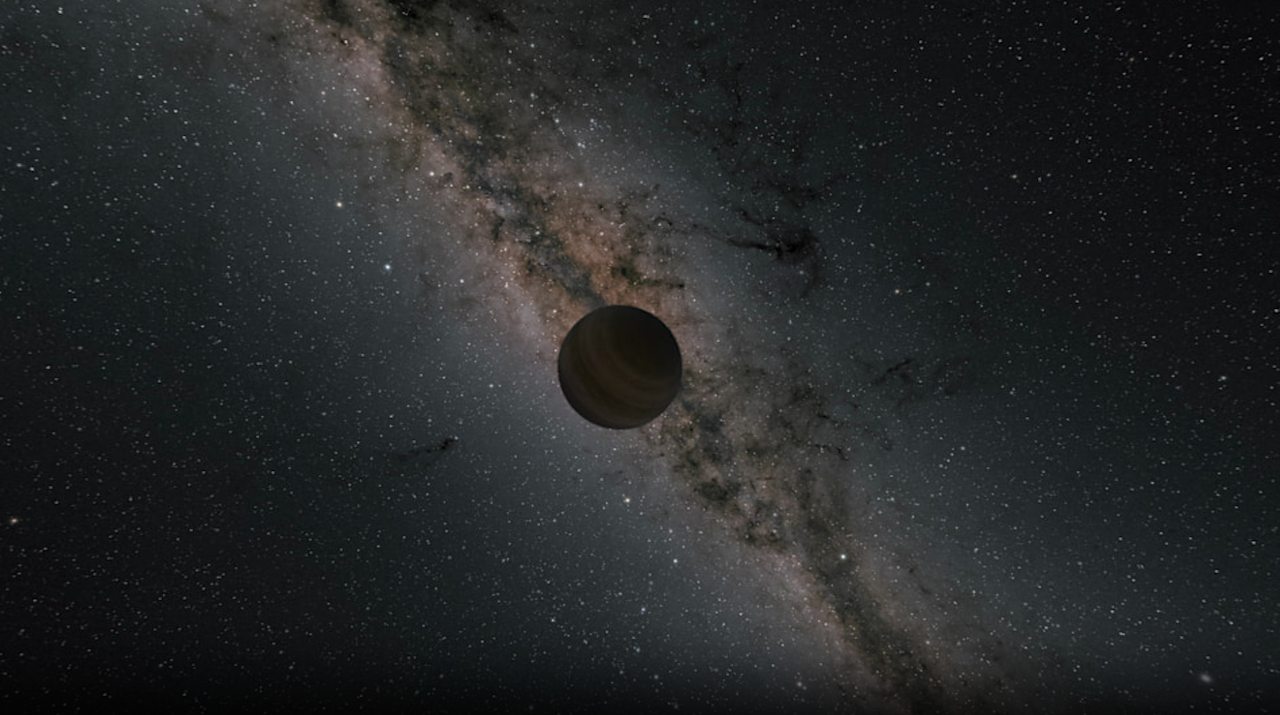
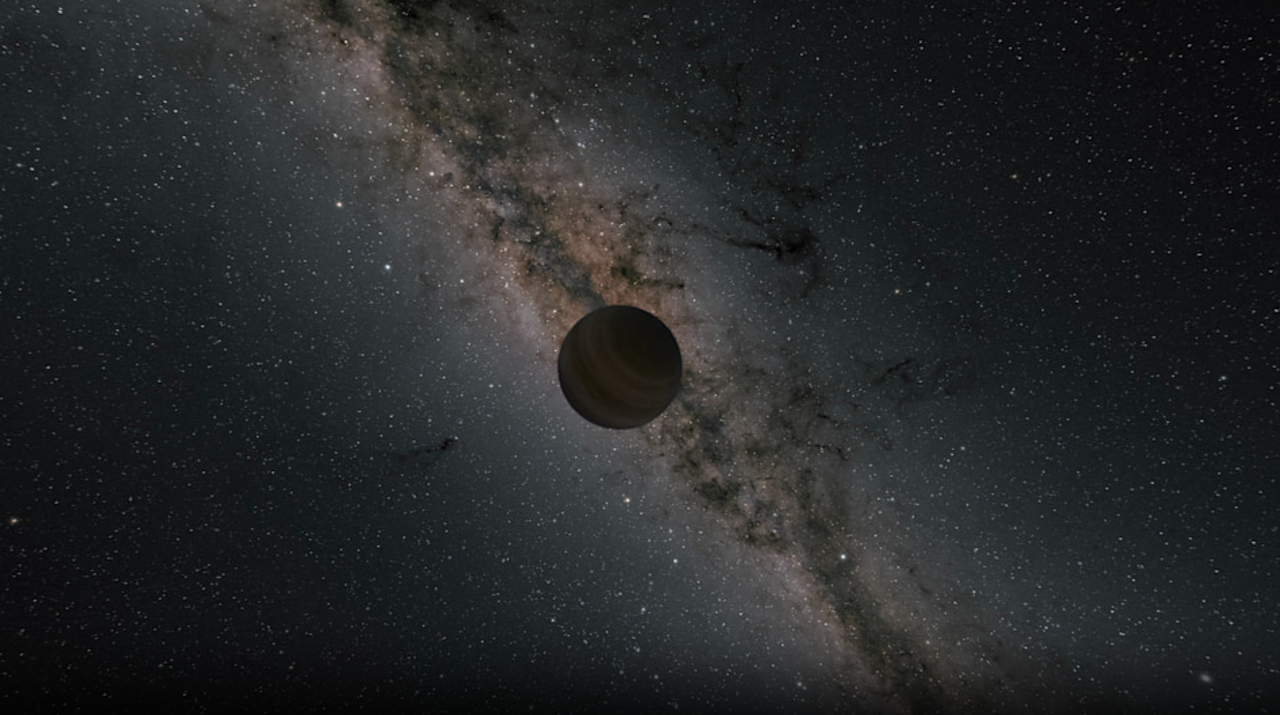
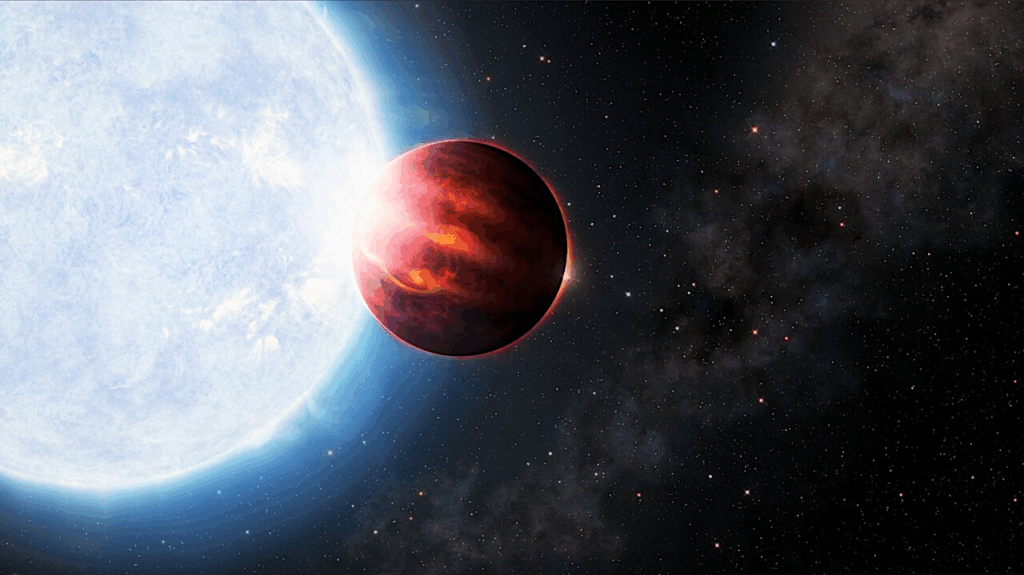
This illustration shows a rogue planet traveling through space. Credit: NASA/JPL-Caltech/R. Hurt (Caltech-IPAC)
A population of free-floating planets is known from gravitational microlensing surveys. None have a directly measured mass, owing to a degeneracy with the distance, but the population statistics indicate that many are less massive than Jupiter.
We report a microlensing event — KMT-2024-BLG-0792/OGLE-2024-BLG-0516, which was observed from both ground- and space-based telescopes — that breaks the mass-distance degeneracy. The event was caused by an object with 0.219^{+0.075}_{-0.046} Jupiter masses that is either gravitationally unbound or on a very wide orbit.
Through comparison with the statistical properties of other observed microlensing events and predictions from simulations, we infer that this object likely formed in a protoplanetary disk (like a planet), not in isolation (like a brown dwarf), and dynamical processes then ejected it from its birth place, producing a free-floating object.
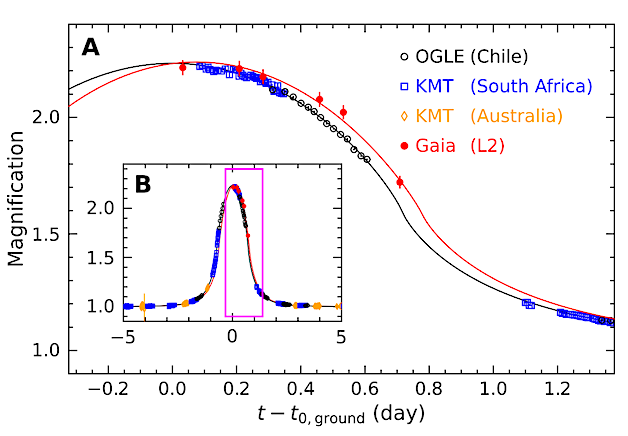
Light curves of the KMT-2024-BLG-0792/OGLE-2024-BLG-0516 microlensing event compared with the best-fitting model. (A)Circles (with 1 𝜎 error bars) indicate observations from the OGLE telescope in Chile (black open circle), a KMTNet telescope in South Africa (blue square), a KMTNet telescope in Australia (orange diamond), and the Gaia spacecraft at L2 (red solid circle). Their source magnification is plotted as a function of time (t), relative to the time of peak magnification determined from the ground-based data (𝑡0,ground = 2460434.323 barycentric Julian date) (table S1). The solid lines indicate the best-fitting microlensing models of the groundbased data (black) and Gaia data (red); the latter reaches its peak approximately 1.9 hours later than the former. (B) Same as (A), but showing an expanded view spanning 10 days. The magenta box indicates the region shown in A. — astro-ph.EP
Subo Dong, Zexuan Wu, Yoon-Hyun Ryu, Andrzej Udalski, Przemek Mroz, Krzysztof A. Rybicki, Simon T. Hodgkin, Lukasz Wyrzykowski, Laurent Eyer, Thomas Bensby, Ping Chen, Sharon X. Wang, Andrew Gould, Hongjing Yang, Michael D. Albrow, Sun-Ju Chung, Cheongho Han, Kyu-Ha Hwang, Youn Kil Jung, In-Gu Shin, Yossi Shvartzvald, Jennifer C. Yee, Weicheng Zang, Dong-Jin Kim, Chung-Uk Lee, Byeong-Gon Park, Radoslaw Poleski, Jan Skowron, Michal K. Szymanski, Igor Soszynski, Pawel Pietrukowicz, Szymon Kozlowski, Dorota M. Skowron, Krzysztof Ulaczyk, Mariusz Gromadzki, Milena Ratajczak, Patryk Iwanek, Marcin Wrona, Mateusz J. Mroz, Guy Rixon, Diana L. Harrison, Elme Breedt
Comments: Published in Science. This is the authors’ version. See the ancillary file for an animation associated with Fig. 2
Subjects: Earth and Planetary Astrophysics (astro-ph.EP); Astrophysics of Galaxies (astro-ph.GA); Solar and Stellar Astrophysics (astro-ph.SR)
Cite as: arXiv:2601.00057 [astro-ph.EP] (or arXiv:2601.00057v1 [astro-ph.EP] for this version)
https://doi.org/10.48550/arXiv.2601.00057
Focus to learn more
Related DOI:
https://doi.org/10.1126/science.adv9266
Focus to learn more
Submission history
From: Subo Dong
[v1] Wed, 31 Dec 2025 19:00:00 UTC (4,988 KB)
https://arxiv.org/abs/2601.00057
Astrobiology, exoplanet,










Related Posts
Stay Informed With the Latest & Most Important News
Previous Post
Next Post

Advertisement
-
 01Two Black Holes Observed Circling Each Other for the First Time
 -
 02From Polymerization-Enabled Folding and Assembly to Chemical Evolution: Key Processes for Emergence of Functional Polymers in the Origin of Life
 -
 03Astronomy 101: From the Sun and Moon to Wormholes and Warp Drive, Key Theories, Discoveries, and Facts about the Universe (The Adams 101 Series)
 -
 04True Anomaly hires former York Space executive as chief operating officer
 -
 05Φsat-2 begins science phase for AI Earth images
 -
 06Hurricane forecasters are losing 3 key satellites ahead of peak storm season − a meteorologist explains why it matters
 -
 07Binary star systems are complex astronomical objects − a new AI approach could pin down their properties quickly