
Now Reading: A monstrous sunspot 15 Earth’s wide is currently facing Earth: Here’s how to see it for yourself
-
01
A monstrous sunspot 15 Earth’s wide is currently facing Earth: Here’s how to see it for yourself

A monstrous sunspot 15 Earth’s wide is currently facing Earth: Here’s how to see it for yourself

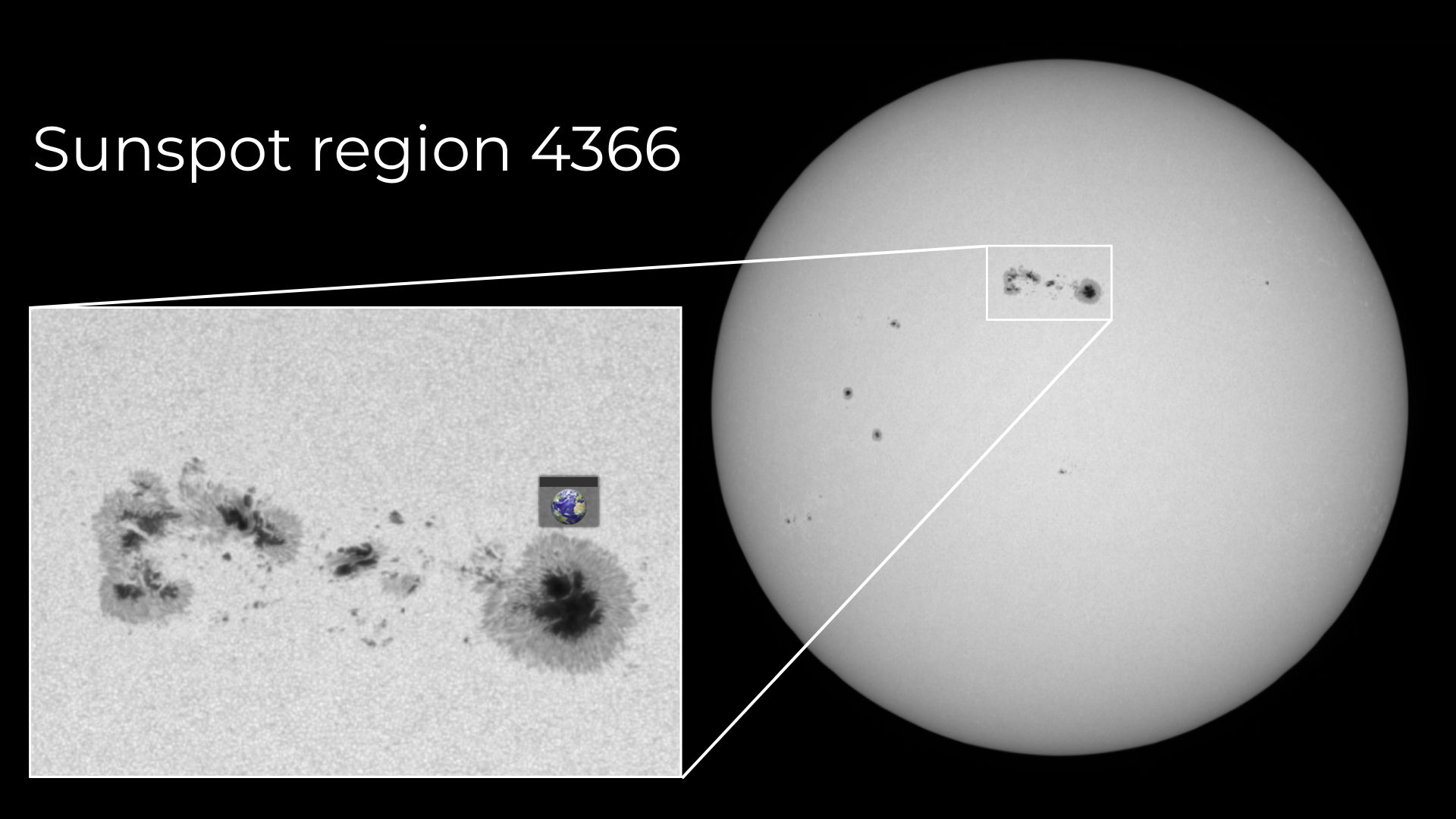
A monstrous sunspot region 15-Earths-wide is currently so large it can be seen without binoculars or telescopes. But you’ll still need proper eye protection. Here’s how you can spot it without putting your vision at risk.
Sunspots are relatively cool regions in the sun‘s atmosphere that form around areas of intense magnetic activity. Because they are cooler than their surroundings they appear dark from Earth and are often associated with short-lived explosions known as solar flares as well as powerful coronal mass ejections (CMEs) — vast expulsions of plasma driven by violent shifts in the sun’s magnetic field.
The sunspot region 4366 is a particularly impressive specimen, having grown significantly since it rotated into view on Jan. 30. It has since unleashed over 20 powerful M- and X-class solar flares — the most potent category of solar flare — triggering radio blackouts upon reaching Earth.
Quality protective eyewear must be used at all times when observing the sun, as doing so without it can lead to permanent vision loss. If you want to spot AR4366 for yourself, you’ll need a pair of solar eclipse glasses to nullify the sun’s intense ultraviolet and infrared radiation and remember, standard off-the-shelf sunglasses won’t offer adequate protection.
With the proper equipment, AR4366 will appear as a small black blotch close to the center of the solar disk, positioned a little above the sun’s equator. You’ll get a clearer view of the sunspot cluster using a pair of dedicated sungazing binoculars such as the Lunt SUNoculars and Celestron Eclipsmart, though for a true close-up of our parent star, you’ll need a telescope fitted with a solar filter from a reputable brand.

AR4366 won’t disappear from view for another few days and, given its short history, is likely to spawn more powerful flares — and potentially accompanying CMEs capable of sparking geomagnetic storm conditions and possible northern lights — before it disperses.
Want to be ready for the next giant sunspot event? Then be sure to read our guide to purchasing quality solar eclipse glasses, which are sure to come in handy if you find yourself in the path of the August 12 total solar eclipse, which will sweep across Spain, Greenland and western Iceland later this year. Photographers may also want to read our expert tips on how to image the sun, along with our roundups of the best cameras and lenses that are on sale in 2026.
Editor’s Note: If you capture an image of the giant sunspot AR4366 and want to share it with Space.com’s readers, then please send your photo(s), comments, and your name and location to spacephotos@space.com.










Related Posts



Stay Informed With the Latest & Most Important News
Previous Post
Next Post


Advertisement
-
 01Two Black Holes Observed Circling Each Other for the First Time
 -
 02From Polymerization-Enabled Folding and Assembly to Chemical Evolution: Key Processes for Emergence of Functional Polymers in the Origin of Life
 -
 03Astronomy 101: From the Sun and Moon to Wormholes and Warp Drive, Key Theories, Discoveries, and Facts about the Universe (The Adams 101 Series)
 -
 04True Anomaly hires former York Space executive as chief operating officer
 -
 05Φsat-2 begins science phase for AI Earth images
 -
 06Hurricane forecasters are losing 3 key satellites ahead of peak storm season − a meteorologist explains why it matters
 -
 07Binary star systems are complex astronomical objects − a new AI approach could pin down their properties quickly