
Now Reading: A new kind of arsenal: commercial satellites
-
01
A new kind of arsenal: commercial satellites


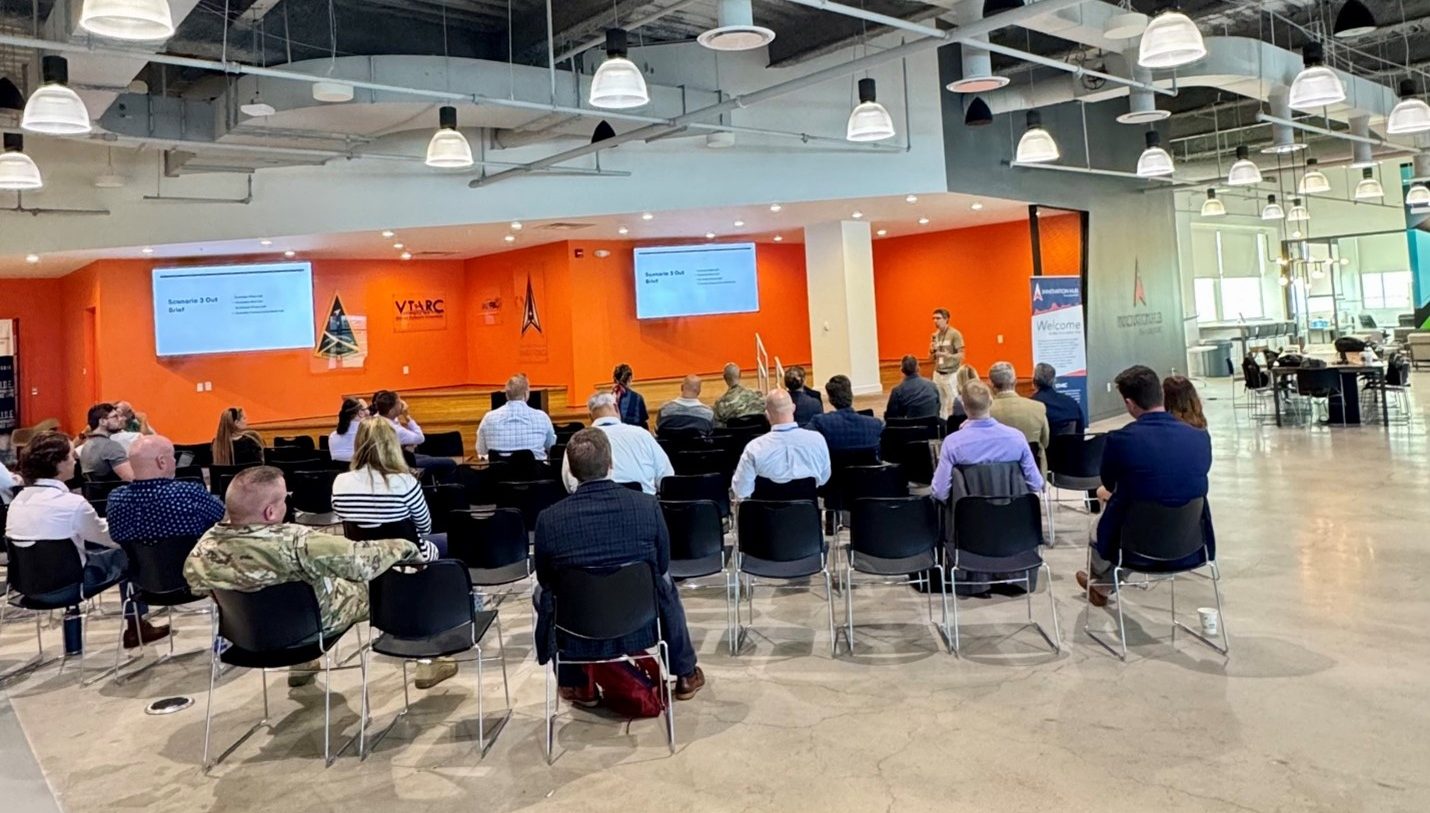

Russia’s invasion of Ukraine was widely described as the first commercial space war. Not because satellites were firing weapons, but because privately owned systems became essential to the fight.
A few years later, that shift is being institutionalized. Commercial space technology is moving even more directly into the war plan.
But that evolution is not without tension. Lt. Col. Timothy Trimailo, who directs the Space Systems Command’s Commercial Space Office, described one of the central challenges as the “battle hardening” of commercial technology, without stripping away the very attributes that made it valuable in the first place.
“At COMSO one of the things we’re working to solve is how to responsibly operationalize commercial capabilities at scale without breaking what makes them commercial in the first place,” Trimailo said at the Air & Space Forces Association’s Warfare Symposium.
One proposed solution has been the Commercial Augmentation Space Reserve, or CASR, which the Space Force has been studying for years. Its logic borrows from an earlier era. In a crisis, commercial providers would commit a portion of their capacity to the military, much as civilian airlines can be called upon to support defense needs.
“We want to make sure that commercial providers and the capabilities that they bring will be there for the warfighter to help us fight and win the next war,” Trimailo said.
Yet as officials have explored CASR, its complications have come into sharper focus. For commercial firms, participation could mean diverting bandwidth from paying customers. It raises unresolved questions about liability, compensation and exposure.
“As we’ve gone through CASR there are things that we’ve frankly struggled with a little bit as we define the framework for each mission area, things like incentive structures,” Trimailo said, as well as liability. “If a commercial asset is targeted by an adversary, who’s responsible for that? And how to guarantee commercial providers will be there by our side in a fight?”
A commercial satellite operator visibly aligned with U.S. military operations may find its assets viewed as military targets. That carries implications not only for security, but for insurance, investment and international business relationships.
In a crisis, would the U.S. government demand that companies “basically turn off all the commercial traffic and only allow Department of War traffic to pass? That’s certainly an approach,” said David Schmolke, vice president of Viasat Government. “But I would propose there’s a better way around that problem.”
Rather than reserving fixed slices of capacity for wartime use, he suggested, the government could rely on the flexibility of modern hybrid networks that can dynamically allocate bandwidth as conditions change.
“We’re able to scale and build out a very powerful network because we have commercial users operating on the network along with military users,” said Schmolke.
For the military, this also creates a cybersecurity advantage “because it frustrates the adversary, because they don’t actually know how the traffic is being routed over what networks,” Schmolke said.
And then there’s another shift happening in the industry: Satellites are becoming cheaper and faster to build, creating another pathway for the Pentagon to secure access.
Rather than rely on commercial providers to reallocate capacity in a crisis, the government can acquire its own government-owned, commercially operated systems.
For communications, that could mean fleets of smaller geosynchronous satellites that can be repositioned as needed. With the growth of so-called “mini GEO” systems, Schmolke noted, the government can “relatively cheaply run and operate their own geo network constellation and steer bandwidth as needed into hot spots.”
The Defense Innovation Unit has begun to apply this concept for geostationary orbit surveillance, evaluating systems that would be developed and initially operated by industry before transitioning to government control.
The appeal of this approach is that it reduces reliance on emergency arrangements such as CASR and places critical assets firmly in the defense inventory.
The Pentagon is no longer asking whether commercial space will matter in future conflicts. It is building a strategy around the assumption that it will.
The challenge is to do so in a way that preserves the strengths of the commercial sector and the security requirements of the state.
This article first appeared in the April 2026 issue of SpaceNews Magazine.










Related Posts

Stay Informed With the Latest & Most Important News
Previous Post
Next Post




Advertisement
-
 01Two Black Holes Observed Circling Each Other for the First Time
 -
 02From Polymerization-Enabled Folding and Assembly to Chemical Evolution: Key Processes for Emergence of Functional Polymers in the Origin of Life
 -
 03Astronomy 101: From the Sun and Moon to Wormholes and Warp Drive, Key Theories, Discoveries, and Facts about the Universe (The Adams 101 Series)
 -
 04True Anomaly hires former York Space executive as chief operating officer
 -
 05Φsat-2 begins science phase for AI Earth images
 -
 06Hurricane forecasters are losing 3 key satellites ahead of peak storm season − a meteorologist explains why it matters
 -
 07Binary star systems are complex astronomical objects − a new AI approach could pin down their properties quickly