
Now Reading: A New Spin On Planet Formation
-
01
A New Spin On Planet Formation


A New Window into Planet Formation — Keck Observatory
Astronomers using the W. M. Keck Observatory on Maunakea, Hawaiʻi Island, have confirmed a long-predicted relationship between planetary mass and rotation.
By measuring the rotation rates of a large sample of directly imaged extrasolar planets and more massive brown dwarf companions, researchers discovered that gas giant planets spin faster than more massive counterparts when accounting for their mass, size and age.
The result confirms a long-standing theoretical prediction and represents the largest survey of spin measurements for directly imaged companions to date.
“Spin is a fossil record of how a planet formed,” said Dino Chih-Chun Hsu, lead author and researcher at Northwestern University. “By measuring how quickly these worlds rotate, we can start to piece together the physical processes that shaped them tens to hundreds of millions of years ago.”
The study, led by Northwestern University, is published in The Astronomical Journal.
The team used the Keck Planet Imager and Characterizer instrument (KPIC) to isolate light from faint planets orbiting far from their host stars to measure fine details in their atmospheres.
As these distant worlds rotate, features in their spectra broaden. By analyzing those broadened features, scientists can determine how quickly a planet is spinning.
“With KPIC, we can detect these tiny signals that reveal a planet’s rotation around other nearby stars,” said Hsu.
A New Window into Planet Formation
Many of the planets studied orbit far from their stars, tens to hundreds of times farther than Earth is from the Sun. Astronomers are still debating how such distant worlds form. Some may grow gradually within a disk of gas and dust surrounding a young star, while others may form more like miniature stars through gravitational collapse.
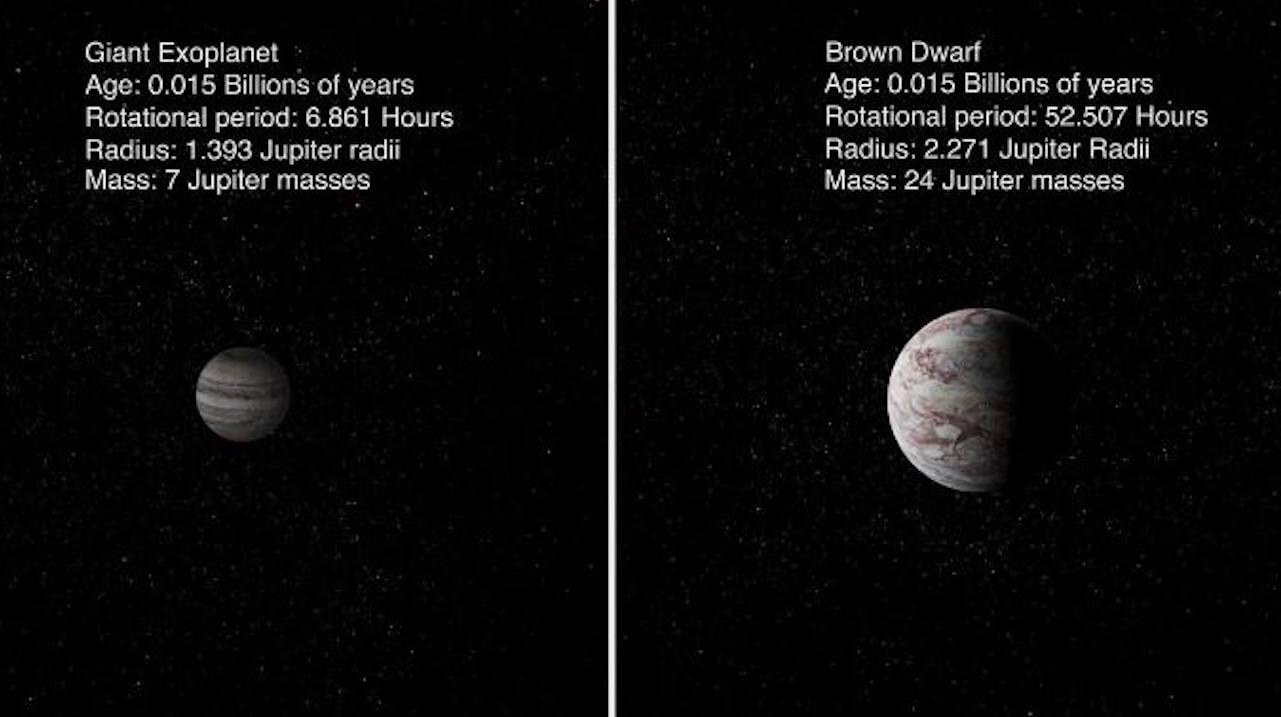
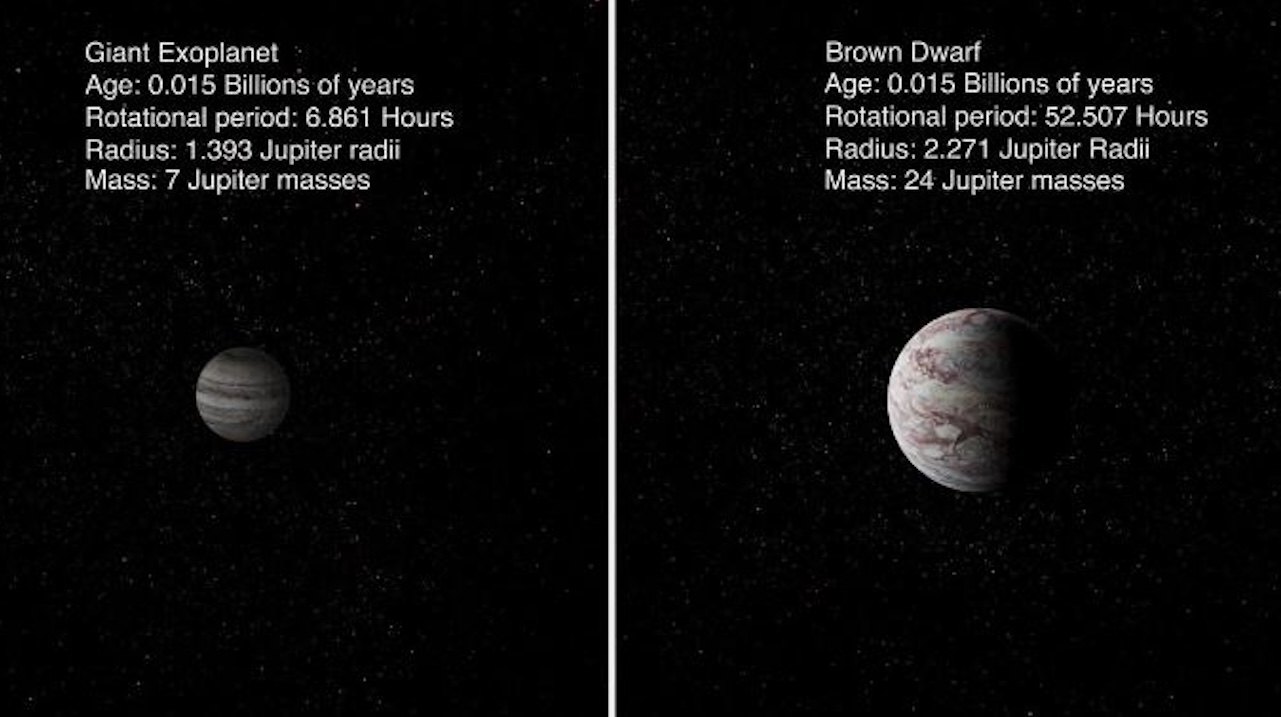
Artist’s animation comparing the rotation of a gas giant exoplanet (left) and a more massive brown dwarf companion (right). Astronomers measured the spin rates of distant worlds by analyzing subtle broadening in their spectra caused by rotation. The study reveals that, when accounting for their mass, size, and age, gas giant planets spin faster than heavier brown dwarf companions. Credit: W. M. Keck Observatory / Adam Makarenko
The newly identified spin trend provides an important clue.
“Our results suggest that both the planet’s mass and the ratio between the planet’s mass and its star’s mass influence how fast the planet ultimately spins,” said Hsu. “That helps us narrow down the physics of how these systems form.”
One planet and one brown dwarf in the study illustrate this complexity: One of the infamous planets in HR 8799, roughly 7 times the mass of Jupiter, spins unusually fast for its mass, compared to a brown dwarf companion of 24 times the mass of Jupiter. This implies that the brown dwarf ended up spinning 6 times slower than the planet.
This can be understood as the planet underwent braking by its magnetic field interaction with the disk around the planet during its infancy. The spin of a more massive companion was slowed down significantly more due to a stronger magnetic field.
What It Means for Our Solar System
Understanding how giant planets spin also helps scientists understand the history of our own solar system.
Jupiter and Saturn both rotate rapidly each completing a rotation in roughly ten hours. Because Jupiter is so massive, it stores a large fraction of the solar system’s rotational energy.
“The way that angular momentum is distributed among planets influences the overall architecture of a planetary system,” said Hsu. “Even Earth’s rotation and magnetic field ultimately connect to how that spin budget was divided when the solar system formed.”
A Legacy of KPIC and a Bright Future of HISPEC
Most of the spin measurements in the study were obtained using KPIC, which was specifically designed to pair Keck’s adaptive optics system with high-resolution spectroscopy. The instrument was designed and built by a team led by Dimitri Mawet, a professor of astronomy at Caltech and senior research scientist at JPL, and a team of students, postdocs, and engineers from Caltech Optical Observatories.
The instrument recently completed its final observations in January, marking the end of a highly productive run.
“KPIC is the first instrument of its kind, opening an entirely new way to study exoplanets,” said Hsu. “It allowed us to measure properties like spin that were previously almost impossible to detect.”
The research team plans to expand their studies by examining the spins of free-floating planetary-mass objects—worlds that drift through space without a host star—as well as investigating the chemical composition of planetary atmospheres across the population.
“We’re just beginning to explore what planetary spin can tell us,” said Hsu. “With future instruments and larger telescopes, we’ll be able to measure spins for even more worlds and connect rotation, chemistry, and formation history across entire planetary systems.”
Advanced future instrumentation, including Keck Observatory’s upcoming HISPEC (High resolution Infrared Spectrograph for Exoplanet Characterization), also led by Mawet, is coming online in 2027. It will extend these measurements to even smaller and more distant worlds.
“We took the lessons learned from KPIC, and put them into HISPEC, which will have better sensitivity, higher spectral resolution, and wider wavelength coverage”, said Jason Wang, Assistant Professor at Northwestern and co-author of the study. “With HISPEC we will be able to drastically increase the number of planets that we can measure spins of, and in particular, we can study planets closer to our own Jupiter in nature to see if our own Jupiter is typical.”
Support for KPIC is generously provided by the Heising-Simons Foundation, Simons Foundation, Caltech, and NASA Jet Propulsion Laboratory. This project is conducted in collaboration with W. M. Keck Observatory, UC Santa Cruz, UCLA, and the University of Hawaiʻi Institute for Astronomy.
These observations were conducted from Maunakea, a place of deep cultural significance to the Native Hawaiian community. The W. M. Keck Observatory is grateful for the opportunity to conduct observations from this sacred mountain and remains committed to respectful stewardship of the mauna and engagement with the Hawaiʻi Island community.
Distinct Rotational Evolution of Giant Planets and Brown Dwarf Companions, The Astronomical Journal (open access)
Astrobiology, exoplanet,










Related Posts
Stay Informed With the Latest & Most Important News
Previous Post
Next Post
Advertisement
-
 01Two Black Holes Observed Circling Each Other for the First Time
 -
 02From Polymerization-Enabled Folding and Assembly to Chemical Evolution: Key Processes for Emergence of Functional Polymers in the Origin of Life
 -
 03Astronomy 101: From the Sun and Moon to Wormholes and Warp Drive, Key Theories, Discoveries, and Facts about the Universe (The Adams 101 Series)
 -
 04True Anomaly hires former York Space executive as chief operating officer
 -
 05Φsat-2 begins science phase for AI Earth images
 -
 06Hurricane forecasters are losing 3 key satellites ahead of peak storm season − a meteorologist explains why it matters
 -
 07Binary star systems are complex astronomical objects − a new AI approach could pin down their properties quickly