
Now Reading: A Research Roadmap For Assessing The Feasibility Of Warming Mars
-
01
A Research Roadmap For Assessing The Feasibility Of Warming Mars


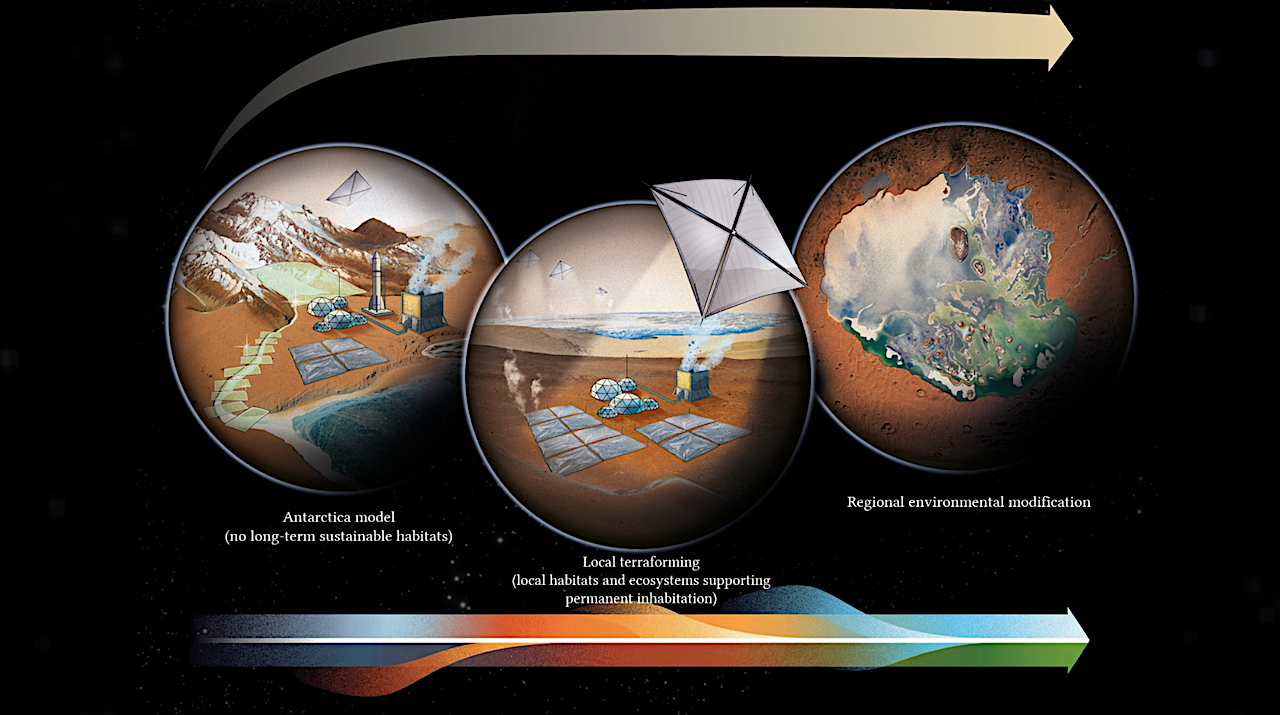
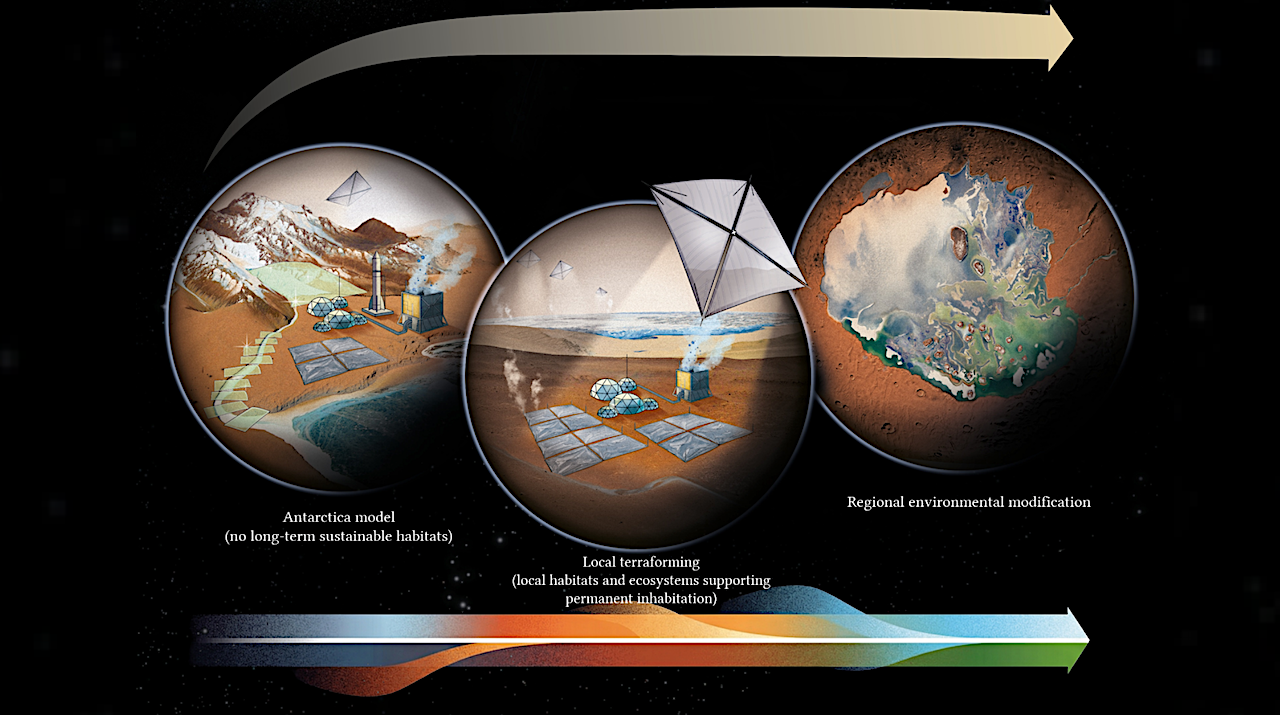
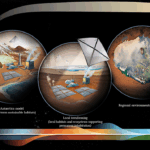
Artist’s impression showing possible choices for the scale of human involvement in the future of Mars. Early on, warming occurs only close to human bases. Solid-state greenhouse membranes harvest liquid water from subsurface ice. Orbiting reflectors augment sunlight, and a pilot factory makes engineered aerosols. It is possible that people will decide to stop at this point. In the case where a decision is made to go for local terraforming, the middle figure shows atmospheric pressure rising from orbiting reflectors, larger areas with solid-state greenhouse membranes, and climate experiments with engineered aerosols. The right panel shows a large region (Hellas basin) suitable for photosynthetic life, in the case where a decision is made to proceed to regional warming. (V. Socianu). Research tasks to assess the feasibility of these options are summarized in Table 1. — astro-ph.IM
This roadmap outlines research pathways to determine whether Mars could be warmed with non-biological methods. It does not presuppose that warming Mars is desirable; its purpose is to identify what would need to be true for Mars to be warmed, what it would cost, and what could go wrong.
Three complementary research tracks appear promising. Solid-state greenhouse membranes offer local warming, aiding water harvesting, food production, and oxygen supply near human bases. Orbiting reflectors can warm key sites such as bases and CO2-ice reservoirs, although a large combined area would be required. Strengthening Mars’ natural greenhouse effect might warm large regions or the globe, although many aspects remain to be worked out.
Each approach carries scientific and technical risks that research must address. Near-term priorities are on-Earth testing of key parameters that will determine whether engineered aerosol warming is realistically possible, assessing whether exponential production of bioplastic habitats is possible, and designing at-Mars process experiments. In the near term, the research proposed here is closely aligned with and supports research needed to understand Mars’ atmosphere and volatile evolution and hazards to human explorers.
The main external uncertainty is whether or not launch costs continue to fall. This is early-stage research, and we discuss key near-term decision points, alternative pathways, and payoffs if research outcomes are negative. We also outline build-out pathways if research succeeds and demand exists. Relatively modest research investments would keep open the option of extending life beyond Earth as Mars’ scientific exploration continues.
E. S. Kite, A. Essunfeld, M. H. Hecht, M. A. Mischna, R. Wordsworth, H. Mohseni, A. Boies, N. Averesch, S. Ansari, M. I. Richardson, E. A. DeBenedictis, D. Stork, A. L. Bamba, C. J. Handmer, C. Jourdain, R. Ramirez, C. E. Mason, A. Kling, A. S. Braude, A. Dumitrescu, S. P. Worden, J. Cumbers, N. Lanza, R. Quayum, C. S. Cockell
Subjects: Instrumentation and Methods for Astrophysics (astro-ph.IM); Earth and Planetary Astrophysics (astro-ph.EP); Geophysics (physics.geo-ph)
Cite as: arXiv:2604.02242 [astro-ph.IM] (or arXiv:2604.02242v1 [astro-ph.IM] for this version)
https://doi.org/10.48550/arXiv.2604.02242
Focus to learn more
Submission history
From: Edwin Kite
[v1] Thu, 2 Apr 2026 16:33:39 UTC (43,944 KB)
https://arxiv.org/abs/2604.02242
Astrobiology, Terraforming,










Related Posts
Stay Informed With the Latest & Most Important News

Advertisement
-
 01Two Black Holes Observed Circling Each Other for the First Time
 -
 02From Polymerization-Enabled Folding and Assembly to Chemical Evolution: Key Processes for Emergence of Functional Polymers in the Origin of Life
 -
 03Astronomy 101: From the Sun and Moon to Wormholes and Warp Drive, Key Theories, Discoveries, and Facts about the Universe (The Adams 101 Series)
 -
 04True Anomaly hires former York Space executive as chief operating officer
 -
 05Φsat-2 begins science phase for AI Earth images
 -
 06Hurricane forecasters are losing 3 key satellites ahead of peak storm season − a meteorologist explains why it matters
 -
 07Binary star systems are complex astronomical objects − a new AI approach could pin down their properties quickly