
Now Reading: A Roadmap For The Exploration Of Enceladus
-
01
A Roadmap For The Exploration Of Enceladus



Enceladus Vent Explorer: Phase II concept. Credits: Masahiro Ono
This paper provides key hypotheses to guide future missions to Enceladus for the current decadal cycle and beyond. Enceladus is a high priority target for the fields of astrobiology and planetary science because it contains the three basic ingredients for life as we understand it: organic materials, a liquid solvent, and an energy source.
This prioritization is reflected in the National Academies of Sciences, Engineering, and Medicine 2023–2032 Planetary Science and Astrobiology Decadal Survey, which highlights Enceladus in the list of destinations for a NASA New Frontiers class mission and recommends an Enceladus Orbilander mission as the second priority Flagship mission. In 2021 the science definition team behind the Enceladus Vent Explorer, a concept funded under NASA’s Innovative Advanced Concepts program, held three workshops to discuss high priority science for Enceladus.
Resulting from these workshops was a list of investigations addressing two science goals: (a) “How has the thermal evolution of Enceladus impacted the moon’s ability to sustain a liquid ocean and recycle nutrients?” and (b) “How has the astrobiological potential of Enceladus changed over time?” Herein we detail the science background, proposed hypotheses, objectives, and physical parameters for each proposed investigation.
In addition, we introduce a novel approach to describe the organic state of a planetary body to facilitate the development of hypotheses related to the emergence of life and to contextualize putative biosignatures. Finally, we provide recommendations for further development of technology and research for ocean world exploration.
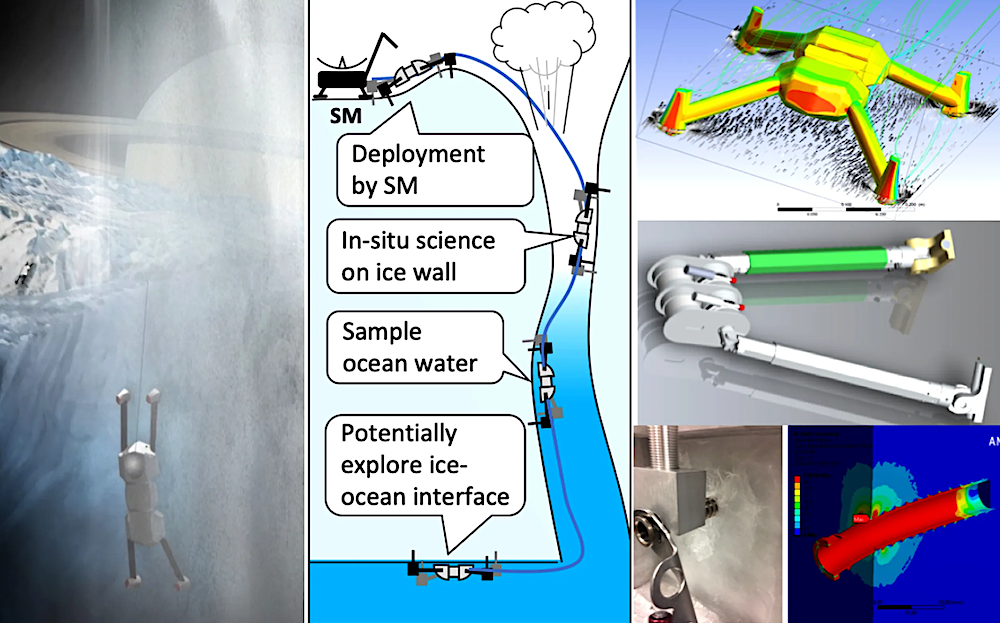
Graphic depiction of the Enceladus Vent Explorer: Phase II concept. Credits: Masahiro Ono NASA (Source)
Astrobiology, Astrogeology,











Related Posts
Stay Informed With the Latest & Most Important News
Previous Post
Next Post
Advertisement
-
 01Two Black Holes Observed Circling Each Other for the First Time
 -
 02From Polymerization-Enabled Folding and Assembly to Chemical Evolution: Key Processes for Emergence of Functional Polymers in the Origin of Life
 -
 03Astronomy 101: From the Sun and Moon to Wormholes and Warp Drive, Key Theories, Discoveries, and Facts about the Universe (The Adams 101 Series)
 -
 04True Anomaly hires former York Space executive as chief operating officer
 -
 05Φsat-2 begins science phase for AI Earth images
 -
 06Hurricane forecasters are losing 3 key satellites ahead of peak storm season − a meteorologist explains why it matters
 -
 07Binary star systems are complex astronomical objects − a new AI approach could pin down their properties quickly