
Now Reading: A Second Visit To Eps Ind Ab With JWST: New Photometry Confirms Ammonia And Suggests Thick Clouds In The Exoplanet Atmosphere Of The Closest Super-Jupiter
-
01
A Second Visit To Eps Ind Ab With JWST: New Photometry Confirms Ammonia And Suggests Thick Clouds In The Exoplanet Atmosphere Of The Closest Super-Jupiter

A Second Visit To Eps Ind Ab With JWST: New Photometry Confirms Ammonia And Suggests Thick Clouds In The Exoplanet Atmosphere Of The Closest Super-Jupiter

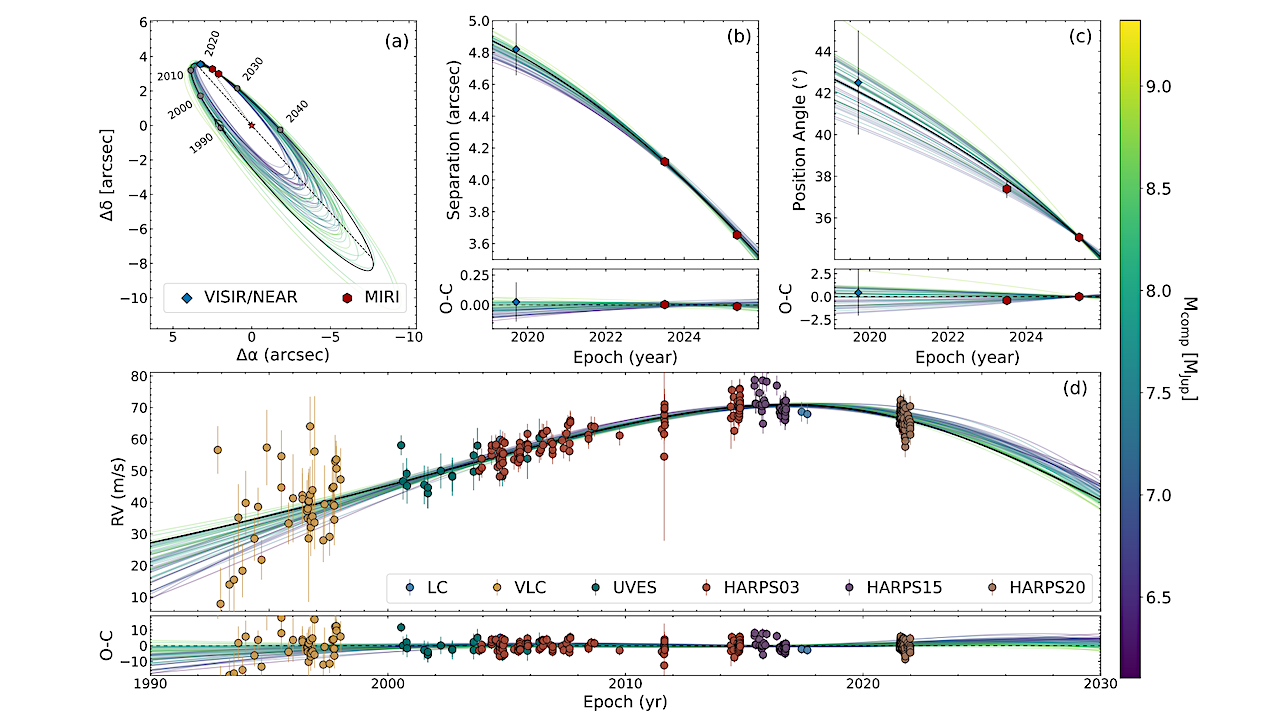
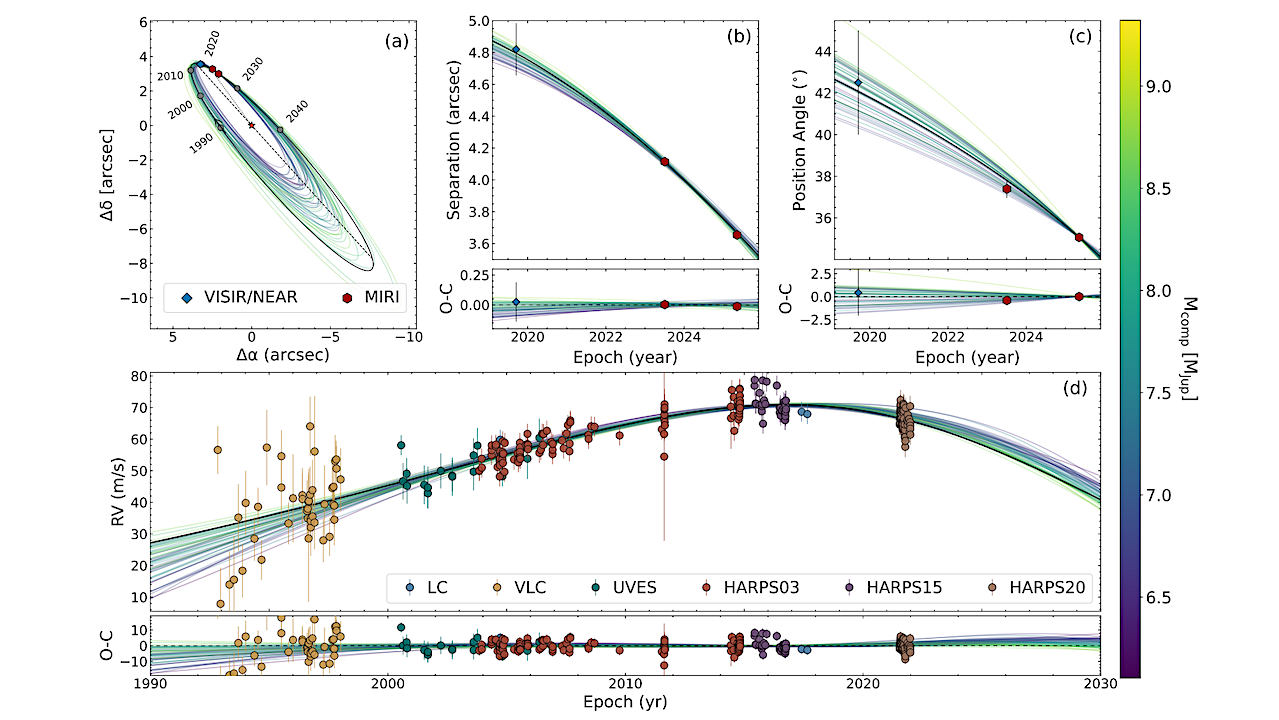
Best-fit orbit solutions. Here we show the on-sky orbit traced by Eps Ind Ab in panel (a); the evolution of on-sky separation and position angle of the planet during our observational baseline in panels (b) and (c) respectively; and the RV data in panel (d). The Maximum A Posteriori (MAP) solution is shown with a thick black line, alongside 50 randomly drawn samples from the posterior, with the same colorbar applying to all panels. Our measured JWST/MIRI and VISIR/NEAR astrometry is shown with red hexagons and a blue diamond respectively, and the predicted on-sky orbit position of the exoplanet between 1990-2040 is indicated with small grey points. — astro-ph.EP
With JWST, we are directly imaging cold (~200-300K), solar-age giant exoplanets for the first time.
At these temperatures many molecular features appear and water-ice clouds may condense and affect the emission spectrum; early photometric measurements of cold giant planets are already showing some tension with the predictions of cloud-free, solar-metallicity atmosphere models.
Here we present new JWST/MIRI coronagraphic observations of the cold giant exoplanet Eps Ind Ab at 11.3um. Together with archival data, we use these new observations to study the atmosphere of this cold exoplanet, and we also re-fit its orbit, finding an updated mass of 7.6±0.7 Mj and an eccentricity of 0.24+0.11−0.08. The planet is significantly brighter (by 0.88±0.08 mag) at 11.3um than at 10.6um, indicating the presence of ammonia.
However, this ammonia feature is shallower than expected. This could indicate a low-metallicity or nitrogen-depleted atmosphere, but our preferred explanation is the presence of thick water-ice clouds that suppress the ammonia feature and the near-IR emission of Eps Ind Ab.
Photometry of the small but growing sample of cold, giant exoplanets demonstrates that they are consistently fainter than expected between 3 to 5um, consistent with the water-ice cloud hypothesis. 10.6um and 11.3um photometry of this cold exoplanet sample would be valuable to determine whether the suppressed ammonia feature is universal, and to frame a new open question about the underlying physical cause.
Elisabeth C. Matthews, James Mang, Aarynn L. Carter, Mathlide Mâlin, Caroline V. Morley, Bhavesh Rajpoot, Leindert A. Boogaard, Jennifer A. Burt, Ian J. M. Crossfield, Fabo Feng, Anne-Marie Lagrange, Mark W Phillips
Comments: Accepted for publication in ApJ Letters. 12 pages (7 figures, 3 tables) + appendices
Subjects: Earth and Planetary Astrophysics (astro-ph.EP)
Cite as: arXiv:2603.08780 [astro-ph.EP] (or arXiv:2603.08780v1 [astro-ph.EP] for this version)
https://doi.org/10.48550/arXiv.2603.08780
Focus to learn more
Submission history
From: Elisabeth Matthews
[v1] Mon, 9 Mar 2026 18:00:01 UTC (1,031 KB)
https://arxiv.org/abs/2603.08780
Astrobiology,










Related Posts
Stay Informed With the Latest & Most Important News
Previous Post
Next Post


Advertisement
-
 01Two Black Holes Observed Circling Each Other for the First Time
 -
 02From Polymerization-Enabled Folding and Assembly to Chemical Evolution: Key Processes for Emergence of Functional Polymers in the Origin of Life
 -
 03Astronomy 101: From the Sun and Moon to Wormholes and Warp Drive, Key Theories, Discoveries, and Facts about the Universe (The Adams 101 Series)
 -
 04True Anomaly hires former York Space executive as chief operating officer
 -
 05Φsat-2 begins science phase for AI Earth images
 -
 06Hurricane forecasters are losing 3 key satellites ahead of peak storm season − a meteorologist explains why it matters
 -
 07Binary star systems are complex astronomical objects − a new AI approach could pin down their properties quickly