
Now Reading: A Universal Brown Dwarf Desert Formed Between Planets And Star
-
01
A Universal Brown Dwarf Desert Formed Between Planets And Star


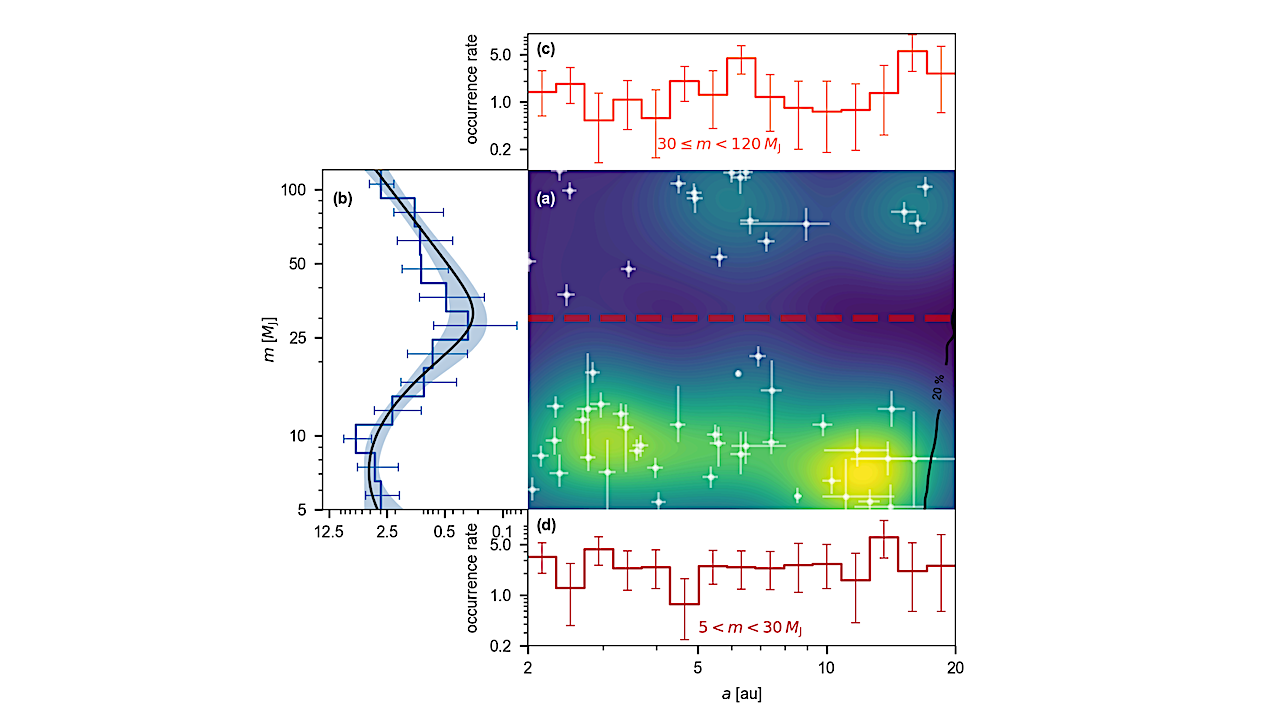
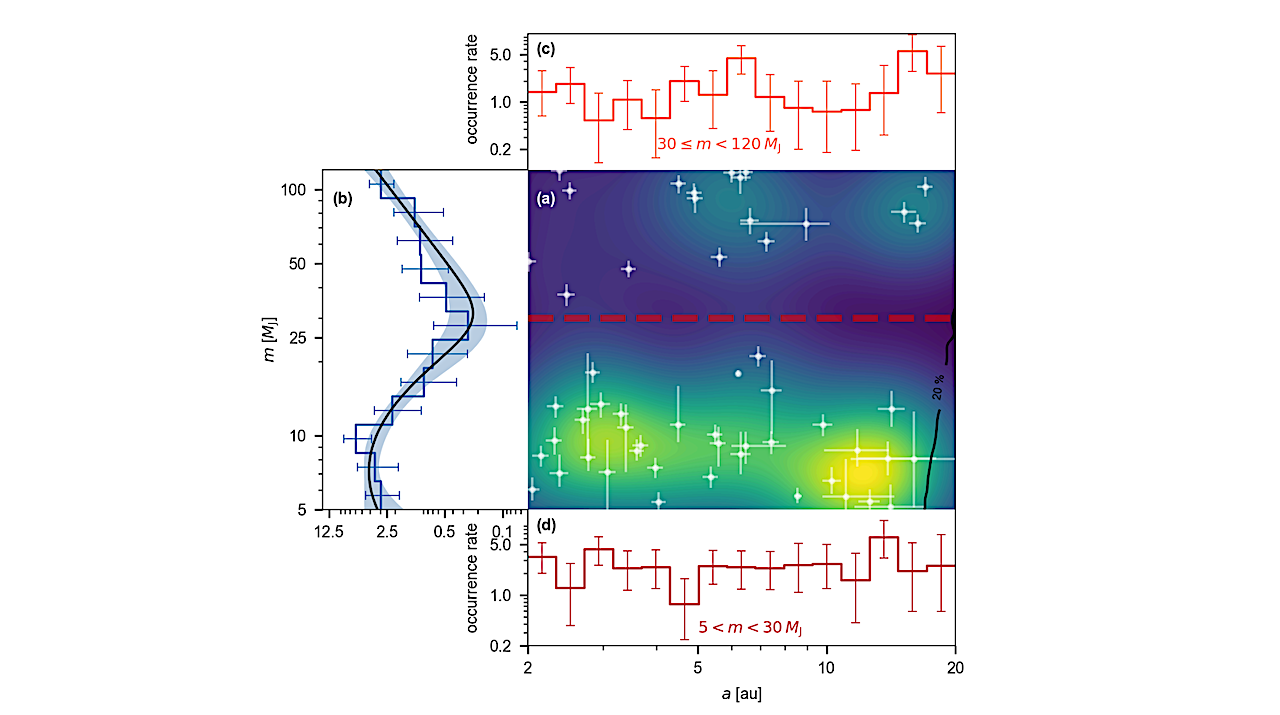
Distribution of companions in semi-major axis and mass,
along with the occurrence rate density of subsamples. (a), Detection efficiency-weighted KDE and distribution of our sample (white
points). We divide the sample into low-mass and high-mass subsamples, with the division marked by a dashed red line at 30MJ.
Detection efficiencies of 20% is outlined by a black contour. (b),
The occurrence rate density vs companion mass (dN/d ln m per
100 stars). The best-fit log-normal plus power-law model with its
uncertainty is overplotted. The uncertainties correspond to the
16th and 84th percentiles of the posterior distributions. (c), The
occurrence rate density vs semi-major axes (dN/d ln a per 100
stars), when companion mass above 30MJ. (d), similar to c but
for companions with m 30MJ.
Giant planets and brown dwarfs play a crucial role in star and planet formation, as they are situated at the boundary between planets and stars with uncertain formation mechanisms.
Previous observational searches for the formation boundary were hampered by the lack of large unified samples of wide-orbit giant planets and substellar companions. A combined analysis of radial velocity and astrometry mitigates this problem and has significantly enlarged the sample.
Here we present a rigorous statistical analysis of the sample of 55 giant planets, brown dwarfs and low-mass stellar companions orbiting FGK stars. We quantitatively analyze the occurrence rates of brown dwarfs and identify a distinct brown dwarf desert at approximately 30MJ, with no evidence of disappearance up to 20 au.
Unlike previous studies that predicted a declining planet occurrence rate beyond the water-ice line, we identify a new population of giant planets and low-mass brown dwarfs in this region.
The metallicity and eccentricity trends in our sample suggest that these are the consequences of two different formation scenarios. Our combined population synthesis model successfully accounts for the observed brown dwarf desert, supporting the dual formation hypothesis.
Kaiming Cui, Guang-Yao Xiao, Fabo Feng, Beibei Liu, Sergei Nayakshin, Cassandra Hall, Kangrou Guo, Dong Lai, Masahiro Ogihara, Yicheng Rui, Alan P. Boss, R. Paul Butler, Yifan Xuan
Comments: Published in PNAS
Subjects: Earth and Planetary Astrophysics (astro-ph.EP); Solar and Stellar Astrophysics (astro-ph.SR)
Cite as: arXiv:2603.01808 [astro-ph.EP](or arXiv:2603.01808v1 [astro-ph.EP] for this version)
https://doi.org/10.48550/arXiv.2603.01808
Focus to learn more
Related DOI:
https://doi.org/10.1073/pnas.2524764123
Focus to learn more
Submission history
From: Kaiming Cui
[v1] Mon, 2 Mar 2026 12:44:13 UTC (8,249 KB)
https://arxiv.org/abs/2603.01808
Astrobiology,











Related Posts
Stay Informed With the Latest & Most Important News
Previous Post
Next Post



Advertisement
-
 01Two Black Holes Observed Circling Each Other for the First Time
 -
 02From Polymerization-Enabled Folding and Assembly to Chemical Evolution: Key Processes for Emergence of Functional Polymers in the Origin of Life
 -
 03Astronomy 101: From the Sun and Moon to Wormholes and Warp Drive, Key Theories, Discoveries, and Facts about the Universe (The Adams 101 Series)
 -
 04True Anomaly hires former York Space executive as chief operating officer
 -
 05Φsat-2 begins science phase for AI Earth images
 -
 06Hurricane forecasters are losing 3 key satellites ahead of peak storm season − a meteorologist explains why it matters
 -
 07Binary star systems are complex astronomical objects − a new AI approach could pin down their properties quickly