
Now Reading: A Whole-planet Model Of The Earth Without Life For Terrestrial Exoplanet Studies
-
01
A Whole-planet Model Of The Earth Without Life For Terrestrial Exoplanet Studies


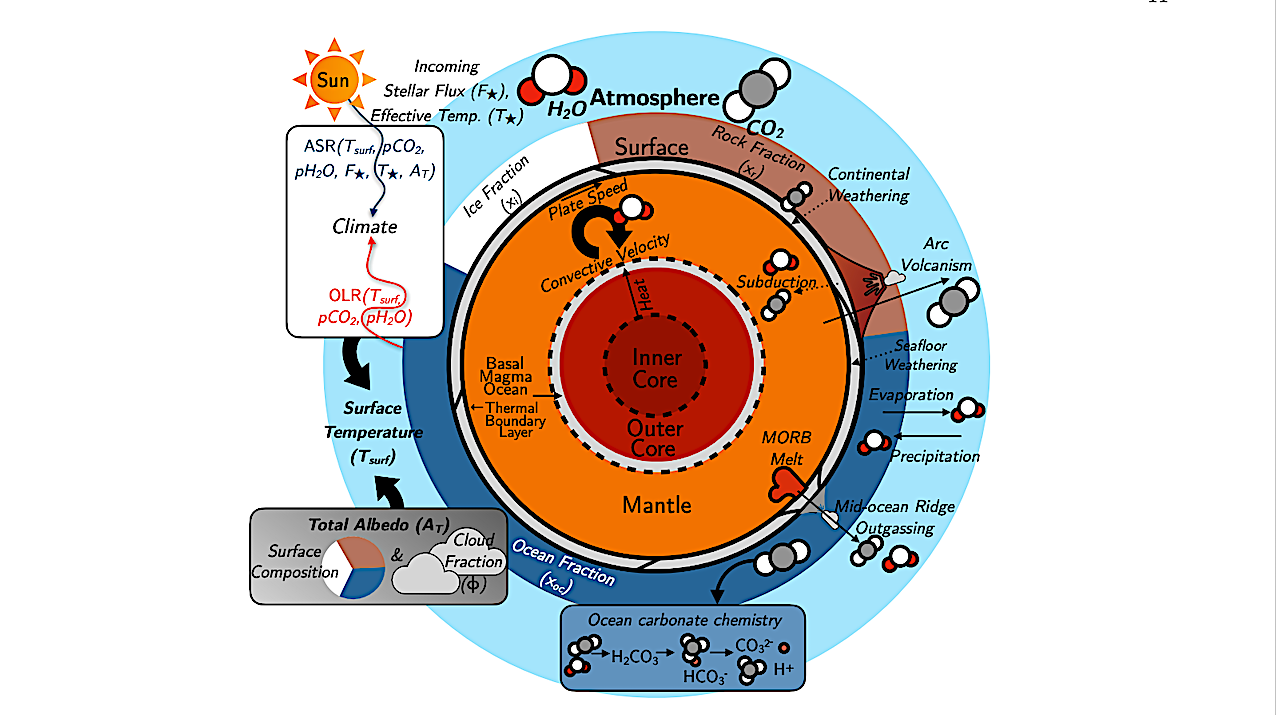
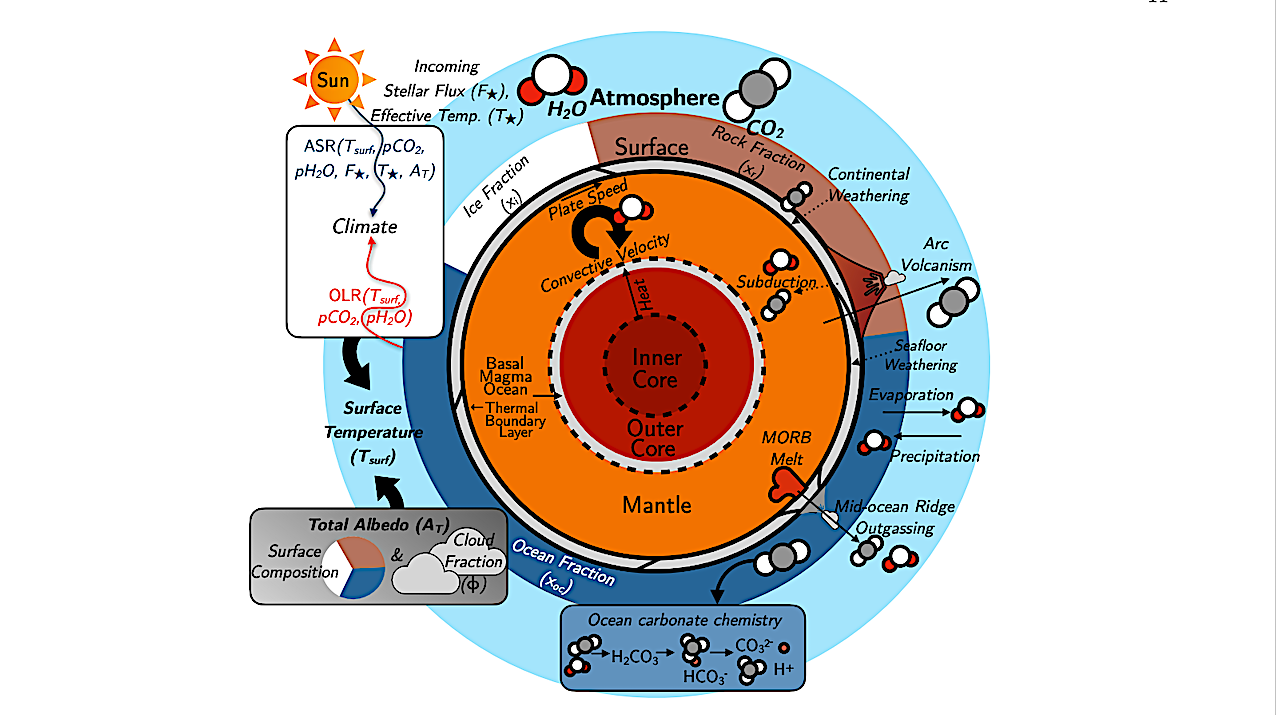
A schematic of the key processes included in our abiotic Earth model. Remotely observable quantities (surface temperature, albedo, and atmospheric H2O and CO2) are in bold. Volatile cycling is diagrammed in more detail in Figure 2. — astro-ph.EP
As the only known habitable (and inhabited) planet in the universe, Earth informs our search for life elsewhere. Future telescopes like the Habitable Worlds Observatory (HWO) will soon look for life on rocky worlds around Sun-like stars, so it is critical that we understand how to distinguish habitable planets from inhabited planets.
However, it remains unknown if life is necessary to maintain a habitable planet, or how all of the components of an evolving planet impact habitability over time. To address these open questions, we present a coupled interior-atmosphere evolution model of the Earth without life from 50 Myr to 5 Gyr that reproduces 19 key observations of the pre-industrial Earth within measurement uncertainties after 4.5 Gyr.
We also produce a reflected light spectrum covering the possible wavelength range of HWO. Our findings support the view that life is not required to maintain habitable surface conditions. The model presented here is apt for predicting the long-term habitability of Earth-like exoplanets via evolving bulk properties.
By generating realistic reflected light spectra from evolved atmospheric states, this model represents significant progress towards whole-planet modeling, which may ultimately provide a robust abiotic baseline for interpreting biosignature observations with HWO.
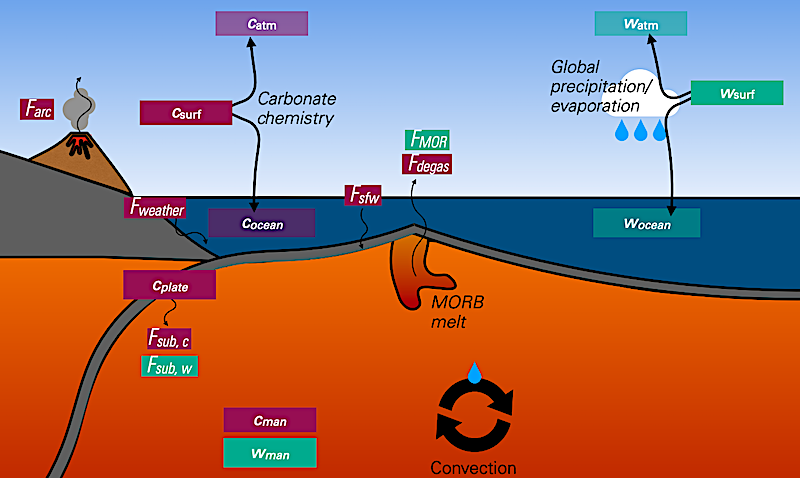
A schematic showing the atmospheric sources and sinks that define the new volatile cycling processes in VPLanet’s ThermInt module, inspired by Figure 1 in Foley (2015). Fluxes related to CO2 are color-coded magenta, and fluxes related to H2O are color-coded teal. We incorporate the climate-stabilizing carbon cycle from Foley (2015), tracking the mass of CO2 across the mantle (cman), plate (cplate), and surface (csurf) reservoirs. We include the deep water cycle from Seales & Lenardic (2020), and a precipitation/evaporation parameterization from Driscoll & Bercovici (2013), which allow us to track the mass of H2O across the mantle (wman) and surface (wsurf) reservoirs. At each timestep, surface carbon and water are partitioned into the atmosphere (catm, watm) and the ocean (cocean, wocean) by enforcing equilibrium at the air-water boundary. This schematic does not depict modeled ocean chemistry. — astro-ph.EP
Samantha Gilbert-Janizek, Rory K. Barnes, Peter E. Driscoll, Nicholas F. Wogan, Avi M. Mandell, Jessica L. Birky, Ludmila Carone, Rodolfo Garcia
Comments: 42 pages, 8 figures, 5 tables, 2 appendices, submitted to Planetary Science Journal
Subjects: Earth and Planetary Astrophysics (astro-ph.EP)
Cite as: arXiv:2602.02267 [astro-ph.EP] (or arXiv:2602.02267v1 [astro-ph.EP] for this version)
https://doi.org/10.48550/arXiv.2602.02267
Focus to learn more
Submission history
From: Samantha Gilbert-Janizek
[v1] Mon, 2 Feb 2026 16:09:57 UTC (5,392 KB)
https://arxiv.org/abs/2602.02267v1
Astrobiology










Related Posts
Stay Informed With the Latest & Most Important News
Previous Post
Next Post




Advertisement
-
 01Two Black Holes Observed Circling Each Other for the First Time
 -
 02From Polymerization-Enabled Folding and Assembly to Chemical Evolution: Key Processes for Emergence of Functional Polymers in the Origin of Life
 -
 03Astronomy 101: From the Sun and Moon to Wormholes and Warp Drive, Key Theories, Discoveries, and Facts about the Universe (The Adams 101 Series)
 -
 04True Anomaly hires former York Space executive as chief operating officer
 -
 05Φsat-2 begins science phase for AI Earth images
 -
 06Hurricane forecasters are losing 3 key satellites ahead of peak storm season − a meteorologist explains why it matters
 -
 07Binary star systems are complex astronomical objects − a new AI approach could pin down their properties quickly