
Now Reading: Aalto plots Australia base to boost planned high-altitude pseudo satellite service
-
01
Aalto plots Australia base to boost planned high-altitude pseudo satellite service


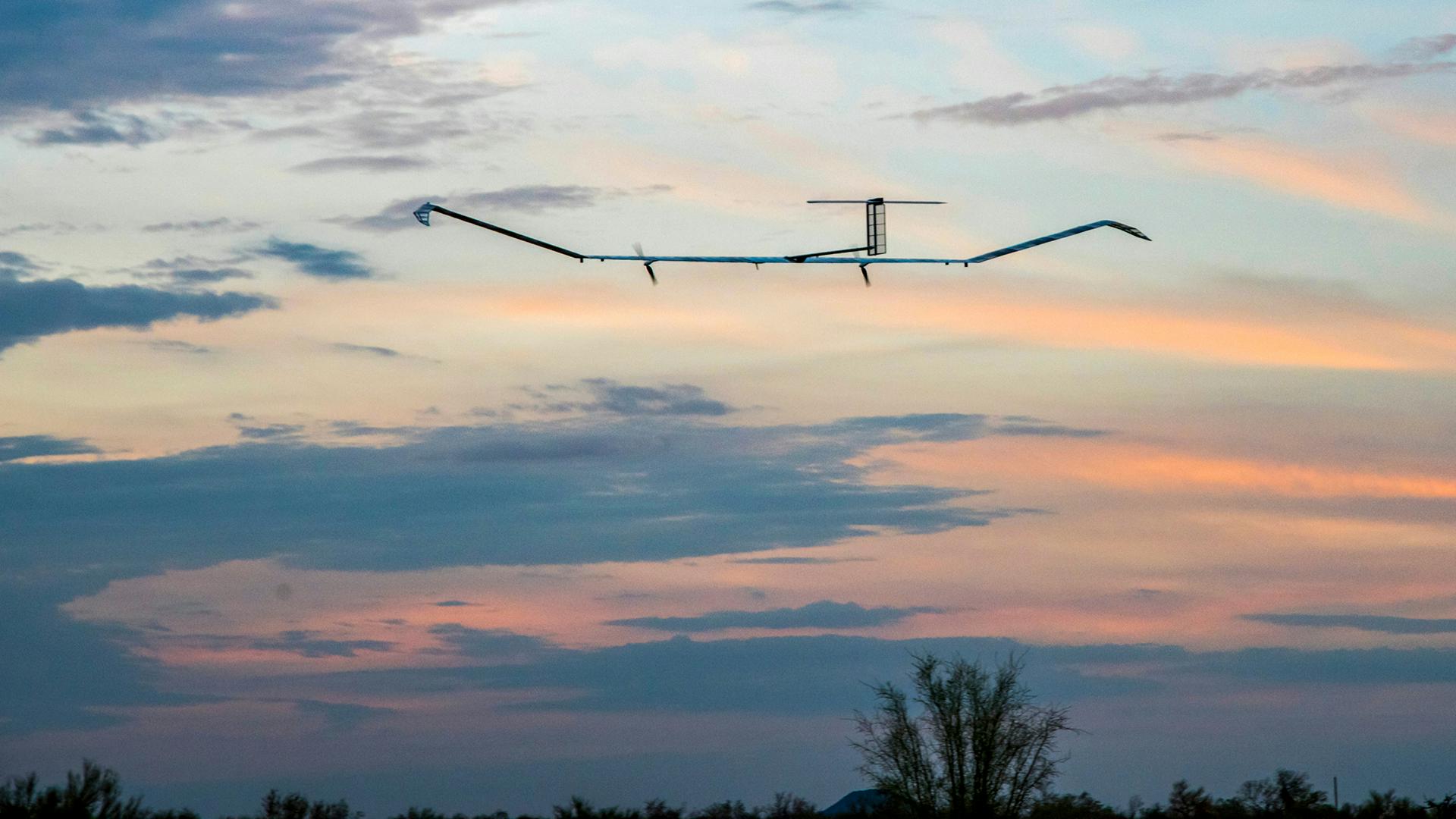

TAMPA, Fla. — Aalto is turning to Australia as a key operating base to bolster the business case for initial commercial services of its stratospheric pseudo-satellite over Japan, now pushed to 2027 amid regulatory hurdles and ongoing system-integration work.
The proposed launch and landing site would shave about 10 days off the 14- to 15-day transit from its Kenya base to Japan for the Airbus-owned venture’s Zephyr drone, according to Aalto CEO Hughes Boulnois.
The shorter route would free up more time for communications and Earth observation services over Asia Pacific, Boulnois said in a Feb. 16 interview, adding that its fixed-wing high-altitude platform station (HAPS) currently has an endurance of roughly 90 days.
“I can add an additional 10 days to the customer for a mission,” he said, “and also I can be much closer to countries like Indonesia and the Philippines, which are quite interested in the capability as well.”
HAPS versus satellite direct-to-device
Aalto raised $100 million in 2024 from Japanese companies led by mobile operator NTT Docomo, which has partnered with the HAPS venture to explore ways to extend 4G and 5G coverage in Japan, as well as restore communications after natural disasters wipe out terrestrial networks.
Such disaster-response connectivity has traditionally relied on satellites, where nascent direct-to-device (D2D) services from low Earth orbit promise to greatly improve coverage and accessibility.
“From my perspective, the type of service we will be delivering from 20 kilometers altitude … will always be of a better quality and better throughput than what you can do from 1,000 kilometers altitude in orbit,” Boulnois said.
While SpaceX seeks to expand beyond the basic D2D data services it has begun offering commercially in Japan and elsewhere, Boulnois said operating closer to Earth enables stronger signals and lower latency, making HAPS better suited to higher-bandwidth applications such as video that are increasingly critical for emergency services.
“I have been witnessing the evolution of the emergency services from … voice-only to voice and data,” he said, “and now data-driven.”
Zephyr is also being positioned for high-resolution Earth observation, alongside connectivity, as part of broader hybrid architectures integrating stratospheric, terrestrial and space-based systems.
Still, commercialization has taken longer than expected, even as HAPS ventures tout their technological readiness. Aalto had previously targeted 2026 for initial services in Japan but now expects 2027 as it works through regulatory constraints and system maturity with partners.
Boulnois said Japanese authorities currently allow Zephyr to fly over water but not close to shore, limiting Aalto’s ability to serve population centers.
Expanding operations nearer land, and eventually over land, is also tied in part to ongoing certification work with the United Kingdom’s Civil Aviation Authority.
“We are taking into account the evolution of the requirements and maturing together with them,” Boulnois said, “rather than rushing into a capability that would not be properly suited.”
Japan proving ground
Aalto is not the only venture in the fledgling HAPS market that is pursuing stratospheric services over Japan.
U.S.-based Sceye, backed by NTT Docomo rival SoftBank, has plans for a commercial pilot this year that would see its solar-powered airship provide broadband over Japan before returning to the United States.
“Sceye has not yet announced the first country or target launch date for full commercial services,” a Sceye spokesperson said, “but we have multiple pre-commercial HAPS flights in 2026 and we are excited to share more on that soon.”
Last year, Sceye also won a NASA Small Business Innovation Research award to demonstrate a hyperspectral Earth observation sensor from its platform in late 2026 or early 2027.
In Australia, Aalto is working with the Northern Territory Government and engaging regulators to secure the airspace approvals needed to establish its second operational base after Kenya.
The French company is also calling on Australian payload developers, research institutions and technology partners to help build a national “Stratospace” ecosystem, targeting dual-use commercial and government applications ranging from connectivity-on-demand to intelligence, surveillance and reconnaissance.










Related Posts


Stay Informed With the Latest & Most Important News
Previous Post
Next Post



Advertisement
-
 01Two Black Holes Observed Circling Each Other for the First Time
 -
 02From Polymerization-Enabled Folding and Assembly to Chemical Evolution: Key Processes for Emergence of Functional Polymers in the Origin of Life
 -
 03Astronomy 101: From the Sun and Moon to Wormholes and Warp Drive, Key Theories, Discoveries, and Facts about the Universe (The Adams 101 Series)
 -
 04True Anomaly hires former York Space executive as chief operating officer
 -
 05Φsat-2 begins science phase for AI Earth images
 -
 06Hurricane forecasters are losing 3 key satellites ahead of peak storm season − a meteorologist explains why it matters
 -
 07Binary star systems are complex astronomical objects − a new AI approach could pin down their properties quickly