
Now Reading: Abundant Hydrocarbons In A Buried Galactic Nucleus With Signs Of Carbonaceous Grain And Polycyclic Aromatic Hydrocarbon Processing
-
01
Abundant Hydrocarbons In A Buried Galactic Nucleus With Signs Of Carbonaceous Grain And Polycyclic Aromatic Hydrocarbon Processing

Abundant Hydrocarbons In A Buried Galactic Nucleus With Signs Of Carbonaceous Grain And Polycyclic Aromatic Hydrocarbon Processing

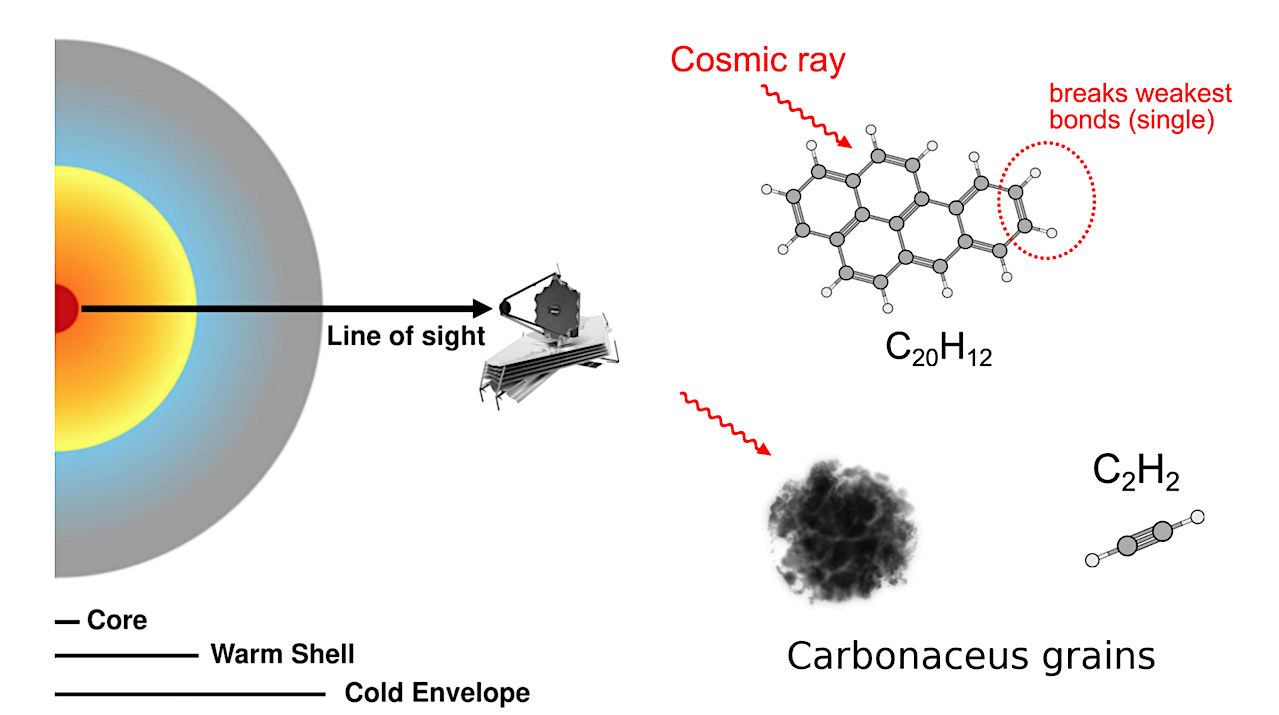
Hydrocarbons play a key role in shaping the chemistry of the interstellar medium (ISM), but their enrichment and relationship with carbonaceous grains and polycyclic aromatic hydrocarbons (PAHs) still lack clear observational constraints.
We report JWST NIRSpec+MIRI/MRS infrared (IR; 3-28 micron) observations of the local ultra-luminous IR galaxy (ULIRG) IRAS 07251-0248, revealing the extragalactic detection of small gas-phase hydrocarbons such as benzene (C6H6), triacetylene (C6H2), diacetylene (C4H2), acetylene (C2H2), methane (CH4), and methyl radical (CH3) as well as deep amorphous C-H absorptions in the solid phase.
The unexpectedly high abundance of these molecules indicates an extremely rich hydrocarbon chemistry, not explained by high-temperature gas-phase chemistry, ice desorption or oxygen depletion. Instead, the most plausible explanation is the erosion and fragmentation of carbonaceous grains and PAHs.
This scenario is supported by the correlation between the abundance of one of their main fragmentation products, C2H2, and cosmic ray (CR) ionization rate for a sample of local ULIRGs. These hydrocarbons are outflowing at ∼160 km/s, which may represent a potential formation pathway for hydrogenated amorphous grains.
Our results suggest that IRAS 07251-0248 might not be unique but represents an extreme example of the commonly rich hydrocarbon chemistry prevalent in deeply obscured galactic nuclei.
I. García-Bernete (1), M. Pereira-Santaella (2), E. González-Alfonso (3), M. Agúndez (2), D. Rigopoulou (4 and 5), F.R. Donnan (4), G. Speranza (2), N. Thatte (4) ((1) Centro de Astrobiología (CAB, CSIC-INTA), (2) Instituto de Física Fundamental (IFF, CSIC), (3) Departamento de Física y Matemáticas, Universidad de Alcalá, (4) Department of Physics, University of Oxford, (5) School of Sciences, European University Cyprus)
Comments: To appear in Nature Astronomy. 15 Figures, 1 Table
Subjects: Astrophysics of Galaxies (astro-ph.GA); Cosmology and Nongalactic Astrophysics (astro-ph.CO); Solar and Stellar Astrophysics (astro-ph.SR)
Cite as: arXiv:2602.04967 [astro-ph.GA] (or arXiv:2602.04967v1 [astro-ph.GA] for this version)
https://doi.org/10.48550/arXiv.2602.04967
Focus to learn more
Related DOI:
https://doi.org/10.1038/s41550-025-02750-0
Focus to learn more
Submission history
From: Ismael Garcia-Bernete Dr.
[v1] Wed, 4 Feb 2026 19:00:06 UTC (2,584 KB)
https://arxiv.org/abs/2602.04967
Astrobiology, Astrochemistry,










Related Posts
Stay Informed With the Latest & Most Important News
Previous Post
Next Post


Advertisement
-
 01Two Black Holes Observed Circling Each Other for the First Time
 -
 02From Polymerization-Enabled Folding and Assembly to Chemical Evolution: Key Processes for Emergence of Functional Polymers in the Origin of Life
 -
 03Astronomy 101: From the Sun and Moon to Wormholes and Warp Drive, Key Theories, Discoveries, and Facts about the Universe (The Adams 101 Series)
 -
 04True Anomaly hires former York Space executive as chief operating officer
 -
 05Φsat-2 begins science phase for AI Earth images
 -
 06Hurricane forecasters are losing 3 key satellites ahead of peak storm season − a meteorologist explains why it matters
 -
 07Binary star systems are complex astronomical objects − a new AI approach could pin down their properties quickly