
Now Reading: After three years, Artemis 2 astronauts ready to launch
-
01
After three years, Artemis 2 astronauts ready to launch


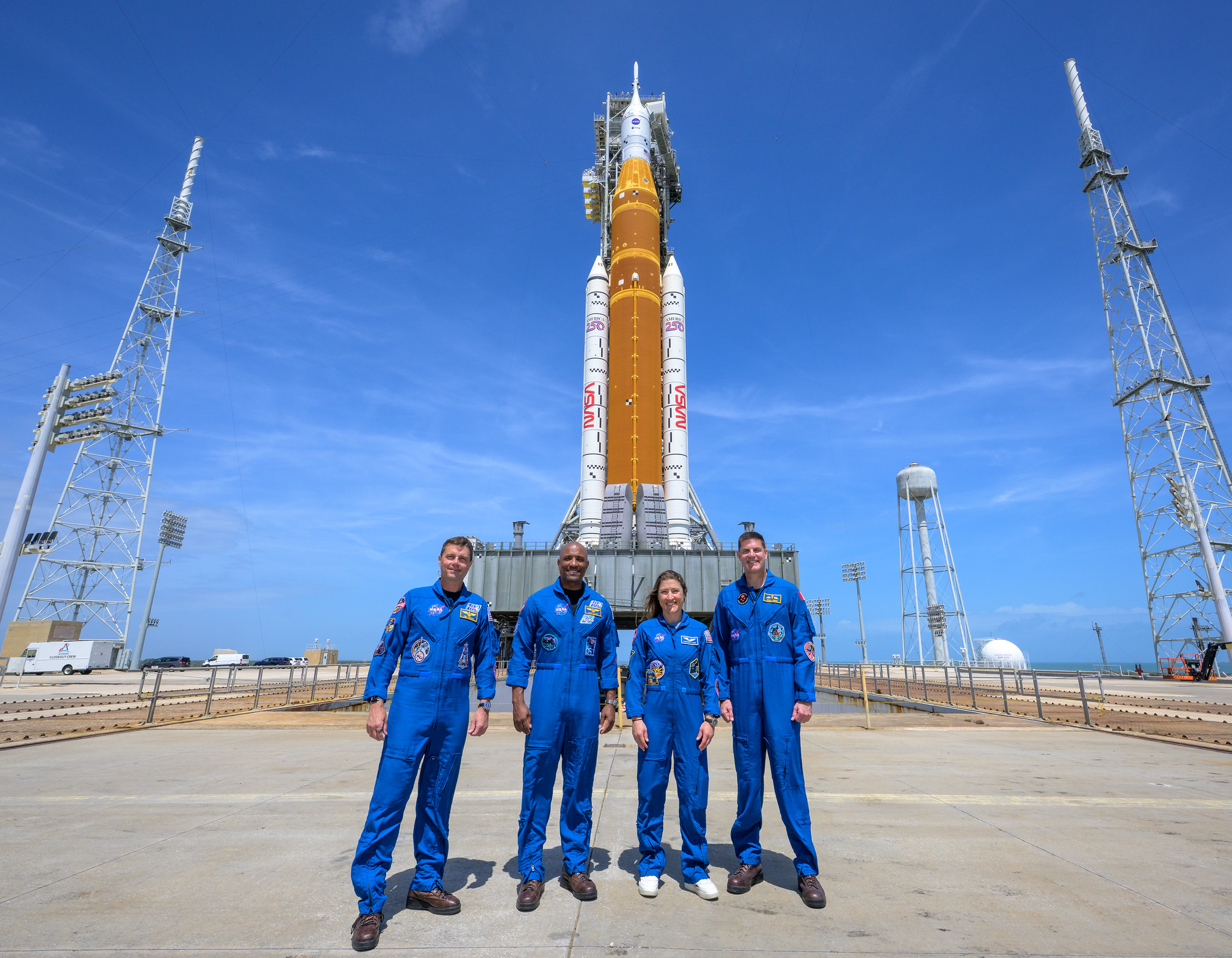

KENNEDY SPACE CENTER, Fla. — Even after three years of public appearances as a crew, there can still be some surprises for the Artemis 2 astronauts.
“I can say that, after three years, that’s the first time I’ve gotten that question,” NASA astronaut Christina Koch said when asked March 27 at the Kennedy Space Center for the crew’s impression of how the public was perceiving their mission. “So, I’m going to wing it here.”
She and the other three members of the crew — Reid Wiseman, Victor Glover and Jeremy Hansen — have had plenty of opportunities to take questions about the mission and prepare for their flight, the first trip beyond Earth orbit by humans since Apollo 17 more than 53 years ago.
If Artemis 2 launches in the current launch period, with daily opportunities from April 1 through 6, they will fly almost exactly three years after NASA announced their selection. When the agency announced the crew in April 2023, Artemis 2 was slated to launch in late 2024, but issues with the Orion spacecraft, particularly its heat shield, pushed the launch into early 2026.
“I think the nation and the world have been waiting a long time to do this again,” Wiseman, the mission commander, said at the KSC event about their trip around the moon. “We are really pumped to go do this for this entire team.”
Throughout that time, the quartet has gone through extensive training on Orion systems, the day-by-day flight plan for the nearly 10-day mission and the science they will carry out.
More recently, there have been starts and stops in mission planning as NASA deals with issues with the Space Launch System rocket and ground systems that postponed launch attempts in February and March. When the four astronauts went into preflight quarantine for this launch attempt March 18, it was the third time they had done so.
“For the crew, we focus on training, readiness and safety, so we’ve known that was a possibility the entire time,” Glover, the pilot, said of the shifting launch schedules. “That’s this business. It’ll go when the engines light at T-0.”
It has become more real for the crew, though, once they arrived at KSC and got closer to launch than the attempts earlier this year. “It’s good to see it,” he said of the Space Launch System rocket on the pad during a March 29 briefing. “Every day we’re here is the first time that we’re doing this, so we are exploring on this timeline as well.”
The crew has gotten attention for the firsts beyond the mission itself. Glover will be the first person of color to leave Earth orbit, Koch the first woman to do so and Hansen, a Canadian Space Agency astronaut, the first non-American.
“We do think about it a lot,” Wiseman said of the firsts. “We are not doing this for the superlatives. We’re doing this because it’s a unique opportunity. We are going for all and by all.”
“One facet of this is the tension,” Glover said, describing a dichotomy he and others on the crew feel of wanting to inspire young people. “But I also hope we are pushing in the other direction so one day we don’t have to talk about these firsts.”
“Although it is something to celebrate, a bunch of firsts,” Koch said, “if there is something to celebrate, it is that we are at a time when everyone who has a dream gets to work equally hard to achieve that dream.”
Hansen said he represented more than just Canadians on the flight. “I hope others outside of Canada feel part of this, too,” he said. “I hope the Commonwealth sees themselves in this mission. I hope all the international partners see themselves flying on this mission, because they truly are.”
The four-person crew has bonded as a team over those three years of training. “We have the best crew that you can put together,” Wiseman said. As commander, he has authority to make critical decisions but described a collaborative mindset among the crew.
“I can just watch my crewmates here. I know their facial expressions. They know mine. We know when we’re tense. We know when an immediate decision needs to be made,” he said. “We have the ultimate trust in each other.”
That trust and bonding will be needed for the four, living and working together in a cramped capsule for nearly 10 days. They acknowledged they may have some traits that could be annoying for the other members of the crew.
Hansen, for example, is the only rookie astronaut on Artemis 2, with the other three all having spent long-duration missions on the ISS. “I won’t know how to float and fly, so I’ll be a little clumsy up there,” he said March 27. “I know that is going to be hilarious and annoying at the same time.”
“There comes a point where something that started off as a potential annoyance actually becomes a thing of endearment,” said Glover. “I think we have reached that point. We have spent so much time together.”
Koch, asked about those public perceptions, discussed highlights of the mission that ranged from a planned “ship-to-ship” call with the ISS and a proximity operations test with the SLS upper stage in the first 24 hours of the mission.
“I do think that as people come online, learning about this mission, that they are feeling, based on the questions we get and the feedback we get, is that it’s for all of humanity,” she said. “We really truly are going for all and by all.”










Related Posts


Stay Informed With the Latest & Most Important News
Previous Post
Next Post



Advertisement
-
 01Two Black Holes Observed Circling Each Other for the First Time
 -
 02From Polymerization-Enabled Folding and Assembly to Chemical Evolution: Key Processes for Emergence of Functional Polymers in the Origin of Life
 -
 03Astronomy 101: From the Sun and Moon to Wormholes and Warp Drive, Key Theories, Discoveries, and Facts about the Universe (The Adams 101 Series)
 -
 04True Anomaly hires former York Space executive as chief operating officer
 -
 05Φsat-2 begins science phase for AI Earth images
 -
 06Hurricane forecasters are losing 3 key satellites ahead of peak storm season − a meteorologist explains why it matters
 -
 07Binary star systems are complex astronomical objects − a new AI approach could pin down their properties quickly