
Now Reading: Albedo prepares second VLEO mission for 2027 launch
-
01
Albedo prepares second VLEO mission for 2027 launch


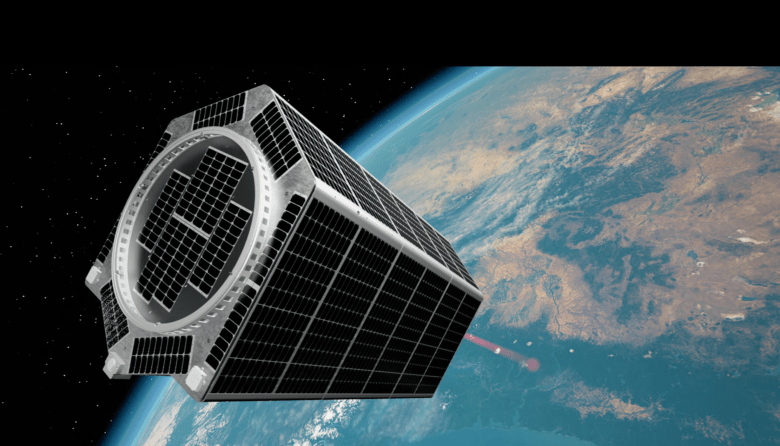
SAN FRANCISCO – Albedo, the former Earth-observation startup now focused on satellite manufacturing, announced plans April 9 to send its second spacecraft into very low-Earth orbit (VLEO).
Vicinity, scheduled to launch in 2027, will deploy solar arrays to provide far more power than the solar panels mounted on Precision, the bus that housed Albedo’s 2025 Clarity-1 mission.
With the launch of Vicinity, Albedo will demonstrate a VLEO spacecraft built for payloads that demand high power like synthetic aperture radar (SAR), electromagnetic warfare and communications, Topher Haddad, Albedo co-founder and CEO, told SpaceNews. “We’ll be able to generate a lot more power with deployed solar arrays, but the satellite will still be purpose-built for the drag and the atomic oxygen in VLEO.”
With a mass of about 300 kilograms, Vicinity is about the same size as Precision. Based on extensive data acquired during Clarity-1’s nine-month mission, Albedo upgraded Vicinity’s flight software and electronics.

Proliferated VLEO
After the 2027 launch, Albedo will gain flight heritage “on our own dime with that new technology including the deployable solar arrays,” Haddad said. Plus, with every VLEO mission, “we learn more and we can improve different things.”
“Clarity-1 proved our Precision bus and demonstrated VLEO imaging,” Albedo said in a news release. “Vicinity will prove a new class of VLEO capability. Once it’s demonstrated, the risk for customers buying Vicinity-class missions drops dramatically.”
Despite pivoting from selling Earth-observation data to satellite manufacturing, Albedo remains focused on VLEO, which “unlocks the ability to capture exquisite-quality data at a price point where you can proliferate it,” Haddad said. “Our vision for the future is that VLEO is just as proliferated as LEO across all the different mission sets.”
In some cases, VLEO constellations will require more satellites than LEO constellations to provide persistent observations or communications. As a result, Albedo is becoming largely vertically integrated in preparation for high-volume production. For example, Albedo uses special coatings and surface treatments to improve the ability of solar panels to withstand atomic oxygen.

Bus, Payload, Turnkey Missions
In addition to selling Precision and Vicinity satellite buses, Albedo will offer optical payloads. Customers also can turn to Albedo for an entire Clarity satellite equipped with high-resolution optical and thermal infrared imaging payloads or a Vicinity bus with a SAR payload.
“If they want the full turnkey VLEO mission with the operations and data processing, we will do that as well,” Haddad said. Other customers may “want to fly these systems in LEO and have the ability to activate into VLEO at a moment’s notice.”
VLEO offers the promise of improved Earth observation and low-latency communications with high link margins. Concerns about congestion in LEO and potential threats have also heightened interest in VLEO among government agencies.
VLEO’s “defense and intelligence value grows as resilience becomes more important,” Haddad said.










Related Posts


Stay Informed With the Latest & Most Important News
Previous Post
Next Post




Advertisement
-
 01Two Black Holes Observed Circling Each Other for the First Time
 -
 02From Polymerization-Enabled Folding and Assembly to Chemical Evolution: Key Processes for Emergence of Functional Polymers in the Origin of Life
 -
 03Astronomy 101: From the Sun and Moon to Wormholes and Warp Drive, Key Theories, Discoveries, and Facts about the Universe (The Adams 101 Series)
 -
 04True Anomaly hires former York Space executive as chief operating officer
 -
 05Φsat-2 begins science phase for AI Earth images
 -
 06Hurricane forecasters are losing 3 key satellites ahead of peak storm season − a meteorologist explains why it matters
 -
 07Binary star systems are complex astronomical objects − a new AI approach could pin down their properties quickly