
Now Reading: Amino Acids as Molecular Linchpins in the Fundamental Prebiotic Processes of RNA Copying and Vesicle Formation
-
01
Amino Acids as Molecular Linchpins in the Fundamental Prebiotic Processes of RNA Copying and Vesicle Formation

Amino Acids as Molecular Linchpins in the Fundamental Prebiotic Processes of RNA Copying and Vesicle Formation

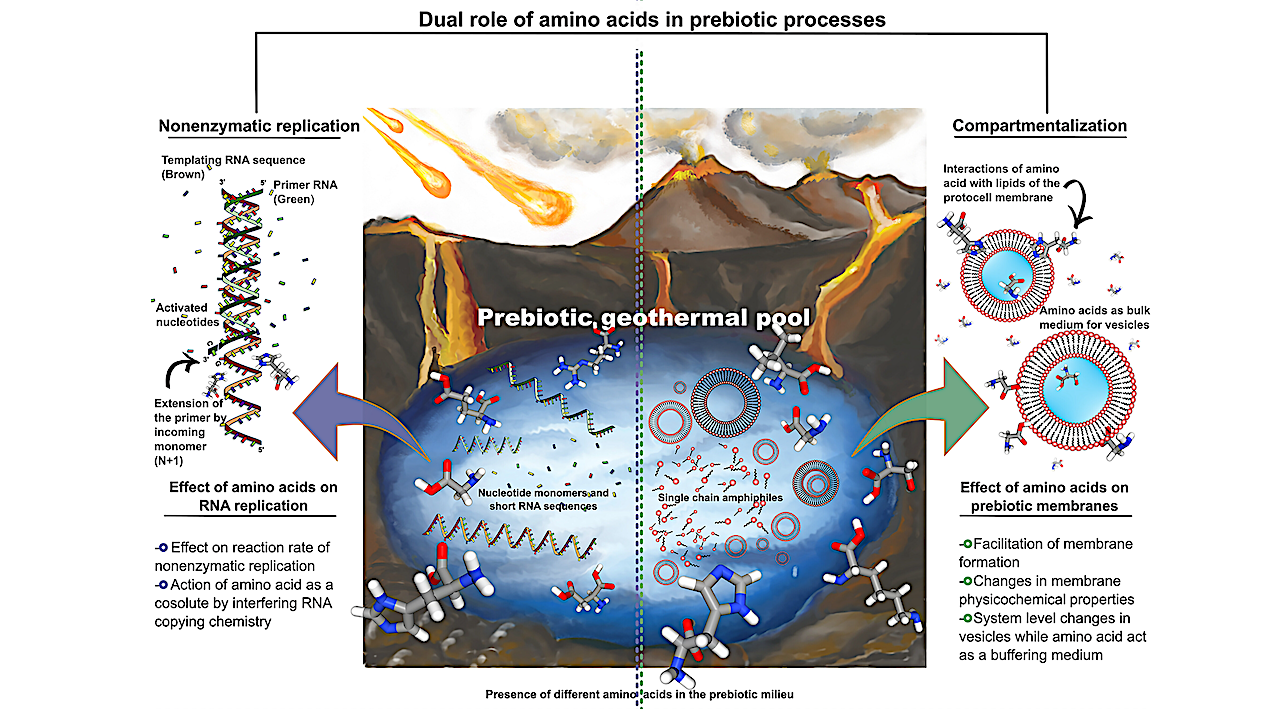
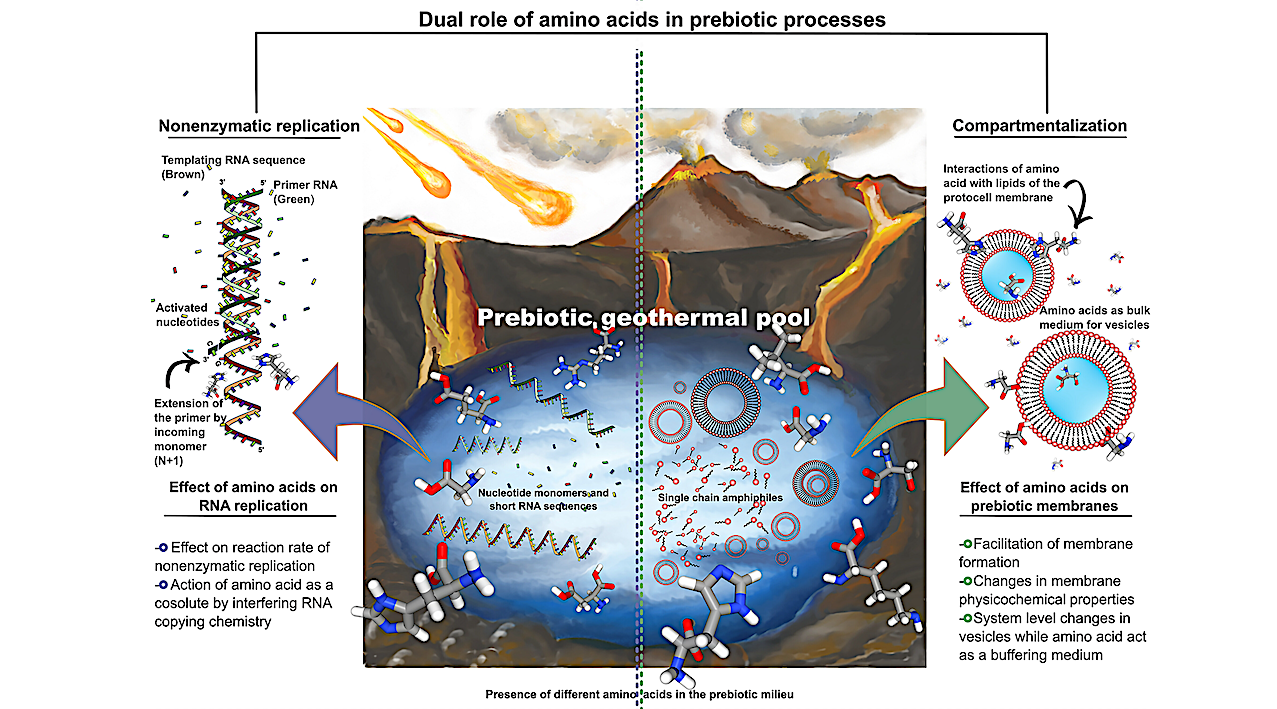
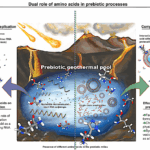
The schematic depiction of the dual role of amino acid monomers in nonenzymatic RNA replication (left panel, blue dotted box) and prebiotic compartmentalization (right panel, green dotted box). The background is of a hypothetical early Earth geothermal pool niche, which depicts molecules in a heterogeneous prebiotic milieu. In the case of nonenzymatic replication (left panel), the coexistence of amino acid monomers (stick models) along with the template sequence and the primer RNA (the brown and green colour strands, respectively, in the RNA cartoon), impacts the incoming monomers’ addition during the copying of information (activated nucleotides, multicoloured floating molecules). In case of prebiotic compartmentalization (right panel), these amino acid monomers act as a buffering agent while coexisting with fatty acids, and facilitate robust vesicle formation even at suboptimal pH. — Astrobiology
In addition to being delivered via exogenous means (e.g., chondritic meteorites and comets), amino acids are hypothesized to have been present on early Earth via Urey–Miller-type abiotic processes.
They conceivably coexisted in the primordial soup with nucleotides/RNA, amphiphiles and other co-solutes, highlighting the importance of characterizing how they would have influenced relevant prebiotic processes.
In previous studies, amino acids have been shown to interact with protocellular moieties and affect nucleotide oligomerization. Nonetheless, the outcome of such interactions on templated-RNA replication, and on the physicochemical properties of protocells made of single-chain amphiphiles, is largely unknown.
In this work, we characterize the role of amino acids as crucial prebiotic co-solutes in RNA copying chemistry. Additionally, we show how amino acids can promote the self-assembly of fatty acid vesicles under suboptimal pH conditions. Overall, our results show that amino acids influence both information copying and compartmentalization, underscoring their importance in shaping the molecular pathways crucial to life’s origin.
In all, this study highlights how interactions between early biomolecular systems would have affected their co-evolution, thus setting the stage for the transition of chemistry to biology on early Earth.
Astrobiology,











Related Posts
Stay Informed With the Latest & Most Important News
Previous Post
Next Post
Advertisement
-
 01Two Black Holes Observed Circling Each Other for the First Time
 -
 02From Polymerization-Enabled Folding and Assembly to Chemical Evolution: Key Processes for Emergence of Functional Polymers in the Origin of Life
 -
 03Astronomy 101: From the Sun and Moon to Wormholes and Warp Drive, Key Theories, Discoveries, and Facts about the Universe (The Adams 101 Series)
 -
 04True Anomaly hires former York Space executive as chief operating officer
 -
 05Φsat-2 begins science phase for AI Earth images
 -
 06Hurricane forecasters are losing 3 key satellites ahead of peak storm season − a meteorologist explains why it matters
 -
 07Binary star systems are complex astronomical objects − a new AI approach could pin down their properties quickly