
Now Reading: An Analytical Framework For Atmospheric Tides On Rocky Planets. I. Formulation
-
01
An Analytical Framework For Atmospheric Tides On Rocky Planets. I. Formulation



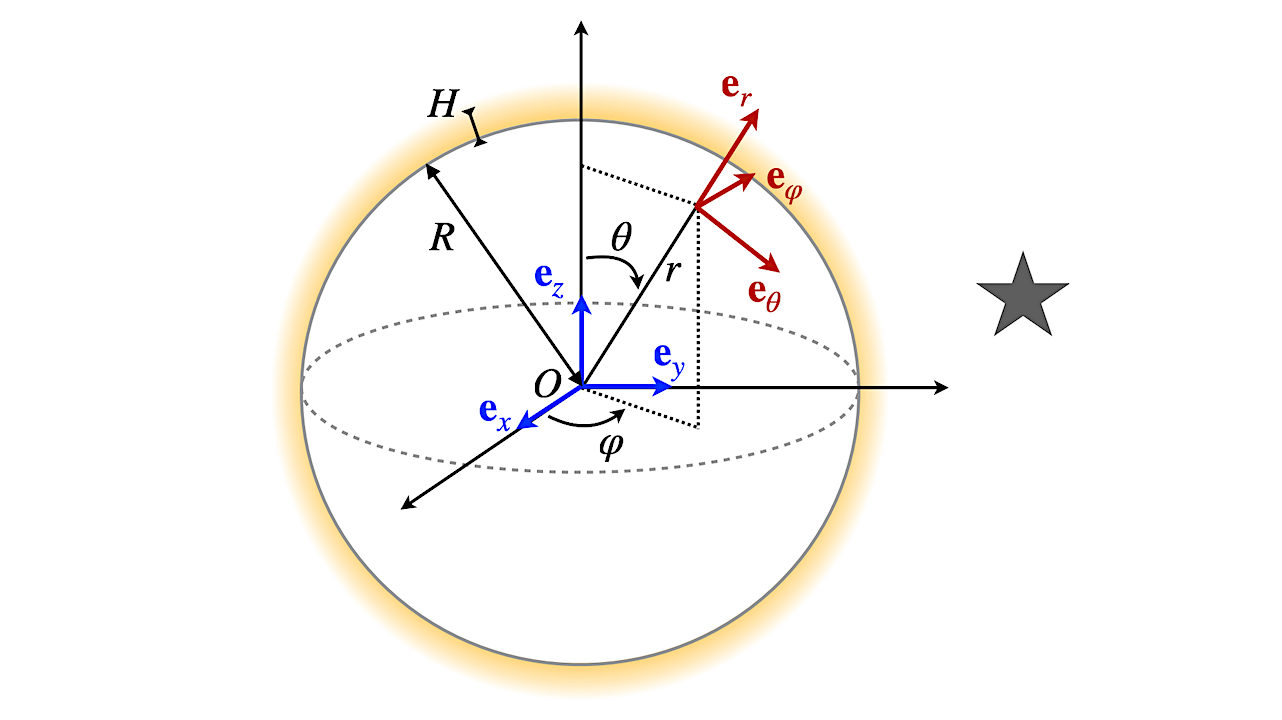
Frame of reference and system of coordinates. Blue arrows denote the Cartesian unit vectors (ex, ey, ez) associated with the frame of reference of the planet, R, and red arrows the unit vector basis (er, eθ, eφ) associated with the standard spherical coordinates (r, θ, φ), with r, θ, and φ being the radial coordinate, the colatitude, and the longitude, respectively. Also are shown the planet’s centre of mass, O, which serves as the origin of R, the planet radius, R, and the pressure height of the atmosphere, H!R. — astro-ph.EP
Atmospheric thermal tides arise from the diurnal contrast in stellar irradiation. They exert a significant influence on the long-term rotational evolution of rocky planets because they can accelerate the planetary spin, thereby counteracting the decelerating effect of classical gravitational tides.
Consequently, equilibrium tide-locked states may emerge, as exemplified by Venus and hypothesised for Precambrian Earth. Quantifying the atmospheric thermal torque and elucidating its dependence on tidal frequency — both in the low- and high-frequency regimes — is therefore essential.
In particular, we focus here on the resonance that affected early Earth, which is associated with a forced Lamb wave. Within the framework of linear theory, we develop a new analytical model of the atmospheric response to both gravitational an thermal tidal forcings for two representative vertical temperature profiles that bracket the atmospheres of rocky planets: (i) an isothermal profile (uniform temperature) and (ii) an isentropic profile (uniform potential temperature). Dissipative processes are incorporated via Newtonian cooling.
We demonstrate that the isothermal and isentropic cases are governed by the same general closed-form solution, and we derive explicit expressions for the three-dimensional tidal fields (pressure, temperature, density and wind velocities) throughout the spherical atmospheric shell.
These results constitute the foundation for two forthcoming papers, in which analytical formulae for the thermotidal torque will be presented and compared with numerical solutions obtained from General Circulation Models (GCMs).
Pierre Auclair-Desrotour, Mohammad Farhat, Gwenaël Boué, Jacques Laskar
Comments: 17 pages, 3 figures, submitted to Astronomy & Astrophysics
Subjects: Earth and Planetary Astrophysics (astro-ph.EP); Atmospheric and Oceanic Physics (physics.ao-ph); Geophysics (physics.geo-ph)
MSC classes: 85-02
Cite as: arXiv:2512.10578 [astro-ph.EP] (or arXiv:2512.10578v1 [astro-ph.EP] for this version)
https://doi.org/10.48550/arXiv.2512.10578
Focus to learn more
Submission history
From: Pierre Auclair-Desrotour
[v1] Thu, 11 Dec 2025 12:07:57 UTC (420 KB)
https://arxiv.org/abs/2512.10578
Astrobiology,











Related Posts
Stay Informed With the Latest & Most Important News
Previous Post
Next Post


Advertisement
-
 01Two Black Holes Observed Circling Each Other for the First Time
 -
 02From Polymerization-Enabled Folding and Assembly to Chemical Evolution: Key Processes for Emergence of Functional Polymers in the Origin of Life
 -
 03Astronomy 101: From the Sun and Moon to Wormholes and Warp Drive, Key Theories, Discoveries, and Facts about the Universe (The Adams 101 Series)
 -
 04True Anomaly hires former York Space executive as chief operating officer
 -
 05Φsat-2 begins science phase for AI Earth images
 -
 06Hurricane forecasters are losing 3 key satellites ahead of peak storm season − a meteorologist explains why it matters
 -
 07Binary star systems are complex astronomical objects − a new AI approach could pin down their properties quickly