
Now Reading: An astronaut’s tiny stand-in: tissue chips in space health
-
01
An astronaut’s tiny stand-in: tissue chips in space health


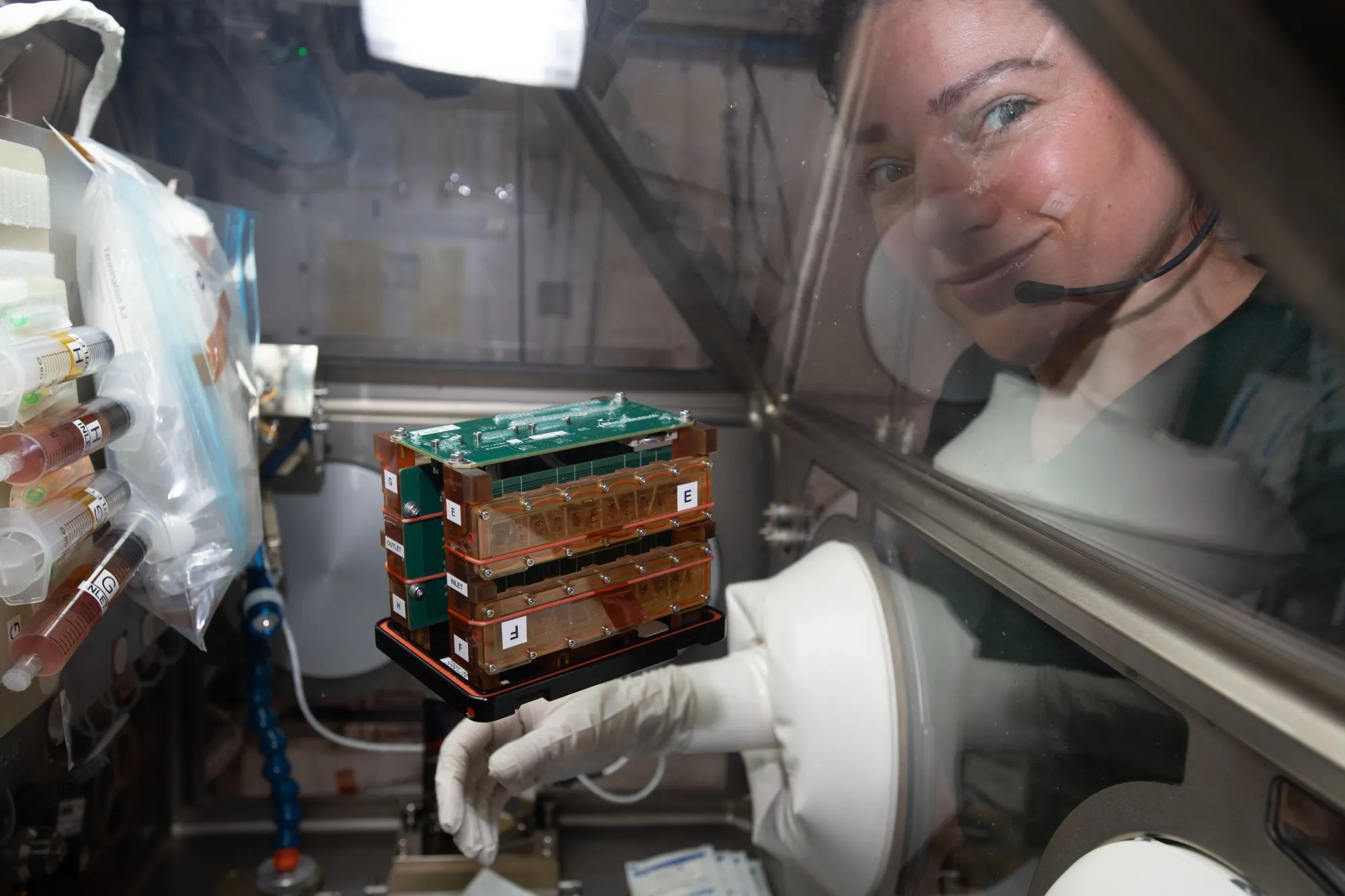

Before you ever set foot on a spacecraft bound for deep space, tiny replicas of your organs might make the journey first. Suspended in microgravity aboard a research mission, this organ-on-a-chip, or tissue chip, engineered from your own cells, could reveal how your body will respond to cosmic radiation and the weightlessness of space. As humanity pushes beyond Earth’s orbit, our biomedical tools must evolve to meet the need. These miniature organ systems could transform how we prepare astronauts for the unknown, but only if NASA leads the investment in developing autonomous, standardized tissue-chip platforms capable of operating in deep space, with universities and private partners contributing to their design and scientific use.
As the scientific research director for the Translational Research Institute for Space Health (TRISH), I lead initiatives aimed at minimizing the health risks to astronauts venturing into deep space. NASA’s Artemis mission plans will place explorers in lunar orbit and on the moon’s surface, with exposure durations to space hazards greatly exceeding prior Apollo programs. In particular, the risk of long-term, cosmic radiation exposure represents an important unknown because it cannot be effectively shielded or realistically studied here on Earth or on the International Space Station (ISS) in low Earth orbit (LEO).
Space health researchers must have the tools to study the effects of long-duration and deep space exposure, as well as test ways to prevent and mitigate its negative effects, without increasing risk to crews. Tissue chips provide a safer, more efficient and potentially cost-effective way to study spaceflight risks and test countermeasures.
NASA and partner research institutes have already sent such chips into space to understand the effects of microgravity, but TRISH is innovating on the next step in unlocking the full potential of astronaut-on-a-chip systems, by focusing on countermeasure testing and analyzing dose response to ensure explorers are appropriately prepared for the stressors of outer space. By removing astronauts from the equation, we also manage the problem of the pending reduction in crewed flights and ISS’ decommission.
Pulse on a chip
Microphysiological systems (MPS), also known as tissue chips, are miniature, lab-grown models of human tissues or organs designed to replicate key aspects of structure and function. Developed at the intersection of bioengineering and cell biology, these small but powerful platforms allow researchers to study human physiology outside the body.
The concept emerged in the early 2010s with the goal of being a more accurate alternative to animal models. The first lung-on-a-chip was made of flexible, transparent polymer containing human lung cells and recreated the breathing motion of the lung by applying mechanical forces, opening the door for more diversified, reliable and human-relevant models for drug testing and toxicity screening.
Recent advances have also enabled the creation of multi-organ models, which is key to understanding integrated effects and testing ways to keep humans healthy in space.
Sending chips in space
Although biomedical research has been a part of space exploration since its inception, opportunities remain limited due to constrained research facilities and the valuable time of small mission astronaut crews. For decades, space health research has relied on critical yet limited astronaut samples and animal models to decipher human responses to spaceflight. Yet, nearly 90% of clinical trials fail despite promising results in mouse models. Obtaining biological samples from astronauts can be challenging, and while mouse models have played a crucial role, the inherent interspecies variations often limit directly translating findings to humans.
The Artemis missions will send astronauts into deep-space radiation environments for longer than any humans have experienced in half a century. Yet the tools we rely on to study those risks remain constrained by crew time, limited facilities and Earth-bound analysis. If exploration is accelerating, our biomedical research models must accelerate with it.
Astronaut-on-a-chip models offer a platform to study biological changes at a sophisticated tissue level without relying on animal tissues, the limited availability of astronaut samples, or returning them to Earth for analysis. Something as unassuming as a shoebox in an unmanned spaceship storing tissue chips could be the key to unlocking the most effective radiation countermeasure.
The push to enable tissue chip research in space began nearly a decade ago with the Microphysiological Systems Program for Translational Research in Space, a partnership between the National Institutes of Health’s National Center for Advancing Translational Sciences and the Center for the Advancement of Science in Space. This early work demonstrated the feasibility of sending advanced biological systems into orbit, laying the groundwork for the sophisticated models we develop today.
Building on these foundational studies, TRISH has funded multiple initiatives aimed at using MPS to study the effects of space radiation and evaluate potential human health countermeasures. While ongoing research in this field now focuses on enhancing the longevity of tissue chips and their utility in studying aging and disease, TRISH is pioneering the next step: using these systems to test and analyze response to countermeasures.
Through our Science ENterprise to INform Exploration Limits (SENTINEL) initiative, we are funding the development of a multi-tissue system focused on radiation dose response with the potential for automation in the future. This next-generation system is designed to analyze how tissues respond to different radiation doses, forming a knowledge base to screen countermeasures for astronauts back on Earth.
To enable humans to venture to Mars, we must, in particular, understand the effects of radiation on biology in the real space environment. This is why the standardization of tissue chips through the SENTINEL program will be critical for conducting studies beyond LEO. Personalized countermeasure strategies can then not only be tested in space but also on the individual astronaut’s own cells. Ultimately, these advancements will progress other remote scientific and medical capabilities required for effective missions to the Moon, Mars, and even here on Earth.
Your spacefaring sentinel
It is not the stuff of science fiction to imagine sending a tiny version of yourself ahead to space, not as a hologram or clone, but as a tissue chip engineered from your own cells. A personal “sentinel” could preview how space travel might affect your body before you ever leave Earth, test radiation countermeasures and evaluate which one works best for you.
If we are serious about sustainable exploration beyond LEO, NASA must lead the investment in autonomous, standardized, deep-space-ready tissue-chip platforms capable of operating independently and generating actionable data in situ, with universities and private partners helping develop and test the technology.
And beyond spaceflight, these bio-analogs could revolutionize medicine on the ground, allowing doctors to trial treatments on “you,” without risking real-world adverse outcomes. As space exploration rapidly advances, we must remember that the advancement of space health is also about ensuring that our solutions are sustainable and benefiting all humans, wherever they explore.
Rihana Bokhari is the scientific research director at the Translational Research Institute for Space Health.
SpaceNews is committed to publishing our community’s diverse perspectives. Whether you’re an academic, executive, engineer or even just a concerned citizen of the cosmos, send your arguments and viewpoints to opinion (at) spacenews.com to be considered for publication online or in our next magazine. If you have something to submit, read some of our recent opinion articles and our submission guidelines to get a sense of what we’re looking for. The perspectives shared in these opinion articles are solely those of the authors and do not necessarily represent their employers or professional affiliations.










Related Posts

Stay Informed With the Latest & Most Important News
Previous Post
Next Post

Advertisement
-
 01Two Black Holes Observed Circling Each Other for the First Time
 -
 02From Polymerization-Enabled Folding and Assembly to Chemical Evolution: Key Processes for Emergence of Functional Polymers in the Origin of Life
 -
 03Astronomy 101: From the Sun and Moon to Wormholes and Warp Drive, Key Theories, Discoveries, and Facts about the Universe (The Adams 101 Series)
 -
 04True Anomaly hires former York Space executive as chief operating officer
 -
 05Φsat-2 begins science phase for AI Earth images
 -
 06Hurricane forecasters are losing 3 key satellites ahead of peak storm season − a meteorologist explains why it matters
 -
 07Binary star systems are complex astronomical objects − a new AI approach could pin down their properties quickly