
Now Reading: An Improved Machine Learning Approach for RFI Mitigation in FAST-SETI Survey Archival Data
-
01
An Improved Machine Learning Approach for RFI Mitigation in FAST-SETI Survey Archival Data

An Improved Machine Learning Approach for RFI Mitigation in FAST-SETI Survey Archival Data

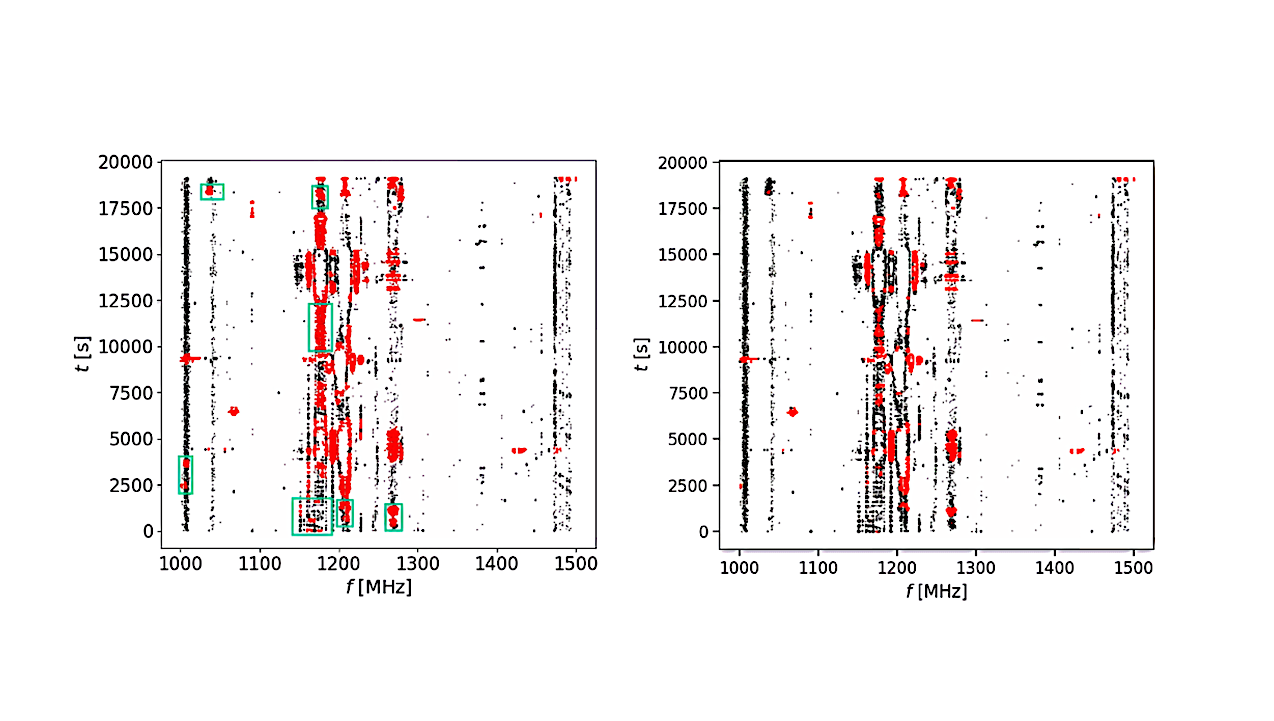
Comparison result between the DBSCAN algorithm and the KNN algorithm for residual RFI mitigation. Data points marked in red represent signals identified and removed as residual RFI, while those in black are retained hits. The left panel shows the waterfall plot after applying the DBSCAN algorithm, demonstrating a residual RFI removal rate of 77.87%. The right panel displays the waterfall plot of the same dataset using the KNN algorithm, achieving a 70.43% removal rate (Y.-C. Wang et al. 2023). Notably, the green boxes in the left panel highlight RFI that DBSCAN effectively mitigation but KNN fails to identify, accounting for approximately 7.44%. — astro-ph.IM
The search for extraterrestrial intelligence (SETI) commensal surveys aim to scan the sky to detect technosignatures from extraterrestrial life.
A major challenge in SETI is the effective mitigation of radio frequency interference (RFI), a critical step that is particularly vital for the highly sensitive Five-hundred-meter Aperture Spherical radio Telescope (FAST).
While initial RFI mitigation (e.g., removal of persistent and drifting narrowband RFI) are essential, residual RFI often persists, posing significant challenges due to its complex and various nature.
In this paper, we propose and apply an improved machine learning approach, the Density-Based Spatial Clustering of Applications with Noise (DBSCAN) algorithm, to identify and mitigate residual RFI in FAST-SETI commensal survey archival data from July 2019. After initial RFI mitigation, we successfully identify and remove 36977 residual RFIs (accounting for ∼ 77.87%) within approximately 1.678 seconds using the DBSCAN algorithm.
This result shows that we have achieved a 7.44% higher removal rate than previous machine learning methods, along with a 24.85% reduction in execution time. We finally find interesting candidate signals consistent with previous studies, and retain one candidate signal following further analysis. Therefore, DBSCAN algorithm can mitigate more residual RFI with higher computational efficiency while preserving the candidate signals that we are interested in.
Li-Li Zhao, Xiao-Hang Luan, Xin Chao, Yu-Chen Wang, Jian-Kang Li, Zhen-Zhao Tao, Tong-Jie Zhang, Hong-Feng Wang, Dan Werthimer
Comments: 14 pages, 2 tables, 8 figures, accepted for publication in The Astronomical Journal
Subjects: Instrumentation and Methods for Astrophysics (astro-ph.IM)
Cite as: arXiv:2512.15809 [astro-ph.IM](or arXiv:2512.15809v1 [astro-ph.IM] for this version)
https://doi.org/10.48550/arXiv.2512.15809
Focus to learn more
Submission history
From: Zhenzhao Tao
[v1] Wed, 17 Dec 2025 09:32:45 UTC (3,360 KB)
https://arxiv.org/abs/2512.15809
Astrobiology, SETI, AI,










Related Posts

Stay Informed With the Latest & Most Important News
Previous Post
Next Post




Advertisement
-
 01Two Black Holes Observed Circling Each Other for the First Time
 -
 02From Polymerization-Enabled Folding and Assembly to Chemical Evolution: Key Processes for Emergence of Functional Polymers in the Origin of Life
 -
 03Astronomy 101: From the Sun and Moon to Wormholes and Warp Drive, Key Theories, Discoveries, and Facts about the Universe (The Adams 101 Series)
 -
 04True Anomaly hires former York Space executive as chief operating officer
 -
 05Φsat-2 begins science phase for AI Earth images
 -
 06Hurricane forecasters are losing 3 key satellites ahead of peak storm season − a meteorologist explains why it matters
 -
 07Binary star systems are complex astronomical objects − a new AI approach could pin down their properties quickly