
Now Reading: Anatomy Of Empirical Transit Spectra Of Mars Based On TGO/NOMAD
-
01
Anatomy Of Empirical Transit Spectra Of Mars Based On TGO/NOMAD


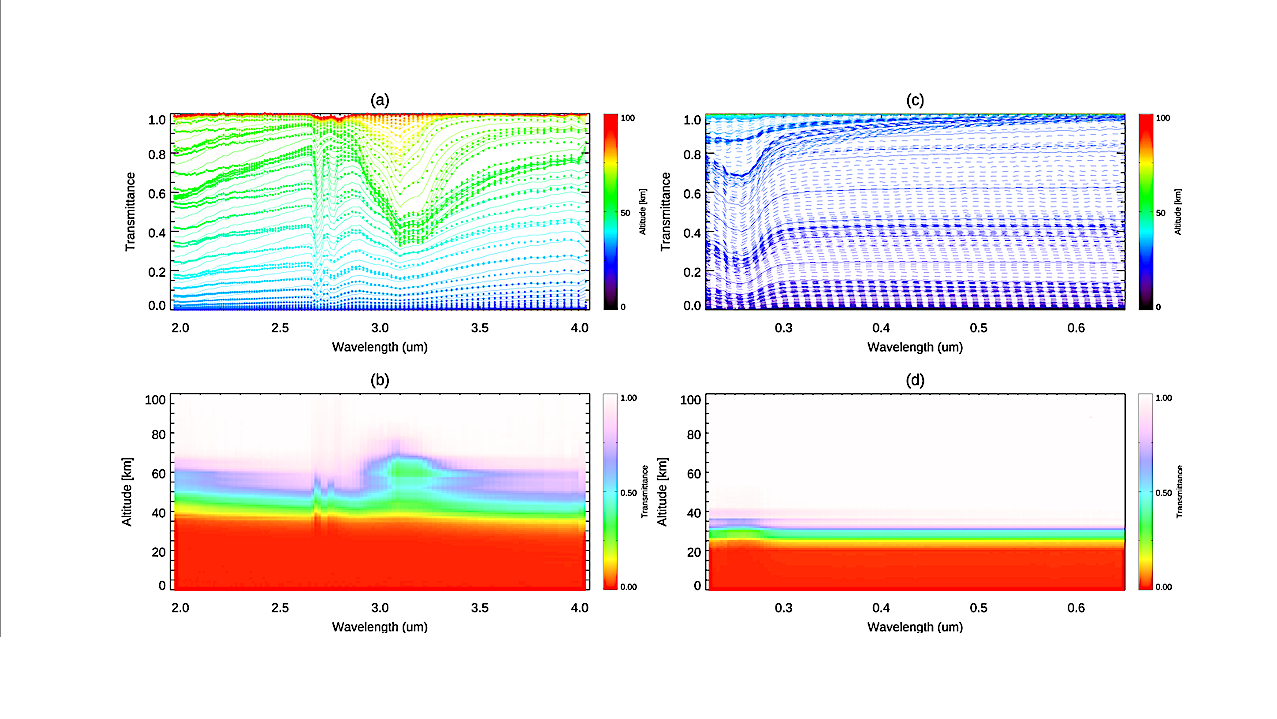

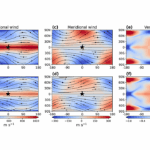
(a,b) An example of the transmittance spectra taken with the full-scan mode of the SO channel of TGO/NOMAD. (c,d) An example of the transmittance spectra taken with the full-scan mode of the UVIS channel. — astro-ph.EP
Transit spectroscopy is a powerful tool for probing atmospheric structures of exoplanets. Accurately accounting for the effects of aerosols is key to reconstructing atmospheric properties from transit spectra, yet this remains a significant challenge. To advance this effort, it is invaluable to examine the spectral features of well-characterized planetary atmospheres.
Here, we synthesize empirical transit spectra of Mars across different seasons based on data from the NOMAD’s Solar Occultation channel onboard ExoMars/TGO, which operates at wavelengths of 0.2-0.65 and 2-4 micron. In the generated empirical transit spectra, the atmosphere below 25 km is found to be largely opaque due to the presence of micron-sized dust and water ice clouds, both of which substantially weaken spectral features.
The spectra exhibit CO2 absorption features at 2.7-2.8 micron and signatures of sub-micron-sized mesospheric water ice clouds around 3.1 micron, accompanied by a continuum slope. The amplitudes of these spectral features are found to vary with the Martian seasons, where the dust storms weaken the CO2 signatures and strengthen the water ice features, which serve as potential indicators of a dusty planet like Mars.
If TRAPPIST-1f possessed a Mars-like atmospheric structure, both CO2 and water ice features would be detectable at a noise level of 3 ppm, a level likely beyond current observational capabilities.
Nevertheless, the 3.1 micron feature produced by sub-micron-sized mesospheric water ice clouds offers a novel avenue for characterizing the atmospheres of habitable-zone exoplanets.
Shohei Aoki, Yuka Fujii, Hideo Sagawa, Geronimo L. Villanueva, Ian Thomas, Bojan Ristic, Frank Daerden, Miguel Angel López-Valverde, Manish R. Patel, Jonathon Mason, Yannick Willame, Giancarlo Bellucci, Ann Carine Vandaele
Comments: 24 pages, 10 figures, Submitted to AAS Journals
Subjects: Earth and Planetary Astrophysics (astro-ph.EP); Instrumentation and Methods for Astrophysics (astro-ph.IM); Solar and Stellar Astrophysics (astro-ph.SR)
Cite as: arXiv:2601.08397 [astro-ph.EP] (or arXiv:2601.08397v1 [astro-ph.EP] for this version)
https://doi.org/10.48550/arXiv.2601.08397
Focus to learn more
Submission history
From: Shohei Aoki
[v1] Tue, 13 Jan 2026 10:05:41 UTC (4,619 KB)
https://arxiv.org/abs/2601.08397
Astrobiology,










Related Posts
Stay Informed With the Latest & Most Important News
Previous Post
Next Post

Advertisement
-
 01Two Black Holes Observed Circling Each Other for the First Time
 -
 02From Polymerization-Enabled Folding and Assembly to Chemical Evolution: Key Processes for Emergence of Functional Polymers in the Origin of Life
 -
 03Astronomy 101: From the Sun and Moon to Wormholes and Warp Drive, Key Theories, Discoveries, and Facts about the Universe (The Adams 101 Series)
 -
 04True Anomaly hires former York Space executive as chief operating officer
 -
 05Φsat-2 begins science phase for AI Earth images
 -
 06Hurricane forecasters are losing 3 key satellites ahead of peak storm season − a meteorologist explains why it matters
 -
 07Binary star systems are complex astronomical objects − a new AI approach could pin down their properties quickly