
Now Reading: Apex to develop larger satellites for missile defense, space-based computing
-
01
Apex to develop larger satellites for missile defense, space-based computing



This story was updated with additional details about the Comet product line
WASHINGTON — Apex, a Los Angeles–based satellite manufacturer, is moving to build larger and more powerful spacecraft, signaling a shift in demand toward energy-intensive missions such as orbital computing and missile defense.
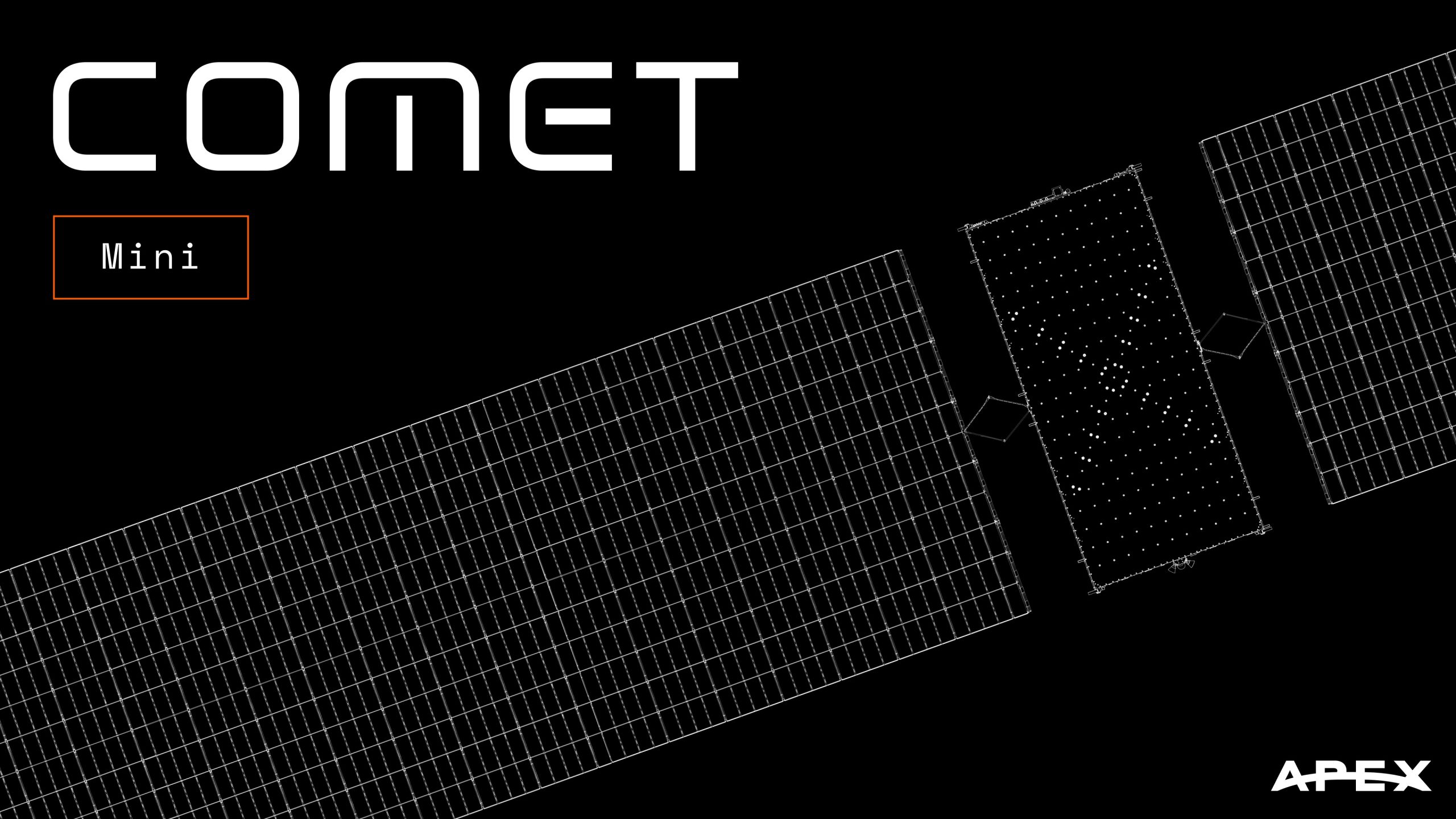
The company said April 9 it is developing two variants of its Comet satellite bus — Comet Mini and Comet XL.
Ian Cinnamon, co-founder and chief executive, said the new models are designed for the “most demanding next-generation payloads that require higher power and more mass.”
“Last year, we unveiled Comet,” he said in a statement. “Today, as we work towards our 2028 readiness timeline, we are excited to announce more details about the platform. Comet comes in two versions: Mini and Comet XL.”
Cinnamon explained that Comet Mini is optimized for a five-meter fairing like a Falcon 9, while XL is built for Starship. “Both build on our work with Aries and Nova, allowing us to utilize our vertically integrated supply chain and lower the price point of power and mass significantly. With the two Comet variants, Apex is able to meet the growing demand for orbital data centers and high end government missions.”
Across the industry, companies are exploring orbital data centers, which would process data in space rather than on the ground. Those systems require significantly more onboard power to run processors continuously, manage heat and transmit large volumes of data back to Earth.
At the same time, the Pentagon’s Golden Dome missile defense architecture is driving interest in satellites capable of hosting interceptors. Those spacecraft would need to support persistent sensing, real-time tracking and rapid command-and-control, while also carrying and managing interceptor payloads.
Both applications are pushing satellite design toward higher power generation and greater mass capacity, areas where traditional small satellite platforms have been limited.
Scaling up Comet
Apex’s existing lineup — Aries, Nova and Comet — was designed to support payloads ranging from roughly 100 to 500 kilograms.
The Comet Mini is designed for flexible launch configurations. In a stacked arrangement, 16 satellites carrying 450-kilogram payloads could launch on a Falcon 9, or eight satellites carrying 1,000 kilograms each. Custom configurations could support payloads of up to 3,000 kilograms, according to the company.
The spacecraft would generate about 20 kilowatts of power, four times the output of the current Comet platform.
A future Comet XL would be larger still, designed for super-heavy lift vehicles such as Starship, with expected peak power of up to 100 kilowatts. Apex said more details on Comet XL configuration specs are “coming soon.”
Founded in 2022, Apex is positioning itself as a high-volume manufacturer of satellites for defense and commercial customers. The company is also pursuing international opportunities.
It has raised multiple rounds of venture funding, including a recent Series D that valued the company at more than $1 billion.
A company spokesperson said Apex cannot yet comment on specific customers for the Comet platform.










Related Posts


Stay Informed With the Latest & Most Important News
Previous Post
Next Post



Advertisement
-
 01Two Black Holes Observed Circling Each Other for the First Time
 -
 02From Polymerization-Enabled Folding and Assembly to Chemical Evolution: Key Processes for Emergence of Functional Polymers in the Origin of Life
 -
 03Astronomy 101: From the Sun and Moon to Wormholes and Warp Drive, Key Theories, Discoveries, and Facts about the Universe (The Adams 101 Series)
 -
 04True Anomaly hires former York Space executive as chief operating officer
 -
 05Φsat-2 begins science phase for AI Earth images
 -
 06Hurricane forecasters are losing 3 key satellites ahead of peak storm season − a meteorologist explains why it matters
 -
 07Binary star systems are complex astronomical objects − a new AI approach could pin down their properties quickly