
Now Reading: Are Uranus and Neptune rock giants and not ice giants?
-
01
Are Uranus and Neptune rock giants and not ice giants?



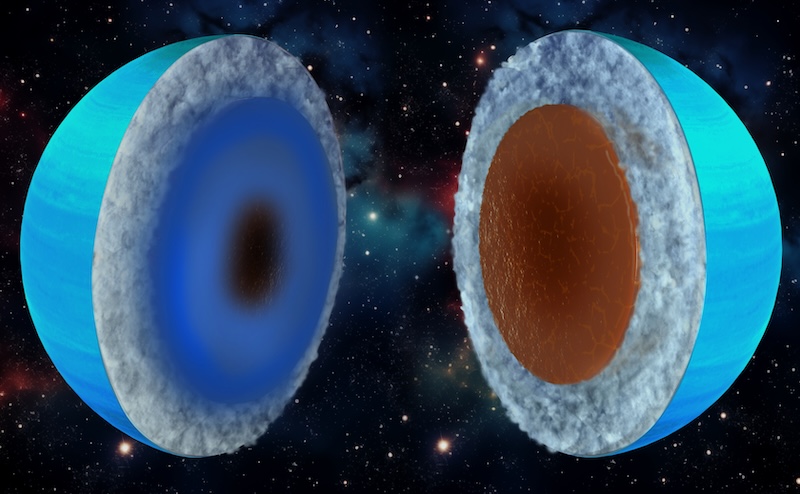
- Uranus and Neptune are known as the “ice giants” in the solar system. Scientists have long thought their interiors are composed mostly of ice. But is that accurate?
- Both planets might instead be rock giants, new research suggests. Their interiors would be much more rocky than previously thought.
- The study doesn’t make any definitive conclusions. But it does expand the possibilities for what Uranus and Neptune are like on the inside.
EarthSky’s 2026 lunar calendar is available now. Get yours today! Makes a great gift.
Uranus and Neptune: Ice giants or rock giants?
Astronomers sort the planets in our solar system into three categories: rocky planets, gas giants and ice giants. Mercury, Venus, Earth and Mars are the rocky planets. Jupiter and Saturn are the gas giants. And Uranus and Neptune are considered ice giants, with volatile materials heavier than hydrogen and helium – such as water, ammonia or methane – in their interiors. But researchers from the University of Zurich and NCCR PlanetS in Switzerland said on December 10, 2025, that Uranus and Neptune might be more rocky than icy on the inside. Could they be rock giants instead of ice giants?
Notably, the new study doesn’t say Uranus and Neptune must be either ice giants or rock giants. Rather, it makes the case that the long-held view of them being ice giants isn’t the only possibility.
The new peer-reviewed paper was published online in Astronomy & Astrophysics on December 10, 2025.
Zurich Univ. press release: Uranus and Neptune might be rock giants www.news.uzh.ch/en/articles/…Article by Morf & Helled: www.aanda.org/10.1051/0004…
— Astronomy & Astrophysics (@aanda-journal.bsky.social) 2025-12-19T08:28:09.935Z
Challenging previous assumptions
The long-held view of Uranus and Neptune is that they are ice giants. This assumes ice makes up the bulk of their interior composition, beneath their deep atmospheres. But is that the only possibility? Perhaps not.
The new study expands the possible interior structures of Uranus and Neptune. It doesn’t claim that any one particular model is correct. But it does increase the range of possibilities. Lead author Luca Morf at the University of Zurich and NCCR PlanetS said calling them ice giants might be too simplified:
The ice giant classification is oversimplified, as Uranus and Neptune are still poorly understood. Models based on physics were too assumption-heavy, while empirical models are too simplistic. We combined both approaches to get interior models that are both ‘agnostic’ or unbiased and yet are physically consistent.

Ice-rich or rock-rich?
The researchers took a new approach to assessing what the interiors of Uranus and Neptune are like. First, they used a random density profile for the planetary interior. Then they calculated the planetary gravitational field that is consistent with observational data. By doing so, they could infer a possible interior composition. Lastly, they repeated the process to obtain the best possible match between the models and the observational data.
The results were intriguing. They suggested that an icy interior is just one possibility. Both Uranus and Neptune could be either ice-rich or rock-rich on the inside. They also support what the researchers first proposed 15 years ago. Co-author Ravit Helled at the University of Zurich said:
It is something that we first suggested nearly 15 years ago, and now we have the numerical framework to demonstrate it.
Questions remain
The rock giant scenario isn’t conclusive yet. Questions remain, as Morf noted:
One of the main issues is that physicists still barely understand how materials behave under the exotic conditions of pressure and temperature found at the heart of a planet, this could impact our results.
Uranus and Neptune could still be either ice giants or rock giants. Helled added:
Both Uranus and Neptune could be rock giants or ice giants depending on the model assumptions. Current data are currently insufficient to distinguish the two, and we therefore need dedicated missions to Uranus and Neptune that can reveal their true nature.

New clues about Uranus’ and Neptune’s magnetic fields
The findings also shed new light on Uranus’ and Neptune’s unusual magnetic fields. They are more complex than Earth’s, since they have more than two poles. Earth, on the other hand, simply has a magnetic North Pole and magnetic South Pole. As Helled explained:
Our models have so-called ‘ionic water’ layers which generate magnetic dynamos in locations that explain the observed non-dipolar magnetic fields. We also found that Uranus’ magnetic field originates deeper than Neptune’s.
There are currently no new missions being developed yet to return to Uranus or Neptune. The last visit was by Voyager 2 in the late 1980s. So, in the meantime scientists will continue to study the data from the old Voyager missions and from current telescopes to try to better understand these mysterious worlds.
Bottom line: Are Uranus and Neptune really ice giants as scientists have long thought? A new study suggests they might be much more rocky instead of icy on the inside.
Source: Icy or rocky? Convective or stable? New interior models of Uranus and Neptune
Read more: Are Uranus and Neptune hiding oceans of water?
Read more: True colors of Uranus and Neptune in newly processed images
The post Are Uranus and Neptune rock giants and not ice giants? first appeared on EarthSky.










Related Posts
Stay Informed With the Latest & Most Important News
Previous Post
Next Post




Advertisement
-
 01Two Black Holes Observed Circling Each Other for the First Time
 -
 02From Polymerization-Enabled Folding and Assembly to Chemical Evolution: Key Processes for Emergence of Functional Polymers in the Origin of Life
 -
 03Astronomy 101: From the Sun and Moon to Wormholes and Warp Drive, Key Theories, Discoveries, and Facts about the Universe (The Adams 101 Series)
 -
 04True Anomaly hires former York Space executive as chief operating officer
 -
 05Φsat-2 begins science phase for AI Earth images
 -
 06Hurricane forecasters are losing 3 key satellites ahead of peak storm season − a meteorologist explains why it matters
 -
 07Binary star systems are complex astronomical objects − a new AI approach could pin down their properties quickly