
Now Reading: Ariane 6 launches Galileo navigation satellites
-
01
Ariane 6 launches Galileo navigation satellites


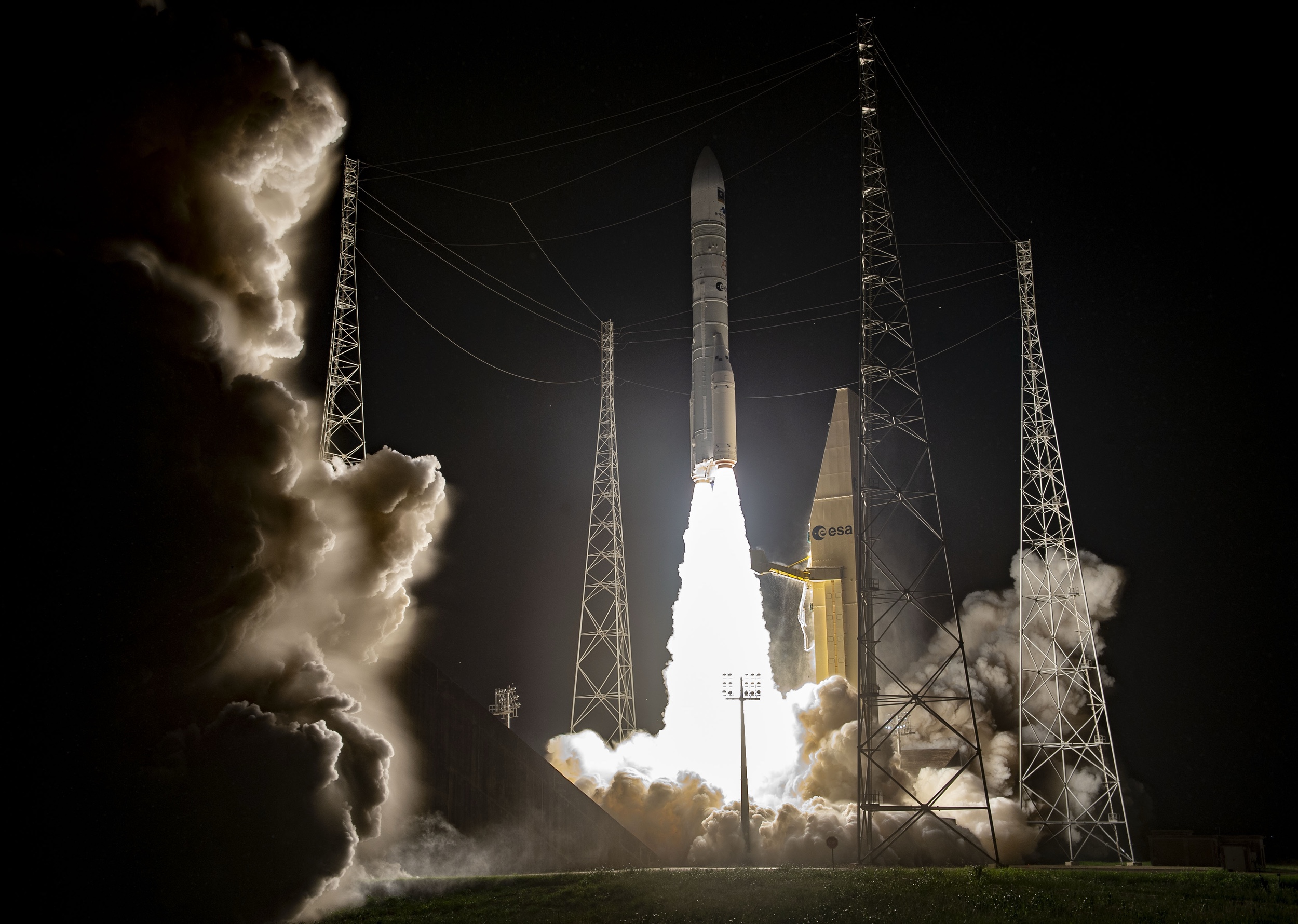

WASHINGTON — An Ariane 6 rocket placed two satellites for Europe’s Galileo navigation system into orbit Dec. 17.
An Ariane 62 lifted off from the European spaceport in Kourou, French Guiana, at 12:01 a.m. Eastern. The payload consisted of two Galileo navigation satellites, built by OHB for the European Commission and the European Space Agency.
After a second burn of its Vinci engine, the Ariane 6 upper stage deployed the two satellites, designated SAT 33 and SAT 34, into medium Earth orbit at an altitude of about 22,900 kilometers, three hours and 55 minutes after liftoff.
This was the fourth Ariane 6 launch this year and the fifth overall. It was also the first Ariane 6 mission to carry Galileo satellites, one of the rocket’s major institutional customers.
Delays in the development of Ariane 6, part of a broader European “launcher crisis,” forced the European Commission to turn to SpaceX to launch two pairs of Galileo satellites in 2024 on Falcon 9 rockets. In one case, European officials avoided naming the Falcon 9 when announcing the successful launch of the spacecraft.
For this mission, officials highlighted the “resilience” of European space capabilities as Galileo launches resumed on European rockets.
“Galileo stands as the world’s most accurate global navigation satellite system, and today we have increased its reliability and robustness,” ESA Director General Josef Aschbacher said in a statement. “Its successful launch aboard Ariane 6 from Europe’s spaceport in Kourou reaffirms not only Europe’s ambition, but also its industrial capability to design, build, launch and operate critical space infrastructure autonomously.”
“As the first launch of Ariane 6 for the Galileo program, the launcher, which perfectly placed the Galileo SAT 33 and SAT 34 satellites into orbit, once again demonstrates its reliability and precision,” David Cavaillolès, chief executive of Arianespace, said in a company statement. “This success strengthens the performance and resilience of Europe’s own navigation system.”
The launch carried the last two of 34 first-generation Galileo satellites built by OHB. Four of those 34 satellites, completed earlier, are in storage and are expected to launch on two Ariane 62 missions in the next 12 to 16 months, Andrea Cotellessa, head of the Galileo space segment management office at ESA, said during a prelaunch briefing.
After that, ESA and the European Commission will transition to a second generation of Galileo satellites. Airbus Defence and Space and Thales Alenia Space will each build six of the new spacecraft, which will feature software-defined payloads to enable new services and greater robustness, he said.
The second-generation satellites will be significantly larger, weighing about 2,500 kilograms, more than three times the mass of the current satellites, which weigh about 730 kilograms each. The satellites will continue to launch two at a time on Ariane 62 rockets but will use electric propulsion to reach their final orbits after deployment, a process expected to take about six months.
The next Ariane 6 launch is expected to be the debut of the Ariane 64, which uses four solid rocket boosters rather than the two used on Ariane 62. That mission, planned for early next year, will carry 32 Amazon Leo broadband constellation satellites and will be the first of 18 Ariane 6 launches planned for the constellation. Amazon said Dec. 9 it shipped the satellites to French Guiana for prelaunch preparations.










Related Posts
Stay Informed With the Latest & Most Important News
Previous Post
Next Post

Advertisement
-
 01Two Black Holes Observed Circling Each Other for the First Time
 -
 02From Polymerization-Enabled Folding and Assembly to Chemical Evolution: Key Processes for Emergence of Functional Polymers in the Origin of Life
 -
 03Astronomy 101: From the Sun and Moon to Wormholes and Warp Drive, Key Theories, Discoveries, and Facts about the Universe (The Adams 101 Series)
 -
 04True Anomaly hires former York Space executive as chief operating officer
 -
 05Φsat-2 begins science phase for AI Earth images
 -
 06Hurricane forecasters are losing 3 key satellites ahead of peak storm season − a meteorologist explains why it matters
 -
 07Binary star systems are complex astronomical objects − a new AI approach could pin down their properties quickly