
Now Reading: Arianespace to begin Amazon Leo launches in February
-
01
Arianespace to begin Amazon Leo launches in February


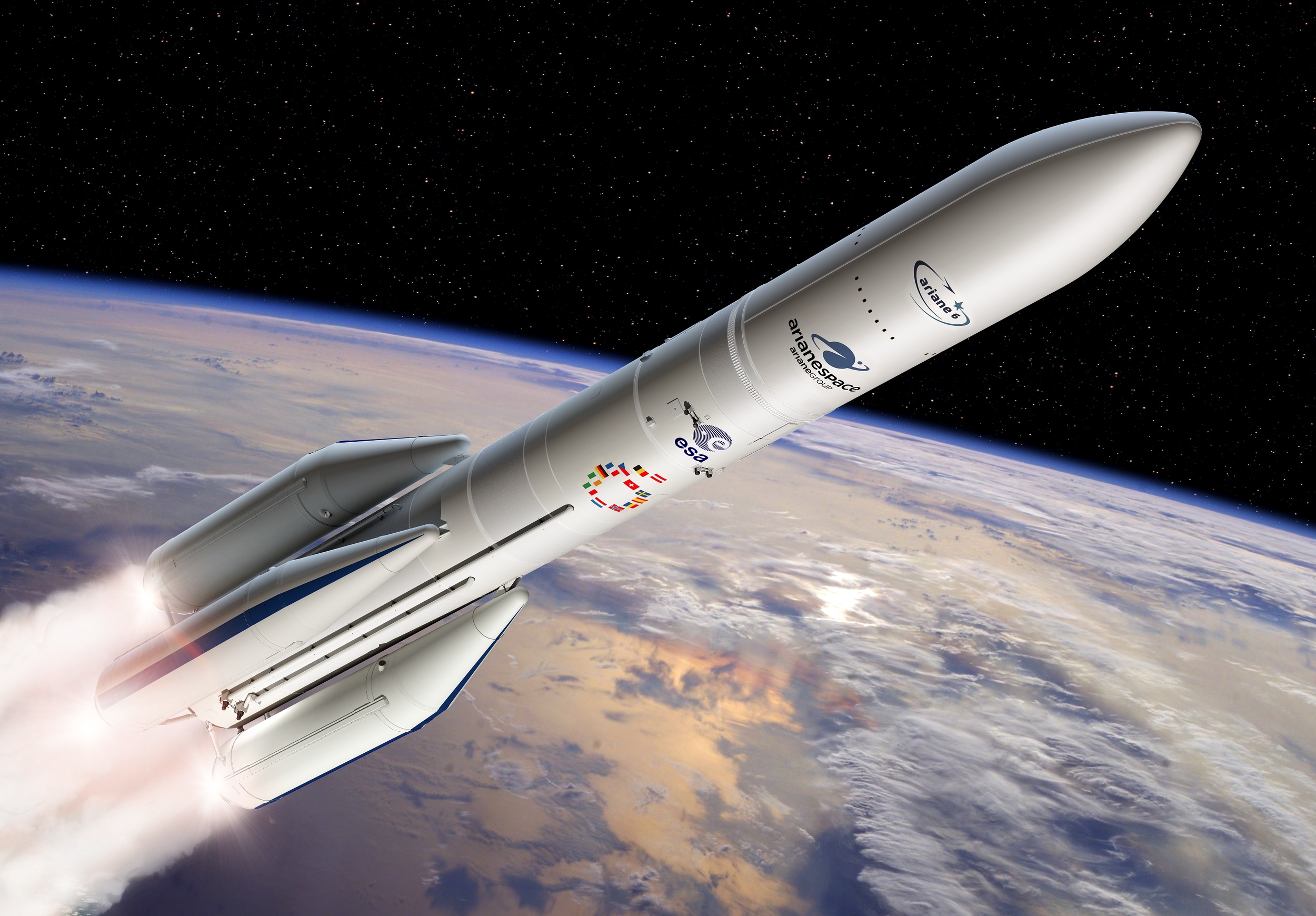

WASHINGTON — Arianespace will begin launches for its largest commercial customer in February as it works to ramp up its flight rate and attract additional business.
Arianespace announced Jan. 15 that it will conduct its first launch for Amazon’s low Earth orbit broadband constellation on Feb. 12 from French Guiana. The mission, the first of 18 under a 2022 contract, will also mark the debut of the Ariane 64, the version of Ariane 6 equipped with four solid rocket boosters.
The launch will carry 32 Amazon Leo — formerly known as Project Kuiper — satellites. It will be the first of “several” Arianespace launches for Amazon this year, Arianespace Chief Executive David Cavaillolès said during a Jan. 15 briefing, though he declined to specify a number. “Amazon will be an important part of the year,” he said.
The mission comes as Amazon works to accelerate deployment of its constellation and Arianespace seeks to increase the Ariane 6 launch rate.
“Our teams are working very closely with Amazon,” Cavaillolès said, adding that he was impressed by Amazon’s ability to scale satellite production. “On my side, I am confident that they’ll have the satellites, and Amazon can be confident that we’ll have the launchers.”
Arianespace projects seven or eight Ariane 6 launches in 2026, roughly double the four launches of that vehicle it conducted in 2025. That total will include a mix of commercial and institutional customers, such as weather satellite operator Eumetsat, although Cavaillolès said the exact breakdown has yet to be determined.
“This is incredibly ambitious, and it will be incredibly difficult,” he said. “What we achieved last year gives us quite a lot of confidence.”
In addition to introducing Ariane 64, Arianespace expects to begin flying vehicles equipped with upgraded solid rocket boosters later this year. The new P160C boosters will replace the P120C motors currently used on Ariane 6.
The larger boosters will allow later Ariane 64 launches for Amazon Leo to carry additional satellites, although Cavaillolès declined to say how many more. He said the upgraded boosters will provide 10% to 15% greater performance.
Seeking more customers
Cavaillolès said the company’s manifest for 2026 is full, but with some openings in 2027, when Arianespace expects to reach a peak Ariane 6 launch rate of 9 to 10 missions per year.
That changes in after 2027. “Starting in 2028 onwards, we have availability. We have quite a lot of availability,” he said.
He pushed back against perceptions that Ariane 6 will be fully booked for years. “Sometimes in Europe I hear this idea that Ariane 6 will be fully booked for years and years,” he said. “I think this is a message that is spread by some people that, for one reason or another, would love to use a non-European launcher.”
Among the major opportunities Arianespace is pursuing is IRIS², Europe’s sovereign broadband constellation. Cavaillolès said the company is reserving launch capacity beginning in 2029 to deploy the system, which he expects would require 10 to 15 launches over several years.
However, he said key details about IRIS² remain uncertain, including satellite size, quantity and deployment schedule. He expects more clarity after an upcoming “rendezvous meeting” involving SpaceRise, the consortium leading IRIS² development. “I’m really impatient to see the outcome of the rendezvous,” he said.
Another potential customer is the German military, which announced in September 2025 plans to invest 35 billion euros ($41 billion) in military space systems over five years. That effort could include a communications constellation, although details remain unclear.
“Overall, we think that those projects fit well with our manifest,” Cavaillolès said, particularly if IRIS² slips. “We think we can be the preferred partner to deploy the German project.”
Cavaillolès said there also remains interest from what was once Arianespace’s major customer, operators of geostationary orbit communications satellites, one where demand has dropped significantly in recent years.
“We see that this market is active,” he said. “Last year, many clients were waiting to see Ariane 6, to be confident enough to go for a deal. We think that, after the year that we delivered in 2025, we will be in good shape to capture this market.”
He added that Arianespace could also support deployment of another large constellation later in the decade.
“From 2028 onward, we have a lot of room,” he said. “We can deploy a whole new constellation. We can stack 10 launchers to deploy a massive project.”
“I think 2026 will be intense from a business development standpoint,” he said. “We have launchers to be sold, we have a good product and I think we have very loyal clients.”










Related Posts

Stay Informed With the Latest & Most Important News
Previous Post
Next Post




Advertisement
-
 01Two Black Holes Observed Circling Each Other for the First Time
 -
 02From Polymerization-Enabled Folding and Assembly to Chemical Evolution: Key Processes for Emergence of Functional Polymers in the Origin of Life
 -
 03Astronomy 101: From the Sun and Moon to Wormholes and Warp Drive, Key Theories, Discoveries, and Facts about the Universe (The Adams 101 Series)
 -
 04True Anomaly hires former York Space executive as chief operating officer
 -
 05Φsat-2 begins science phase for AI Earth images
 -
 06Hurricane forecasters are losing 3 key satellites ahead of peak storm season − a meteorologist explains why it matters
 -
 07Binary star systems are complex astronomical objects − a new AI approach could pin down their properties quickly