
Now Reading: Artemis 2 returns to the pad for April launch attempt
-
01
Artemis 2 returns to the pad for April launch attempt


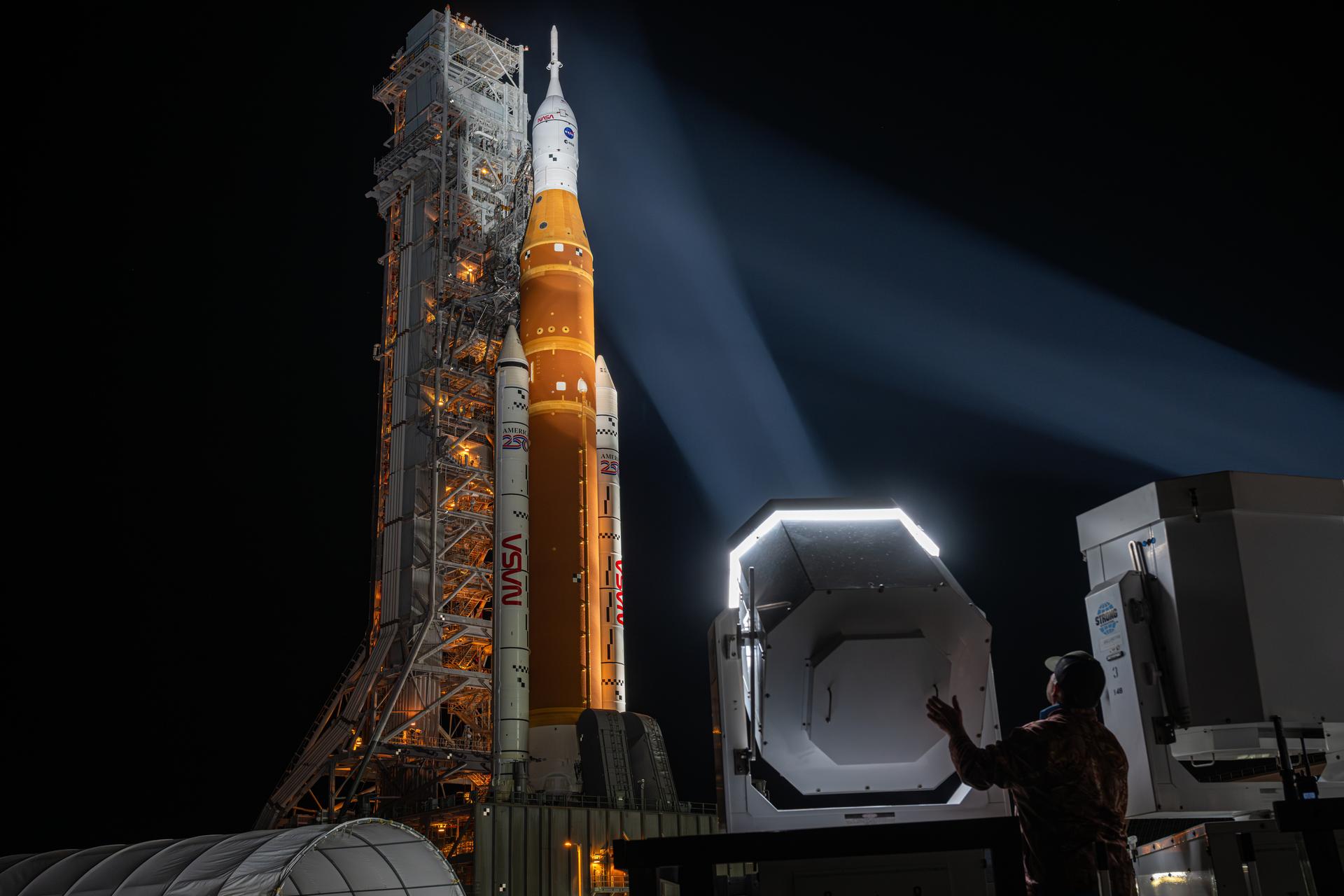

WASHINGTON — The Artemis 2 launch vehicle and spacecraft have returned to the launch pad for a launch as soon as April 1.
The mobile launch platform carrying the Space Launch System rocket and Orion spacecraft emerged from the Vehicle Assembly Building at 12:20 a.m. Eastern on March 20, nearly four and a half hours later than planned because of high winds. The platform arrived at Launch Complex 39B 11 hours later.
Artemis 2 first rolled out to the pad Jan. 17 and completed two fueling tests, known as wet dress rehearsals, there. However, a day after setting a March 6 launch date for the mission, NASA announced Feb. 21 that it was rolling the rocket back to the VAB to fix a blockage of helium in the rocket’s upper stage.
Engineers traced the problem to a dislodged seal in a quick-disconnect line feeding helium into the upper stage. After a flight readiness review on March 12, NASA approved plans to return the vehicle to the pad for the next set of launch opportunities, which begin April 1.
NASA does not plan to conduct another wet dress rehearsal or other fueling test at the pad. Agency officials said at a March 12 briefing that they believed they had resolved issues with seals that caused hydrogen leaks during the first wet dress rehearsal in early February.
“From my perspective, when we tank the vehicle the very next time, I would like it to be on a day we could actually launch,” said Lori Glaze, acting associate administrator for exploration systems development, at the briefing. “If we are able to successfully fully tank the vehicle, I want to be able to poll ‘go’ to launch.”
NASA has two-hour launch windows available daily between April 1 and 6, with the first window opening at 6:24 p.m. Eastern on April 1. The agency said operational limitations would restrict it to four launch attempts during that six-day period.
After April 6, the next launch opportunity is April 30, but NASA has not disclosed how long into May those opportunities extend.
Preparations for Artemis 2 continue as NASA revamps later phases of the Artemis lunar exploration initiative. NASA announced Feb. 27 it would add an SLS/Orion mission in low Earth orbit in 2027 to test operations with lunar landers under development by Blue Origin and SpaceX, with the first lunar landings planned for early 2028 on Artemis 4 and late 2028 on Artemis 5.
The agency also announced it would no longer develop the Exploration Upper Stage that would have been used on SLS launches starting with Artemis 4. It instead will procure and modify Centaur upper stages from United Launch Alliance for the Artemis 4 and 5 missions.
More details about those plans, and other potential changes, may be revealed in the coming week. At a March 19 press conference, Josef Aschbacher, director general of the European Space Agency, said NASA had invited the international community to Washington next week for updates on Artemis.
“ESA will be present, and we really look forward to the updates from NASA on what their plans are within the Artemis context,” he said.
Industry will also be in Washington next week for an annual meeting of companies involved in exploration programs, known as the Artemis Suppliers Conference. That meeting is scheduled for March 23-25.










Related Posts

Stay Informed With the Latest & Most Important News



Advertisement
-
 01Two Black Holes Observed Circling Each Other for the First Time
 -
 02From Polymerization-Enabled Folding and Assembly to Chemical Evolution: Key Processes for Emergence of Functional Polymers in the Origin of Life
 -
 03Astronomy 101: From the Sun and Moon to Wormholes and Warp Drive, Key Theories, Discoveries, and Facts about the Universe (The Adams 101 Series)
 -
 04True Anomaly hires former York Space executive as chief operating officer
 -
 05Φsat-2 begins science phase for AI Earth images
 -
 06Hurricane forecasters are losing 3 key satellites ahead of peak storm season − a meteorologist explains why it matters
 -
 07Binary star systems are complex astronomical objects − a new AI approach could pin down their properties quickly