
Now Reading: Artemis 2 science gets underway as Orion begins its return trip
-
01
Artemis 2 science gets underway as Orion begins its return trip


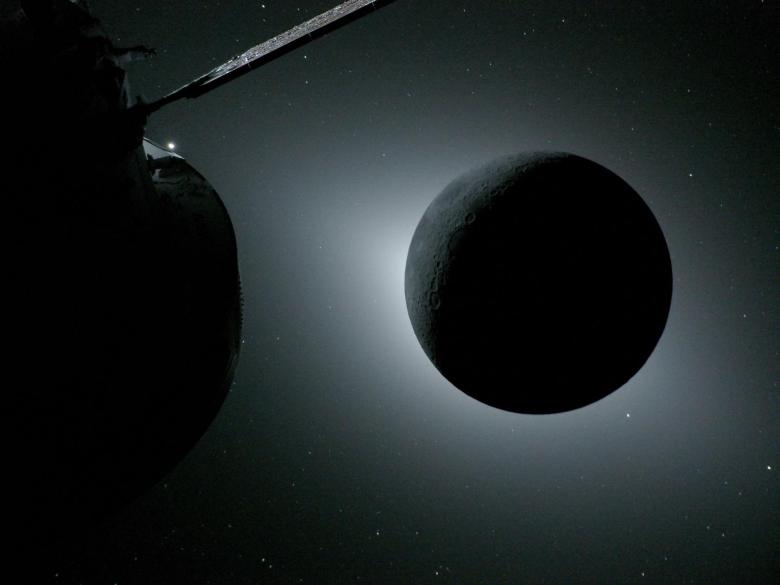
WASHINGTON — As Artemis 2 begins its return to Earth, scientists are just starting to review the images and observations taken by the crew as they flew around the moon.
At an April 7 briefing, NASA officials said that the Orion spacecraft Integrity continued to operate well on its return leg from the moon. The spacecraft is scheduled to splash down off the coast of San Diego, California, at 8:07 p.m. Eastern April 10.
The crew of Reid Wiseman, Victor Glover, Christina Koch and Jeremy Hansen had some off-duty time on April 7, a day after they became the first people in more than half a century to fly around the moon. Their activities included a “ship-to-ship” call with the International Space Station and a debrief with scientists.
The spacecraft also tweaked its trajectory with a maneuver at 8:03 p.m. Eastern, firing reaction control system thrusters for 15 seconds to adjust its speed by about 0.5 meters per second.
“While it’s been really exciting here the last couple of days, as we’ve been watching all of the activity in Orion, we still have to ensure that Reid, Victor, Christina and Jeremy return home safely on Friday evening. So, we’re pretty focused on that now,” Lori Glaze, NASA acting associate administrator for exploration systems development, said at the briefing.
The spacecraft remains in good condition, although one issue remains with the spacecraft’s toilet. Rick Henfling, an Artemis 2 flight controller, said the problem was not with the toilet itself but rather a vent line for wastewater that appeared to be at least partially blocked.
He said engineers have ruled out ice buildup where the vent line ejects wastewater into space. “The latest theory is related to some of the chemistry that goes into ensuring that the wastewater doesn’t develop any biofilms,” he said, which may be creating debris of some kind clogging a filter.
As the flight operations team gets Orion ready for its return to Earth, the science team for Artemis 2 is starting its analysis of the images and observations from the crew during the lunar flyby. NASA released some of the first high-resolution images taken by the astronauts during the flyby, including breathtaking images of the Earth setting behind the moon as well as the eclipse when the moon passed in front of the sun from the spacecraft’s vantage point.

NASA Administrator Jared Isaacman said at the briefing that the crew took more than 175 gigabytes of images during the lunar flyby alone. Of that, about 50 gigabytes of data had been returned as of the briefing, much of it using an experimental laser communications payload on Orion.
“We got 20 gigabytes down in a little more than 45 minutes. That’s orders of magnitude more than we get via our S-band telemetry system,” Henfling said of that laser communications system.
The data includes not just images but also voice recordings from the crew narrating their observations. “That’s a really rich scientific data set, because it captures the nuance of what the crew were seeing,” said Kelsey Young, the science team lead for Artemis 2. “There are multiple hours of recordings of meaty science observations.”
The science team has already started to review those observations and images, she said, and talked with the crew earlier in the day. All of the lunar science data will be archived and made publicly available within six months of splashdown.
The team will also work on two reports to be released within six months of splashdown. One will be about the work of the science team itself, including how it was structured. The second will be a preliminary lunar science report, examining how the mission addressed the 10 science objectives set before the mission.
That report is “really trying to understand what data we got relevant to each objective, but set up the community for success so that they can access those data and help us answer these fundamental driving science questions,” she said.
“It was our charter to develop the objectives and to maximize the science value out of this mission,” she said of the mission’s lunar science team. “We’ll be doing an initial assessment over six months, and then we’re really eager to see what the community is able to do with these data.”
Young added that the experience of browsing through the images returned so far was thrilling.
“I’ve spent most of my morning just flipping through the thousands of images that have started to come down, and there is something in every image that surprises me,” she said. “You might think that, after looking at hundreds of images taken of the lunar surface, I would get sick of it. I have not, nor do I anticipate getting sick of it.”










Related Posts
Stay Informed With the Latest & Most Important News
Previous Post
Next Post

Advertisement
-
 01Two Black Holes Observed Circling Each Other for the First Time
 -
 02From Polymerization-Enabled Folding and Assembly to Chemical Evolution: Key Processes for Emergence of Functional Polymers in the Origin of Life
 -
 03Astronomy 101: From the Sun and Moon to Wormholes and Warp Drive, Key Theories, Discoveries, and Facts about the Universe (The Adams 101 Series)
 -
 04True Anomaly hires former York Space executive as chief operating officer
 -
 05Φsat-2 begins science phase for AI Earth images
 -
 06Hurricane forecasters are losing 3 key satellites ahead of peak storm season − a meteorologist explains why it matters
 -
 07Binary star systems are complex astronomical objects − a new AI approach could pin down their properties quickly