
Now Reading: Artemis 2’s (nearly) 10-day flight around the moon
-
01
Artemis 2’s (nearly) 10-day flight around the moon


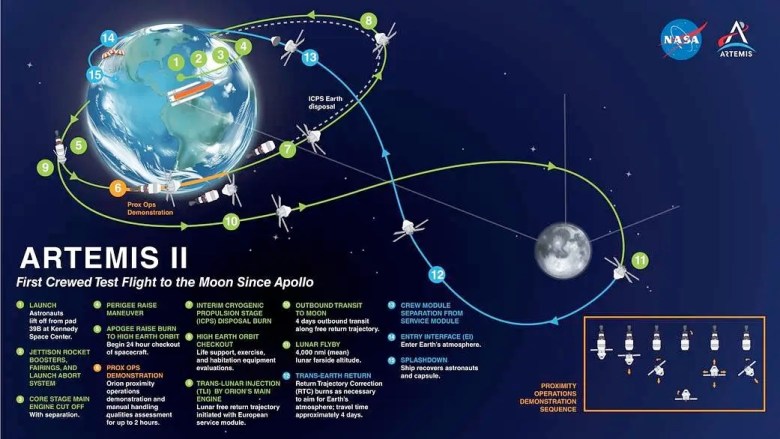
KENNEDY SPACE CENTER, Fla. — The Artemis 2 mission will send humans to the vicinity of the moon for the first time in more than 50 years on a mission lasting 10 days — or, rather, a little short of 10 days.
NASA has advertised Artemis 2, the first crewed flight of the Orion spacecraft and Space Launch System rocket, as a 10-day mission. However, the actual elapsed time from liftoff to splashdown is about nine days and two hours.
The SLS will lift off from Launch Complex 39B and, two minutes and eight seconds later, its two solid rocket boosters will separate. The four RS-25 engines in the core stage will shut down six minutes later. The Interim Cryogenic Propulsion Stage, or ICPS, with Orion attached will separate 10 seconds later in an orbit of 27 by 2,222 kilometers.
Before going to the moon, though, Orion will spend a day in Earth orbit. A burn by the ICPS’s RL10 engine 49 minutes after liftoff will put the stage and Orion spacecraft into an orbit of 185 by 2,222 kilometers, ensuring they are in a stable orbit. A second maneuver an hour later raises the apogee to about 70,380 kilometers.
It’s in this highly elliptical orbit that Orion will separate from the ICPS three hours and 24 minutes after liftoff. For nearly 75 minutes after separation, astronauts will maneuver Orion around the ICPS, approaching within 10 meters for what’s known as a “proximity operations” demonstration as a test for future missions where Orion will dock with a lunar lander.
“We want to make sure we understand our manual capabilities. The Artemis 2 demonstration gives the crew an opportunity to, I would say, test drive the car,” said Howard Hu, NASA Orion program manager. “They get a sense of the feedback of the system, how the spacecraft performs.”
After the end of those tests, ICPS will perform a burn about five hours after liftoff to ensure it reenters over the Atlantic Ocean. It will also deploy four cubesats from Argentina, Germany, Saudi Arabia and South Korea, which will perform space weather observations and technology demonstrations before also reentering.
The day in Earth orbit will also be used to check out Orion systems, including life support systems that were not fully tested on Artemis 1 in 2022. “The big emphasis will be on environmental control and life support systems,” said Kirk Shireman, vice president and program manager of Orion at Lockheed Martin, the prime contractor. Another key test will be how the crew interacts with the displays and controls in the spacecraft.

About 25 and a half hours after launch, Orion’s main engine will perform its translunar injection, or TLI, burn, placing the spacecraft on a free-return trajectory around the moon. While Orion will, at that point, be able to return without using its engine, there are some abort or “early return” options to come back in an emergency.
“Once we hit TLI, from there you can abort to come home, but you get very rapidly to a point of diminishing returns where you’re not going to shave that many days off the mission,” said Emily Nelson, NASA chief flight director. “You’re almost always going to err toward the free-return trajectory because it’s a much less dynamic situation.”
During the outbound leg to the moon, the crew will perform tests, such as demonstrating the ability to rapidly get into their spacesuits in an emergency, as well as finalize plans for observing the moon. That lunar observation campaign will begin four days and 22 hours into the mission, lasting about a day.
The Artemis 2 astronauts have worked with scientists to plan lunar observations, using cameras and the human eye. However, the portions of the moon that will be visible will vary depending on when the mission launches, requiring last-minute planning after launch to refine their plans.
Orion will reach its furthest point from Earth a little more than five days after liftoff. The exact distance will depend on the day of the launch and performance of the vehicle, but a launch in the first days of the early April launch period will allow Artemis 2 to break the record for greatest distance from Earth by a crewed mission, set by Apollo 13 in 1970 on its free-return trajectory around the moon.
Trajectories for launches in the second half of the launch period are less certain to break the record. “It’s within the error of our trajectory planning tools,” Nelson said.
The return leg of the mission includes additional demonstrations as well as some off-duty time for the crew. Reentry preparations begin about eight days and 22 hours into the mission, with the astronauts going through checklists and making final vehicle preparations.
The Orion crew module will separate from the service module about nine days and one hour into the mission, shortly before reaching the atmospheric entry interface. Orion will reenter and deploy drogue and main parachutes to prepare for splashdown off the coast of San Diego, where it will be recovered.
The reentry will be closely watched because of greater-than-expected erosion of the heat shield on Artemis 1. While that erosion did not jeopardize the spacecraft, NASA pushed back the Artemis 2 mission by more than a year to study it.
NASA and Lockheed Martin are changing the design of the heat shield on future Orion spacecraft, starting with Artemis 3, but for Artemis 2 they have retained the existing heat shield design and changed the reentry path to reduce the heat load on the shield. Current NASA Administrator Jared Isaacman reviewed those plans just weeks after being confirmed and accepted them.
If all goes as planned, splashdown will take place nine days, one hour and 46 minutes after liftoff. “We’re going to keep calling it a 10-day mission,” said Nelson. “It’s maybe not a full 10 days, but I’m going to round up.”










Related Posts


Stay Informed With the Latest & Most Important News
Previous Post
Next Post


Advertisement
-
 01Two Black Holes Observed Circling Each Other for the First Time
 -
 02From Polymerization-Enabled Folding and Assembly to Chemical Evolution: Key Processes for Emergence of Functional Polymers in the Origin of Life
 -
 03Astronomy 101: From the Sun and Moon to Wormholes and Warp Drive, Key Theories, Discoveries, and Facts about the Universe (The Adams 101 Series)
 -
 04True Anomaly hires former York Space executive as chief operating officer
 -
 05Φsat-2 begins science phase for AI Earth images
 -
 06Hurricane forecasters are losing 3 key satellites ahead of peak storm season − a meteorologist explains why it matters
 -
 07Binary star systems are complex astronomical objects − a new AI approach could pin down their properties quickly