
Now Reading: Astrometric Reconnaissance of Exoplanetary Systems (ARES). I. Methodology Validation With HST Point-source Images Of Proxima Centauri
-
01
Astrometric Reconnaissance of Exoplanetary Systems (ARES). I. Methodology Validation With HST Point-source Images Of Proxima Centauri

Astrometric Reconnaissance of Exoplanetary Systems (ARES). I. Methodology Validation With HST Point-source Images Of Proxima Centauri

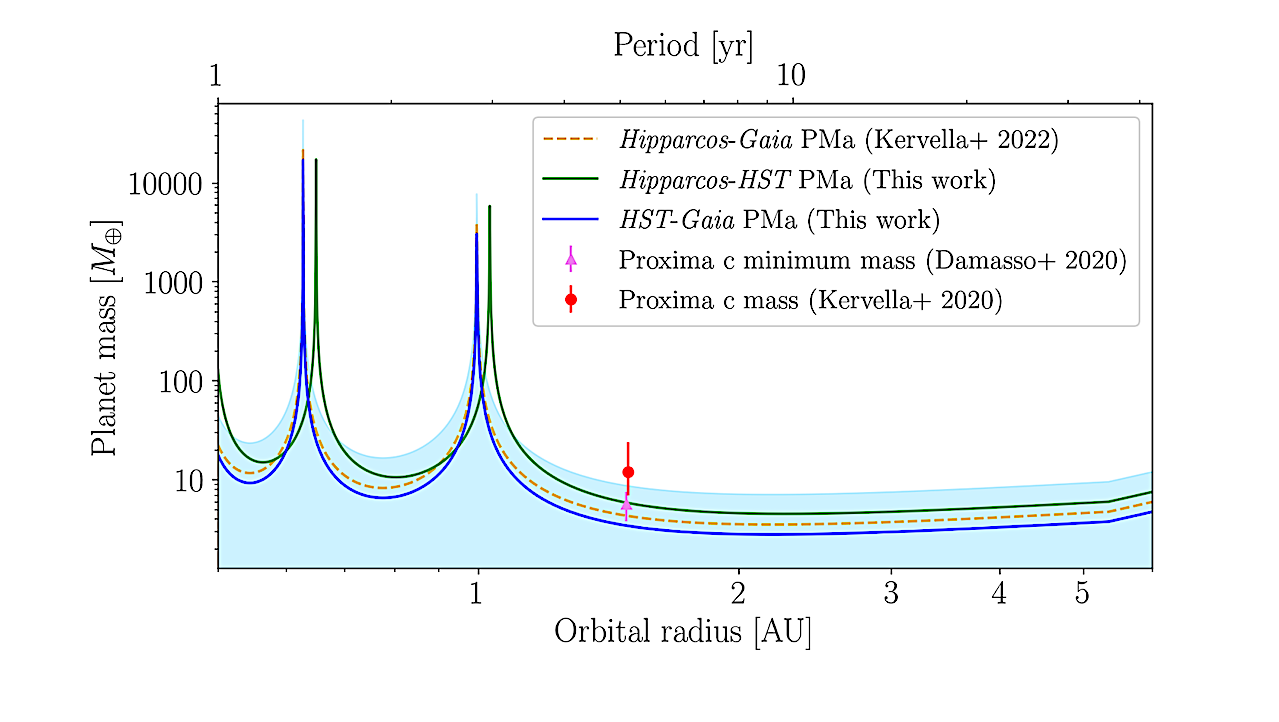

Expected mass of Proxima c as a function of its orbital radius derived from the PMa analysis. The solid blue line shows the mass estimate obtained in this work from the combination of HST and Gaia-DR3 astrometry, with the shaded light-blue region representing the 1σ uncertainty. The relation obtained combining Hip-Gaia (just “Hipparcos” in the plot legend for clarity) and part of the HST data is shown as a solid green line. The dashed yellow line represents the PMa-based relation obtained by Kervella et al. (2022) using Hipparcos and Gaia. The pink triangle marks the minimum mass derived of Proxima c from Damasso et al. (2020), while the red point shows the mass estimate from Kervella et al. (2020). — astro-ph.EP
We present the first results of the Astrometric Reconnaissance of Exoplanetary Systems (ARES) project, aimed at validating and characterizing candidate exoplanets around the nearest systems using multi-epoch Hubble Space Telescope (HST) data.
In this first paper, we focus on Proxima Centauri, leveraging archival and recent HST observations in point-source imaging mode. We refine the geometric-distortion calibration of the HST detector used, and develop a robust methodology to derive high-precision astrometric parameters by combining HST measurements with the Gaia DR3 catalog.
We determine Proxima’s position, proper motion, and parallax with uncertainties at the ∼0.4-mas, 50-μas yr−1, and 0.2-mas level, respectively, achieving consistent results with what measured by Gaia within ∼1σ.
We further investigate the presence of the candidate exoplanet Proxima c by analyzing the proper-motion anomaly derived from combining long-term HST-based and short-term Gaia astrometry. Under the assumption of a circular, face-on orbit, we obtain an estimated mass of mc=3.4+5.2−3.4 M⊙, broadly consistent with radial-velocity constraints but limited by our current uncertainties.
These results establish the foundation for the next phase of ARES, which will exploit HST spatial-scanning observations to achieve astrometric precisions of a few tens of μas and enable a direct search for astrometric signatures of low-mass companions.
M. Libralato, L. Bedin, A. Burgasser
Comments: 11 pages, 5 figures, 4 tables. Accepted for publication in A&A
Subjects: Earth and Planetary Astrophysics (astro-ph.EP); Instrumentation and Methods for Astrophysics (astro-ph.IM); Solar and Stellar Astrophysics (astro-ph.SR)
Cite as: arXiv:2512.08533 [astro-ph.EP](or arXiv:2512.08533v1 [astro-ph.EP] for this version)
https://doi.org/10.48550/arXiv.2512.08533
Focus to learn more
Submission history
From: Mattia Libralato
[v1] Tue, 9 Dec 2025 12:27:55 UTC (2,937 KB)
https://arxiv.org/abs/2512.08533
Astrobiology, exoplanet,










Related Posts

Stay Informed With the Latest & Most Important News
Previous Post
Next Post





Advertisement
-
 01Two Black Holes Observed Circling Each Other for the First Time
 -
 02From Polymerization-Enabled Folding and Assembly to Chemical Evolution: Key Processes for Emergence of Functional Polymers in the Origin of Life
 -
 03Astronomy 101: From the Sun and Moon to Wormholes and Warp Drive, Key Theories, Discoveries, and Facts about the Universe (The Adams 101 Series)
 -
 04True Anomaly hires former York Space executive as chief operating officer
 -
 05Φsat-2 begins science phase for AI Earth images
 -
 06Hurricane forecasters are losing 3 key satellites ahead of peak storm season − a meteorologist explains why it matters
 -
 07Binary star systems are complex astronomical objects − a new AI approach could pin down their properties quickly