
Now Reading: Astronomers Uncover 1400 Rare Celestial Anomalies Using AI to Analyze Hubble Archive
-
01
Astronomers Uncover 1400 Rare Celestial Anomalies Using AI to Analyze Hubble Archive

Astronomers Uncover 1400 Rare Celestial Anomalies Using AI to Analyze Hubble Archive

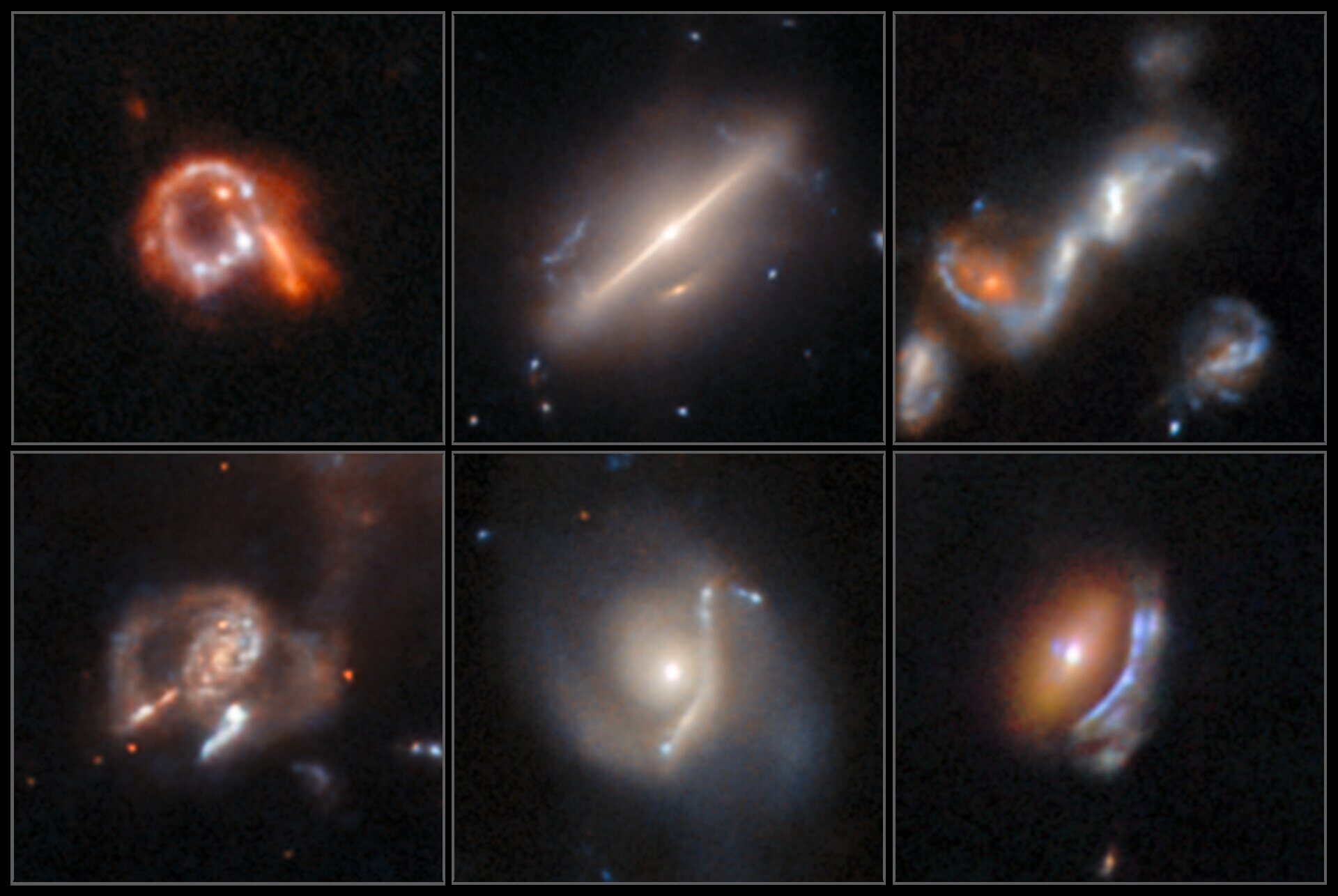

A team of astronomers has made significant strides in uncovering rare celestial objects from the Hubble Legacy Archive by employing a cutting-edge AI-assisted technique. Over a remarkable span of just two and a half days, the researchers sifted through an astounding nearly 100 million image segments, resulting in the identification of close to 1,400 anomalies, with over 800 of these stretching the boundaries of existing scientific literature.
Objects such as colliding galaxies, gravitational lenses, and ring galaxies are among the most intriguing targets for astronomers, but the sheer volume of data generated by telescopes like the NASA/ESA Hubble Space Telescope makes their detection increasingly challenging. As the data universe expands, the question of how to effectively locate these astronomical anomalies has become critical. Recently, astronomers David O’Ryan and Pablo Gómez from the European Space Agency developed a transformative AI tool that enhances the ability to analyze vast arrays of astronomical images in a fraction of the time a human would require. The developers showcased this approach using the Hubble Legacy Archive, which boasts an extensive collection of datasets accumulated over Hubble’s extensive operational history spanning 35 years.
O’Ryan emphasized the extensive value of archival data from Hubble in exploring astrophysical anomalies. Traditionally, these rare objects have been uncovered either through meticulous manual searches or serendipitously by scientists. However, the enormity of the Hubble dataset far surpasses the capacity for expert analysis at the needed granular level. While initiatives that engage the public in citizen science have expanded research efforts, they remain inadequate when faced with comprehensive archives like Hubble’s or high-volume surveys from new telescopes like the European Space Agency’s Euclid.
In a groundbreaking advancement, O’Ryan and Gómez deployed a neural network named AnomalyMatch, which draws inspiration from human neural processes to analyze data and identify patterns indicative of rare astronomical phenomena. This systematic investigation of the Hubble Legacy Archive marked a pioneering effort to search for these anomalies using AI. Within a remarkably short time frame, AnomalyMatch completed its analysis, producing a list of potential anomalies that warranted further investigation by astrophysicists.
Following the search, O’Ryan and Gómez meticulously scrutinized the objects flagged by their AI as most likely to be unusual. Their evaluation confirmed that over 1,300 of these were indeed true anomalies, with a significant number—more than 800—previously unreported. The majority of the identified anomalies represented galaxies that are either merging or interacting with each other, displaying distinctive shapes or trailing streams of stars and gas. Several gravitational lenses were also cataloged, where the gravitational field of a foreground galaxy distorts spacetime and creates arcs or circles of light from more distant galaxies. Among the discoveries were also rare objects such as jellyfish galaxies—characterized by gaseous ‘tentacles’—and various disks involved in planet formation, showcasing appearances that resemble hamburgers or butterflies.
Gómez hailed this achievement as a stellar application of AI that optimizes the scientific yield of the Hubble archive. He noted the unexpected abundance of anomalous objects found in an archive widely believed to have been extensively searched. This accomplishment not only highlights the enormous potential of the AnomalyMatch tool but also sets a precedent for future examinations of vast astronomical datasets.
With the Hubble Space Telescope producing merely one of many extensive archives in astronomy, the horizon gleams with promise as new observatories prepare to generate even more data. Upcoming ventures such as ESA’s Euclid, which commenced its survey of billions of galaxies in 2023, the NSF–DOE Vera C. Rubin Observatory planning a decade-long exploration, and NASA’s Nancy Grace Roman Space Telescope set to launch by May 2027, all portend an influx of astronomical data. Enhanced AI methodologies like AnomalyMatch are crucial for managing this anticipated data deluge, poised to unveil new discoveries and perhaps even phenomena previously unseen in the cosmos.










Related Posts

Stay Informed With the Latest & Most Important News
Previous Post
Next Post



Advertisement
-
 01Two Black Holes Observed Circling Each Other for the First Time
 -
 02From Polymerization-Enabled Folding and Assembly to Chemical Evolution: Key Processes for Emergence of Functional Polymers in the Origin of Life
 -
 03Astronomy 101: From the Sun and Moon to Wormholes and Warp Drive, Key Theories, Discoveries, and Facts about the Universe (The Adams 101 Series)
 -
 04True Anomaly hires former York Space executive as chief operating officer
 -
 05Φsat-2 begins science phase for AI Earth images
 -
 06Hurricane forecasters are losing 3 key satellites ahead of peak storm season − a meteorologist explains why it matters
 -
 07Binary star systems are complex astronomical objects − a new AI approach could pin down their properties quickly