
Now Reading: Atmospheric Escape Rates from Mars – If it Orbited an Old M-Dwarf Star
-
01
Atmospheric Escape Rates from Mars – If it Orbited an Old M-Dwarf Star


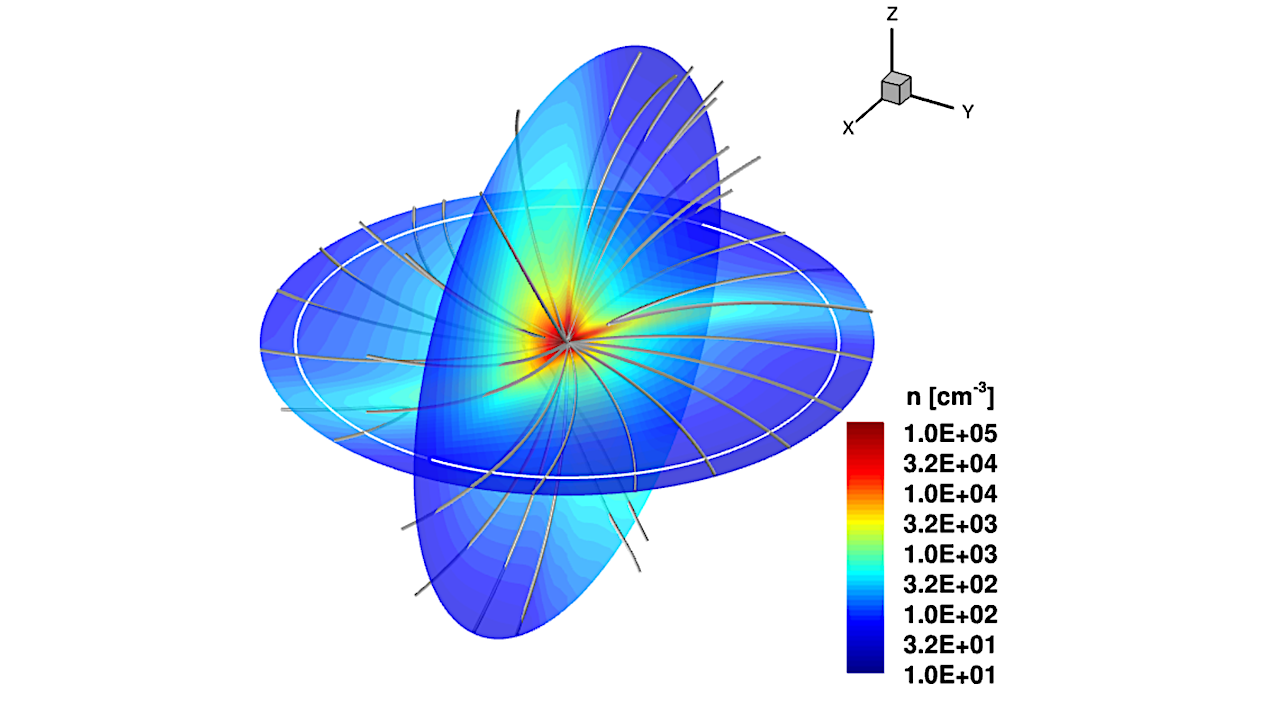

The three-dimensional MHD stellar wind solution for Barnard’s Star. Color contours represent number density values, while selected magnetic field lines are also shown. The solid white circle marks the orbit of the planet. — astro-ph.EP
Atmospheric escape is an important process that influences the evolution of planetary atmospheres. A variety of physical mechanisms can contribute to escape from an atmosphere, including thermal escape, ion escape, photochemical escape, and sputtering.
Here we estimate escape rates via each of these processes for a hypothetical Mars-like exoplanet orbiting Barnard’s star (an old, inactive M dwarf star). We place the planet at an orbital distance that receives the same total stellar flux as it does in our solar system.
We use the measured stellar extreme ultraviolet (EUV) spectrum and assumptions on the star’s magnetic field to determine both the high-energy radiation and the stellar wind environment around the planet. This information is used to model the response of the planet’s thermosphere, exosphere and magnetosphere using a variety of models that have been validated against solar system observations.
We find overall escape rates that are dominated by thermal processes and elevated by 2-5 orders of magnitude relative to present-day Mars, suggesting that a Mars-like planet orbiting Barnard’s star would not retain a significant atmosphere for more than 10’s of millions of years.
Recently reported planets around Barnard’s star should also not have retained significant atmospheres. By extension, Mars-like planets orbiting any M dwarf near the ‘Habitable Zone’ should not retain atmospheres for extended periods of time.
David A. Brain, Ofer Cohen, Thomas E. Cravens, Kevin France, Alex Glocer, Parker Hinton, Francois Leblanc, Yingjuan Ma, Akifumi Nakayama, Shotaro Sakai, Ryoya Sakata, Kanako Seki, Julián D. Alvarado-Gómez, Zachory Berta-Thompson, Eryn M. Cangi, Michael Chaffin, Jean-Yves Chaufray, Renata Frelikh, Yoshifumi Futaana, Katherine Garcia-Sage, Lukas Hanson, Mats Holmström, Bruce Jakosky, Riku Jarvinen, Ravi Kopparapu, Daniel R. Marsh, Aimee Merkel, Thomas Earle Moore, Yuta Notsu, Rachel A. Osten, William K. Peterson, Laura Peticolas, Robin Ramstad, Kevin B. Stevenson, Robert Strangeway, Wenyi Sun, Naoki Terada, Aline A. Vidotto
Comments: 39 pages, 8 figures, submitted to ApJ
Subjects: Earth and Planetary Astrophysics (astro-ph.EP)
Cite as: arXiv:2603.11561 [astro-ph.EP] (or arXiv:2603.11561v1 [astro-ph.EP] for this version)
https://doi.org/10.48550/arXiv.2603.11561
Focus to learn more
Submission history
From: David Brain
[v1] Thu, 12 Mar 2026 05:32:42 UTC (3,500 KB)
https://arxiv.org/abs/2603.11561
Astrobiology,










Related Posts
Stay Informed With the Latest & Most Important News
Previous Post
Next Post



Advertisement
-
 01Two Black Holes Observed Circling Each Other for the First Time
 -
 02From Polymerization-Enabled Folding and Assembly to Chemical Evolution: Key Processes for Emergence of Functional Polymers in the Origin of Life
 -
 03Astronomy 101: From the Sun and Moon to Wormholes and Warp Drive, Key Theories, Discoveries, and Facts about the Universe (The Adams 101 Series)
 -
 04True Anomaly hires former York Space executive as chief operating officer
 -
 05Φsat-2 begins science phase for AI Earth images
 -
 06Hurricane forecasters are losing 3 key satellites ahead of peak storm season − a meteorologist explains why it matters
 -
 07Binary star systems are complex astronomical objects − a new AI approach could pin down their properties quickly