
Now Reading: Benchmark demonstrates high-throughput ASCENT thruster in hotfire testing at Edwards Air Force Base
-
01
Benchmark demonstrates high-throughput ASCENT thruster in hotfire testing at Edwards Air Force Base

Benchmark demonstrates high-throughput ASCENT thruster in hotfire testing at Edwards Air Force Base

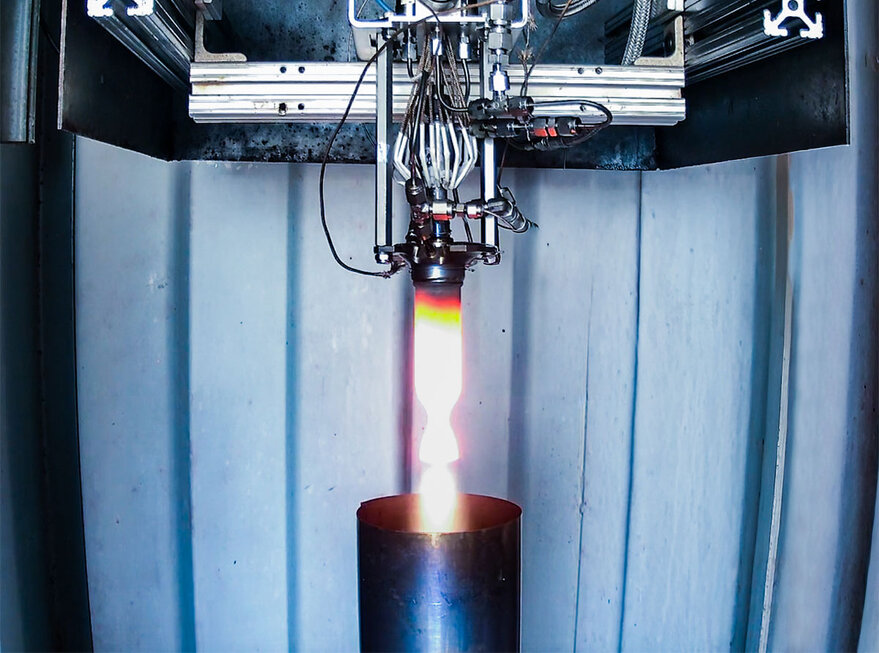

SAN FRANCISCO – Benchmark Space Systems’ ASCENT-fueled Macaw thruster performed a 10-minute continuous burn, clearing the way for an on-orbit application of the propulsion technology, the company announced Dec. 10.
“Because ASCENT has 50% greater impulse density than other monopropellants, mission planners and spacecraft designers can get the similar delta-v [change in velocity] with less mass, volume, and cost,” Peter Woodson, Benchmark executive vice president for mission success and ASCENT program manager, told SpaceNews by email. “That directly translates into more spacecraft capacity for payloads or additional propellant, giving designers greater flexibility in constrained mission envelopes.”
ASCENT, short for Advanced Spacecraft Energetic Non-Toxic, is a hydrazine-replacement monopropellant developed by the U.S. Air Force Research Laboratory (AFRL). Burlington, Vermont-based Benchmark, a firm that specializes in non-toxic and customized propulsion systems, won a $4.9 million AFRL contract in 2024 to develop ASCENT-based propulsion systems and components including the 22-Newton Macaw thruster.
Flight Qualification
Since completing the 10-minute burn in vacuum conditions, part of an extensive testing campaign conducted with AFRL Aerospace Systems Directorate at Edwards Air Force Base in California, Benchmark is preparing to qualify Macaw for on-orbit demonstration missions.
“Discussions with potential government and commercial customers for additional operational mission are already underway,” Woodson said. “This recent testing milestone enables those mission teams to confidently begin planning ASCENT into future spacecraft designs.”
At the end of the recent testing campaign, the ASCENT thruster was “still fully operational, suggesting significantly extended lifetime potential for space missions requiring long-duration maneuvers,” according to the news release.
“Our 22-Newton unit didn’t just meet expectations, it exceeded them,” Woodson said in a statement. “For the first time, mission planners can rely on ASCENT for real, sustained mobility for spacecraft in the 250-to-1,000-kilogram range.”
To date, ASCENT propulsion systems have been limited to small-scale, low-thrust applications. In contrast, the 22-Newton ASCENT thruster was designed to offer the performance, throughput and endurance that larger spacecraft need for “meaningful orbital transfers,” Woodson said.
During flight qualification of Macaw thrusters, Benchmark is interested in collaborating with spacecraft component manufacturers, satellite integrators and subsystem providers.










Related Posts
Stay Informed With the Latest & Most Important News
Previous Post
Next Post


Advertisement
-
 01Two Black Holes Observed Circling Each Other for the First Time
 -
 02From Polymerization-Enabled Folding and Assembly to Chemical Evolution: Key Processes for Emergence of Functional Polymers in the Origin of Life
 -
 03Astronomy 101: From the Sun and Moon to Wormholes and Warp Drive, Key Theories, Discoveries, and Facts about the Universe (The Adams 101 Series)
 -
 04True Anomaly hires former York Space executive as chief operating officer
 -
 05Φsat-2 begins science phase for AI Earth images
 -
 06Hurricane forecasters are losing 3 key satellites ahead of peak storm season − a meteorologist explains why it matters
 -
 07Binary star systems are complex astronomical objects − a new AI approach could pin down their properties quickly