
Now Reading: Blue Origin accelerates New Glenn rocket production with major facility upgrades and new variant plan
-
01
Blue Origin accelerates New Glenn rocket production with major facility upgrades and new variant plan

Blue Origin accelerates New Glenn rocket production with major facility upgrades and new variant plan

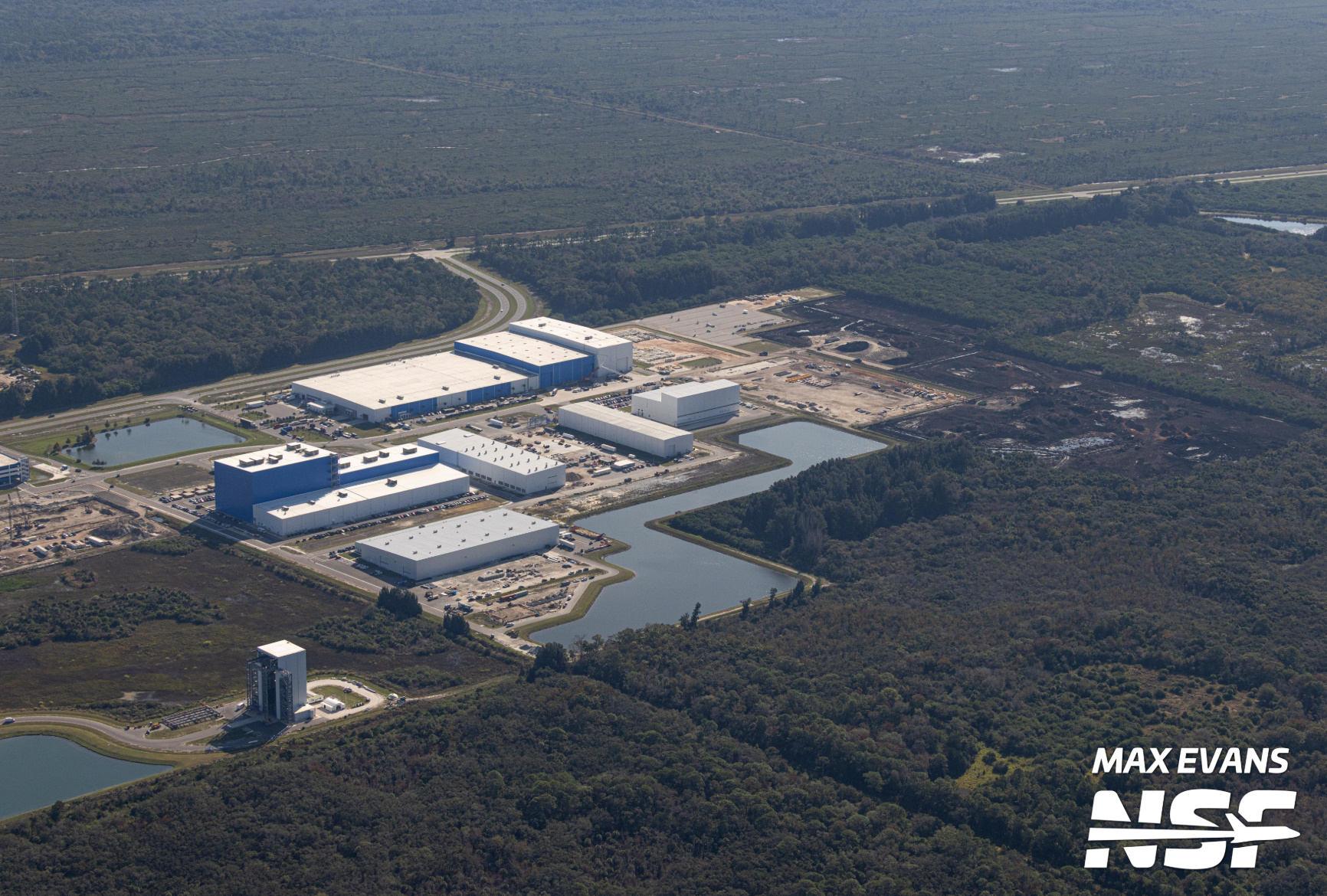

Blue Origin is making substantial strides at its rocket manufacturing facility located in Exploration Park, Florida, as it intensifies its efforts in producing the heavy-lift New Glenn rocket. This comes alongside plans for future upgrades, including a new variant that will enhance the rocket’s capabilities significantly.
Recent aerial footage taken by the NSF team shows that a second-stage tank for the New Glenn has been installed in the company’s 2CAT building, dedicated to the cleaning and testing of second-stage components. This development reflects continued progress in the manufacturing of parts for the rocket’s second stage, which is essential for Blue Origin to establish a reliable launch schedule. Currently, the 2CAT building is notably operating without its main entrance, which was damaged during a vigorous testing incident last year. Crews are in the process of replacing this door, allowing an unusual glimpse into the usually-private facility.
In conjunction with these developments, Blue Origin has opted for a significant expansion of its campus, merging initial plans for seven separate buildings into one expansive structure, thus emphasizing the company’s ambitious production goals. Additionally, the main manufacturing facility for composite materials is nearing completion, likely intended for the New Glenn’s enlarged payload fairings, which are expected to evolve in size in upcoming models. Workers have recently been seen assembling components resembling these fairings outside.
Construction efforts are also visible at a newly enclosed metal-forming facility, and groundwork has started on the Hardware Integration Facility, which will serve as a final assembly location for hardware before it heads to the launch pad.
Meanwhile, at Launch Complex 36 (LC-36), the first stage of New Glenn, which recently successfully launched its mission dubbed “Never Tell Me The Odds,” has returned for refurbishment. This booster now resides alongside the upper stages intended for the next two missions, creating noticeable space challenges within the Horizontal Integration Facility. First- and second-stage simulators have been repositioned outdoors to accommodate the hardware, a move that has garnered attention from aerial views. It remains unclear whether the refurbished booster will see further flight on the upcoming third mission or will be held back for further inspection pending the completion of new boosters.
Plans for the payload on this third flight are still uncertain, with speculation suggesting it could transport Blue Origin’s prototype Mk1 lunar lander, although different missions could also be considered based on customer requirements.
In terms of enhancements, Blue Origin has officially designated the current New Glenn model as the “New Glenn 7×2,” indicating its configuration of seven BE-4 engines on the first stage and two on the second. Upcoming upgrades will introduce propellant subcooling, which enhances the rocket’s performance by cooling the liquid oxygen and methane significantly before they are loaded into the tanks. This technique, successfully used by SpaceX in the Falcon 9, has markedly increased payload capabilities in the past. Preparations for subcooling have been ongoing, marked by the installation of new nitrogen infrastructure and subcooling units at the launch pad.
Additionally, Blue Origin has revealed its plans for a new, larger variant known as the New Glenn 9×4, featuring nine BE-4 engines on the first stage, four on the second, and an increased height to accommodate more propellant and payload. Imagery shows the 9×4 version launching from LC-36, but the company also has access to the adjacent LC-12 site, suggesting the potential for a dedicated launch complex for this upgraded rocket.
As production accelerates and facilities expand, Blue Origin stands on the brink of significantly enhancing both the capabilities and flight frequency of its New Glenn heavy-lift rocket in the near future.










Related Posts

Stay Informed With the Latest & Most Important News





Advertisement
-
 01Two Black Holes Observed Circling Each Other for the First Time
 -
 02From Polymerization-Enabled Folding and Assembly to Chemical Evolution: Key Processes for Emergence of Functional Polymers in the Origin of Life
 -
 03Astronomy 101: From the Sun and Moon to Wormholes and Warp Drive, Key Theories, Discoveries, and Facts about the Universe (The Adams 101 Series)
 -
 04True Anomaly hires former York Space executive as chief operating officer
 -
 05Φsat-2 begins science phase for AI Earth images
 -
 06Hurricane forecasters are losing 3 key satellites ahead of peak storm season − a meteorologist explains why it matters
 -
 07Binary star systems are complex astronomical objects − a new AI approach could pin down their properties quickly