
Now Reading: Blue Origin targets four-flight campaign for New Glenn’s path to Space Force certification
-
01
Blue Origin targets four-flight campaign for New Glenn’s path to Space Force certification

Blue Origin targets four-flight campaign for New Glenn’s path to Space Force certification

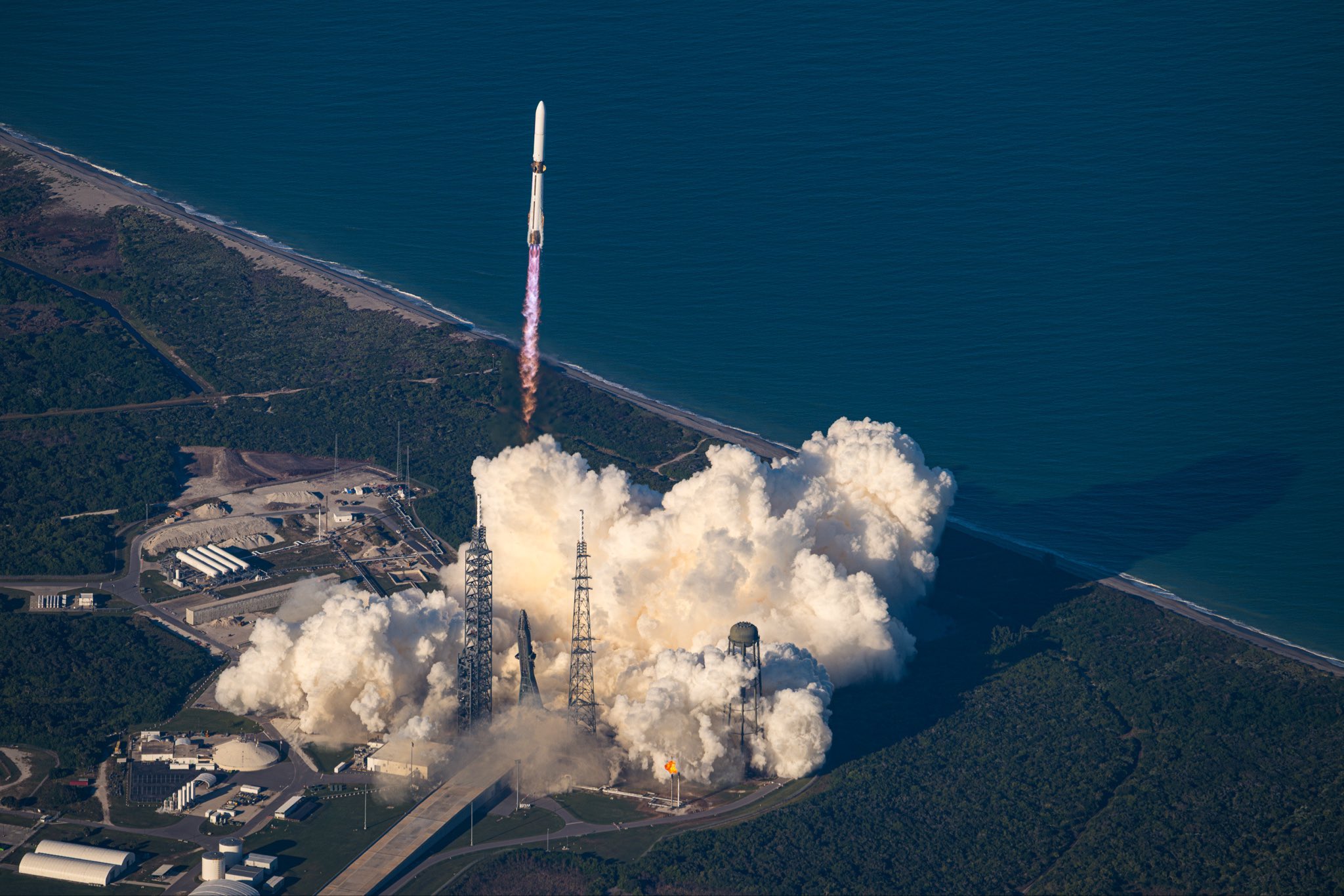

ORLANDO, Fla. — Blue Origin’s New Glenn rocket will have to complete four successful orbital flights as its pathway to certification under the U.S. Space Force’s National Security Space Launch (NSSL) program, Lt. Gen. Philip Garrant said Dec. 10 at the Spacepower conference.
Garrant, who leads the Space Systems Command, said Blue Origin selected the four-flight benchmark and the government agreed. “The government is supporting a four-flight certification for New Glenn,” he told reporters. The rocket has logged two successful missions so far, and Garrant said a third launch is expected “earlier in the new year than later.” If upcoming flights stay on track, he added, “I think they’re going to be in a fantastic place to become our third certified provider and compete for missions.”
If certified, Blue Origin would join SpaceX and United Launch Alliance as the Space Force’s third heavy-lift launch provider.
Garrant described New Glenn’s progress as encouraging. “I’ve been very pleased with the progress to date,” he said.
How NSSL certification works
NSSL certification is the gate every new launch provider must pass before carrying national security satellites. The process is designed to show the government that a rocket is reliable, repeatable and ready for operational use. For new entrants, that usually means technical assessments, flight demonstrations and substantial data sharing to verify that the vehicle performs as modeled.
Although the certification framework is standardized, the specifics are tailored to each rocket. “It’s a well documented process,” Garrant said, pointing to the New Entrant Certification Guide, which has been repeatedly updated over the past decade. “It’s a collaborative effort with the government and the launch service provider.”
The number of flights required isn’t fixed. It depends on design maturity, test history, and the government’s risk tolerance. In recent years, the Space Force has leaned toward risk-based assessments rather than formulaic flight counts. A proven design might require fewer launches; a novel architecture could require more.
How New Glenn compares to other entrants
SpaceX’s Falcon 9 completed three successful launches and major engineering reviews before the U.S. Air Force certified it in 2015. United Launch Alliance’s Vulcan reached certification after two flights, completing its second mission in October 2024 and securing approval in March 2025.
Even after Blue Origin completes the fourth mission, certification won’t be automatic. “It won’t be like the next day they get certified. There’ll be a significant amount of review,” Garrant cautioned. But if performance stays consistent, he said he anticipates “timely and quick certification.”
The Space Force for years has been seeking a third certified provider to expand launch options at a time when national security launch demand continues to rise.










Related Posts
Stay Informed With the Latest & Most Important News
Previous Post
Next Post




Advertisement
-
 01Two Black Holes Observed Circling Each Other for the First Time
 -
 02From Polymerization-Enabled Folding and Assembly to Chemical Evolution: Key Processes for Emergence of Functional Polymers in the Origin of Life
 -
 03Astronomy 101: From the Sun and Moon to Wormholes and Warp Drive, Key Theories, Discoveries, and Facts about the Universe (The Adams 101 Series)
 -
 04True Anomaly hires former York Space executive as chief operating officer
 -
 05Φsat-2 begins science phase for AI Earth images
 -
 06Hurricane forecasters are losing 3 key satellites ahead of peak storm season − a meteorologist explains why it matters
 -
 07Binary star systems are complex astronomical objects − a new AI approach could pin down their properties quickly