
Now Reading: Blue Origin’s surprise TeraWave constellation jolts LEO broadband race
-
01
Blue Origin’s surprise TeraWave constellation jolts LEO broadband race


Blue Origin, the rocket company founded by Jeff Bezos, is preparing to enter one of the most hotly contested arenas in the space industry: global broadband from low Earth orbit (LEO).
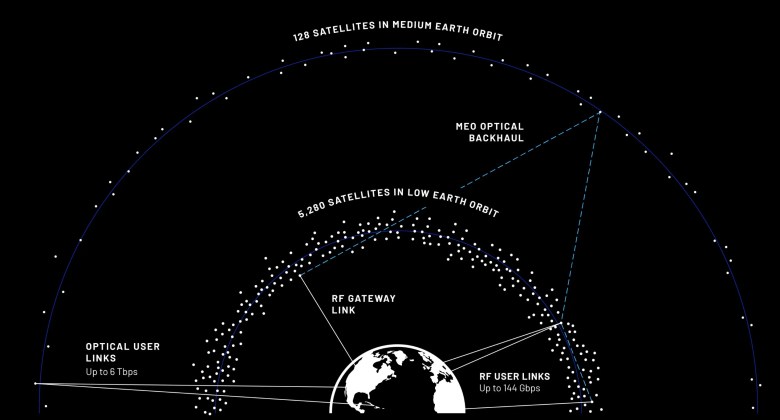
In a regulatory filing that caught many in the industry off guard, Blue Origin set forth plans for a network called TeraWave comprising more than 5,000 LEO satellites, paired with a medium Earth orbit (MEO) layer to deliver up to 6 terabits per second in point-to-point ground links.
The plan marks a sharp expansion for Blue Origin, which has until now focused on developing rockets, lunar landers and an in-space mobility vehicle platform called Blue Ring.
It’s an ambitious program that raises immediate questions about whether launch capacity and the required technology will be ready at scale on Blue Origin’s timeline.
The LEO satellites would use higher-frequency spectrum than rivals, making those links more susceptible to atmospheric interference, while the blistering speeds being promised from MEO hinge on emerging optical space-to-ground technology.
One industry executive privately said TeraWave is being assessed as a longer-term competitive threat that’s potentially more plausible in the next decade than in the next few years.
“I am not convinced it’s real,” said Armand Musey, founder of advisory firm Summit Ridge Group, citing the slow pace of deployment for Amazon’s 3,232-satellite LEO broadband constellation.
“There aren’t enough launch vehicles. There are not even enough launch vehicles to get Amazon Leo launched on schedule.”
Blue Origin disputes that view, pointing to the New Glenn rocket it has flown twice so far.
“We plan to fly the TeraWave constellation on our fleet of New Glenn rockets,” Blue Origin spokesperson Stephanie Plucinsky told SpaceNews, though she didn’t elaborate further.
Bold ambitions
Blue Origin’s FCC application filed Jan. 21 details a network of 5,280 LEO satellites operating in Q- and V-bands, higher-frequency spectrum than the Ku- and Ka-bands used by most current broadband constellations.
The satellites would be linked via lasers to 128 spacecraft flying above in MEO, which in turn would connect to optical ground terminals capable of symmetrical upload and download data speeds of up to 6 Tbps anywhere on Earth.
“Six Tbps is the capacity of one MEO satellite, which can deliver up to that data rate as a point-to-point connection between two ground terminals,” Plucinsky said.
This point-to-point design helps set TeraWave apart from consumer broadband systems that rely on shared capacity across large numbers of users, even as it places Bezos in the unusual position of backing a second satellite network while Amazon rolls out its own to challenge SpaceX’s Starlink.
“TeraWave will not be competing with Amazon Leo,” Plucinsky said via email. “We identified an unmet need with customers who were seeking enterprise-grade internet access with higher speeds, symmetrical upload/download speeds, more redundancy, and rapid scalability for their networks.”
Unlike Amazon Leo and SpaceX’s LEO-only Starlink, TeraWave would also be a bespoke non-consumer service that is capped at around 100,000 enterprise and government customer sites worldwide to avoid network congestion.
Still, the ambitious timeline positions Blue Origin among constellations years in the making and similarly aimed at enterprise and government users, many with plans to start deploying operational satellites in 2027.

Among the most notable are Telesat’s Lightspeed, Rivada’s Outernet and the filler OneWeb satellites Eutelsat is deploying before its contribution to Europe’s IRIS² program comes into play around the end of the decade.
There are also implications for SES, which pioneered commercial MEO broadband and is leaning on its upgraded O3b mPower constellation as a key differentiator amid an increasingly saturated LEO broadband market.
But how much is Blue Origin willing to invest to turn TeraWave into an operational reality, and what does it mean for the increasingly crowded LEO broadband market?
Latest twist in LEO broadband saga
“Strategically, I see this as Blue Origin targeting an entirely new, largely untapped market rather than competing directly with existing [non-geostationary satellite] operators,” said Jean-Baptiste Thépaut, a principal at boutique consultancy Novaspace.
“The constellation does not sit cleanly against Starlink, Amazon Leo, OneWeb or Telesat Lightspeed, whose value propositions depend on relatively inexpensive terminals and predictable availability.”
The closest potential point of competitive friction is with O3b mPower and certain government use cases, where very high-capacity matters more than terminal size or cost, Thépaut said.
“This could however further reduce the market for OneWeb and Telesat Lightspeed,” he added, “which already face a severe competition from Starlink today and Amazon Leo tomorrow on the low-end of the market, and which could see their potential competitive advantage on higher-end verticals further under pressure through the apparition of TeraWave.”
According to executives at satellite operator SES, Blue Origin’s planned entry validates its premise of tapping into MEO connectivity.
“We’ve known for some time that it’s a great orbit and we’ve been able to be successful in that orbit,” said Carmel Ortiz, senior vice president of MEO constellation programs at SES.
“Yes, TeraWave is coming along — and we don’t ever underestimate any of our competition, so we’ll be watching very closely what their plans are, but … it’s validating in that they must also see the market and the fact that the market is growing.”
Ortiz also pointed to how Starlink’s push into an industry once dominated by geostationary spacecraft has helped promote satellite communications and expand the overall market.
“We think that there will be a similar phenomenon with the TeraWave constellation,” she said, adding that “it doesn’t scare us. It doesn’t put us on the back foot.”
SES is also not standing still as it prepares to deploy another batch of O3b mPower satellites in September to add more capacity to the network.
The Luxembourg-based operator also recently embarked on an iterative approach to upgrading its MEO capabilities that involves deploying a technology pathfinder every year.
The first of these pathfinder payloads, co-developed with manufacturing startup K2 Space, was weeks away from being launched on a rideshare mission at the time of writing.
Ortiz said the payload includes optical technology designed primarily to test links between satellites and an optical ground station supplied by France’s Cailabs.
However, the payload could be used to test space-to-user-terminal optical connectivity, she added, as SES also explores higher frequencies to deliver additional capacity after filing for permission to use Q- and V-band spectrum.
| Constellation | Announced | Start of operational deployments |
| Logos Space | 2024 | 2027 |
| E-Space | 2022 | TBD |
| Outernet | 2022 | 2027 |
| Lightspeed | 2016 | 2027 |
The importance of heritage and sovereignty
SES’ experimental work builds on decades of operational experience.
“MEO is a tough orbit, from a radiation standpoint, and … we have quite good experience under our belt on dealing with that,” Ortiz said.
Eutelsat made a similar case about heritage, pointing to its fully deployed OneWeb constellation of more than 600 satellites as the only operational LEO alternative to Starlink, which has more than 9,700 satellites in orbit and counting. Amazon Leo, by contrast, has deployed just 212 satellites since beginning launches in April.
“That distinction matters,” Eutelsat spokesperson Joanna Darlington said.
“Some announced approaches remain conceptual, relying on technologies that have yet to be proven in orbit or at scale, and are still years away from operational deployment.”
Eutelsat and other operators also highlighted how Blue Origin — like SpaceX and Amazon — is based in the United States, amid a growing push by international governments for sovereign control over communications infrastructure.
“Sovereignty, resilience and control of critical infrastructure are increasingly important for governments, institutions and enterprises,” Darlington said. “Eutelsat already provides a European, operational alternative.”
For rivals still in development, another massive broadband constellation plan helps underscore the market’s potential for their investors and anchor customers.
“While Blue Origin’s constellation is clearly still in its very earliest stages, it shows what we have long known — there is strong and growing demand for enterprise-grade connectivity in” LEO, Rivada spokesperson Brian Carney said. He argued that the company’s Outernet offering would provide a fully integrated connectivity service.
Yet, even at this early stage, competitors are weighing what TeraWave could mean for their own plans.
“It is possible TeraWave could be a direct competitor of Telesat Lightspeed for some applications,” said Manik Vinnakota, Telesat’s vice president of products and customer experience, “but [it] might also expand the current addressable LEO market. The stated extremely high data rates could provide backup links for subsea cable cuts or as a redundancy offering for data centers with limited space for antennas — areas where Telesat is not.”
Still, Vinnakota said Telesat designed Lightspeed from the outset for enterprise and government users, emphasizing secure architecture, terrestrial-network integration and service-level guarantees on performance such as latency and reliability.
Technological leaps
Blue Origin also faces significant technical hurdles.
High frequencies and optical links could enable the high data rates Blue Origin has outlined, but they are also more vulnerable to atmospheric disruption.
“The user terminal ecosystem for these bands does not exist today and the power requirements for the terminals are expected to be high,” Vinnakota added.
“From an architectural standpoint, TeraWave is a bold design choice,” Thépaut said.
“Just a single 6 Tbps laser link is higher capacity than the sellable capacity of most [non-geostationary orbit] constellations. If it works, it pushes satellite systems beyond connectivity substitution and into true capacity augmentation and infrastructure-level services.
“However, this approach also comes with substantial technical risk, most notably rain-fade mitigation in Q/V bands and the availability of optical space-to-ground links,” he added, “both of which remain largely unproven at scale, particularly for user terminals.”
The use of MEO for in-orbit backhaul also adds complication and technological risk, one satellite engineer who spoke under the condition of anonymity told SpaceNews via email.
“As far as we can tell, the MEO shell is ‘bent pipe’ — what goes up, comes down to the LEO shell. It doesn’t appear to transit through the MEO shell to achieve true global end-to-end data paths in space. The MEO shell also adds latency, of course.”

Blue Origin has so far kept TeraWave largely under wraps, offering few details beyond the FCC filing and broad messaging about enterprise-grade connectivity and network resilience.
“TeraWave is designed for dedicated, predictable capacity — not shared consumer broadband,” Blue Origin’s Plucinsky said.
“Each customer receives reserved speeds for mission-critical use cases such as government operations, data centers, logistics and industrial networks.”
In its FCC application, Blue Origin describes TeraWave as a platform designed to support growing bandwidth needs driven by cloud migration, artificial intelligence workloads and real-time data transfer between data centers.
Amazon operates Amazon Web Services, one of the world’s largest cloud and data center businesses. Bezos has also recently championed the idea of space-based data centers, arguing that in the long term it could become cheaper to build large-scale computing infrastructure in orbit than on Earth.
For Thépaut, the case for TeraWave as a data-center connectivity play is compelling in theory, though also uncertain in practice. “Data centers have not historically been major satellite customers, yet the throughput figures being discussed, tens of Gbps in [radio frequency] and potentially terabits per second via optical links, could change that, especially for edge data centers,” he said.
“I do not see TeraWave replacing terrestrial fiber for hyperscalers, but it could become relevant in specific scenarios if Blue Origin can reconcile the tension between mission-critical applications and the lower availability typically associated with Q/V-band and optical systems.”
Speed to market
Blue Origin’s plan to begin launches within 18 months has raised eyebrows, not least because that timeline depends heavily on regulatory approvals and other factors beyond its control.
The FCC filing includes multiple waiver requests, including relief from a framework that groups competing non-geostationary satellite applications for collective review rather than processing them individually.
Still, the FCC has been under pressure to accelerate its satellite licensing process amid surging demand.
LEO startup Logos Space Services was recently cleared to deploy more than 4,000 broadband satellites about seven months after revising and enlarging its proposed constellation, and 15 months after it was initially submitted.
However, plans to streamline satellite licensing further have become increasingly controversial as proposed constellations grow larger and more complex.
A Senate committee recently revised and advanced legislation that would require the FCC to rule on satellite and ground station applications within one year, narrowing earlier “deemed granted” provisions that had raised concerns about automatic approval of large constellations.
Sibling rivalry
Even if regulatory approvals are secured quickly, launch availability remains a key question for many analysts.
Amazon recently asked the FCC to either extend a regulatory deadline for deploying 50% of its constellation by July, or waive it entirely, because of a lack of launch capacity. In the request, the company said “hundreds of flight-qualified satellites” are on standby for launch, despite signing multibillion-dollar, multi-provider launch contracts back in 2022.
That launch backlog includes 27 New Glenn missions for Amazon Leo, alongside five missions for Eutelsat and additional launches for Lightspeed, according to Novaspace.
Blue Origin has also signed deals to launch satellites for direct-to-device venture AST SpaceMobile and other customers.
Given the lack of public detail and Blue Origin’s already crowded portfolio of major programs, Thépaut said “some schedule slippage would not be surprising.”
Yet while TeraWave adds pressure to Blue Origin’s launch schedule, it could also help justify it.
“At the same time, TeraWave creates an internal rationale by generating long-term, stable demand for launch services, while also diversifying Blue Origin’s revenue base through recurring service revenues,” he added.
Summit Ridge Group’s Musey said Blue Origin’s only path may be to take all of the SpaceX Falcon 9 launches after Starship enters service, referring to the company’s heavy-lift rocket in development.
“Even then, it’s not clear SpaceX would continue the Falcon 9 program just to launch a competitor,” he said.
While Starship could greatly expand launch supply, it would also likely supercharge Starlink’s dominance as SpaceX pushes into orbital data centers and other new markets.
TeraWave could also end up competing with Amazon Leo for launch capacity, Musey added, raising questions about whether Bezos is willing to tolerate what could become a major conflict of interest.
“If Amazon waived the conflict, it suggests they don’t think it’s real, as they wouldn’t want this level of competition for launch vehicles, much less for service when it’s ready,” Musey said.
Telecom analyst Tim Farrar of TMF Associates said a key question is whether Blue Origin and Amazon ultimately converge their plans.
Vertical integration of launch and satellite manufacturing is essential to be competitive long term, Farrar said via email. He added that spinning Amazon Leo off to Blue Origin so it could be combined with TeraWave “ultimately seems to make the most sense.”
This article first appeared in the March 2026 issue of SpaceNews Magazine with the title “Out of the blue.”










Related Posts

Stay Informed With the Latest & Most Important News
Previous Post
Next Post




Advertisement
-
 01Two Black Holes Observed Circling Each Other for the First Time
 -
 02From Polymerization-Enabled Folding and Assembly to Chemical Evolution: Key Processes for Emergence of Functional Polymers in the Origin of Life
 -
 03Astronomy 101: From the Sun and Moon to Wormholes and Warp Drive, Key Theories, Discoveries, and Facts about the Universe (The Adams 101 Series)
 -
 04True Anomaly hires former York Space executive as chief operating officer
 -
 05Φsat-2 begins science phase for AI Earth images
 -
 06Hurricane forecasters are losing 3 key satellites ahead of peak storm season − a meteorologist explains why it matters
 -
 07Binary star systems are complex astronomical objects − a new AI approach could pin down their properties quickly