
Now Reading: Boeing demonstrates large language model for space-grade hardware
-
01
Boeing demonstrates large language model for space-grade hardware


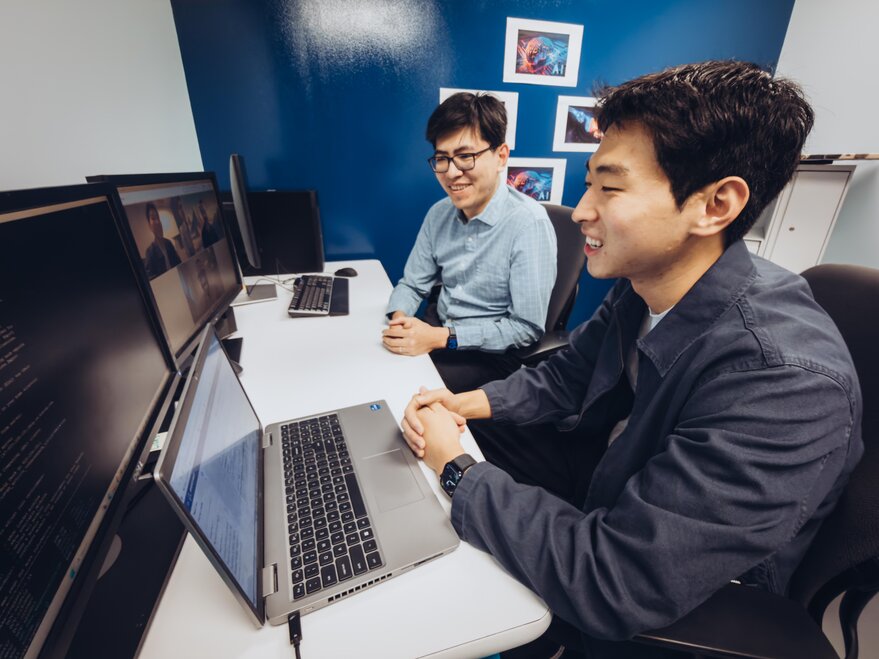

SAN FRANCISCO – Before uploading a large language model to space-grade hardware, Boeing Space Mission Systems engineers sought guidance from the hardware manufacturer.
“They told us it wasn’t possible, but we are skilled engineers who were going to figure out a pathway to make it happen,” Arvel Chappell III, Boeing Space Mission Systems AI Lab director, told SpaceNews.
In recent ground tests, Boeing engineers demonstrated that a large language model running on commercial off-the-shelf hardware could examine telemetry and report in natural language on the health of a satellite.
“It speeds up the latency,” Chappell said. “We were looking at being able to talk to our satellite in natural language and get a response back that made sense instead of just zeros and ones that had to be deciphered by ground software and engineers.”
Space-Based Edge
Traditionally, satellites have sent telemetry to the ground for analysis. Increasingly, companies are developing edge computers for satellites and shielding terrestrial devices for space applications.
“You want to do your compute as close to where you need it as possible,” Chappell said. “In the case of a satellite, if you have information that needs to be calculated, you want it to be done as close to the device as possible and then send results down.”
Space-qualified devices, though, often lack the memory and power necessary for large language models. Because it can take years to space-qualify hardware, Boeing engineers modified a large language model to run on existing hardware.
“We wanted to provide a path for our current constellations to enable processing of artificial intelligence models in space,” Chappell said. “We proved in the lab that we could enable this capability with a software upgrade.”
AI Lab
Boeing Space Mission Systems AI Lab, formally established in 2025, is like an accelerator. Employee at the El Segundo, California, site where Boeing designs and builds communications satellites submit ideas.
“You can’t even get into the lab unless you prototype what you’re trying to build because we don’t want a lot of PowerPoint engineering,” Chappell said. “Come with your value proposition, we’ll give you some funding. Then, we’ll move fast, learn and iterate.”
Engineers in the AI Lab are testing ways to enhance satellite autonomy and simplify satellite operations. The AI models are grounded in physics to bolster safety and prevent hallucinations. Boeing also is focused on narrative alignment “to ensure that the models can align with our customers values and our Boeing values as well,” Chappell said.










Related Posts

Stay Informed With the Latest & Most Important News
Previous Post
Next Post
Previous Post
Next Post




Advertisement
-
 01Two Black Holes Observed Circling Each Other for the First Time
 -
 02From Polymerization-Enabled Folding and Assembly to Chemical Evolution: Key Processes for Emergence of Functional Polymers in the Origin of Life
 -
 03Astronomy 101: From the Sun and Moon to Wormholes and Warp Drive, Key Theories, Discoveries, and Facts about the Universe (The Adams 101 Series)
 -
 04True Anomaly hires former York Space executive as chief operating officer
 -
 05Φsat-2 begins science phase for AI Earth images
 -
 06Hurricane forecasters are losing 3 key satellites ahead of peak storm season − a meteorologist explains why it matters
 -
 07Binary star systems are complex astronomical objects − a new AI approach could pin down their properties quickly