
Now Reading: Breakthrough Listen Observations Of 3I/ATLAS With The Green Bank Telescope at 1-12 GHz
-
01
Breakthrough Listen Observations Of 3I/ATLAS With The Green Bank Telescope at 1-12 GHz

Breakthrough Listen Observations Of 3I/ATLAS With The Green Bank Telescope at 1-12 GHz


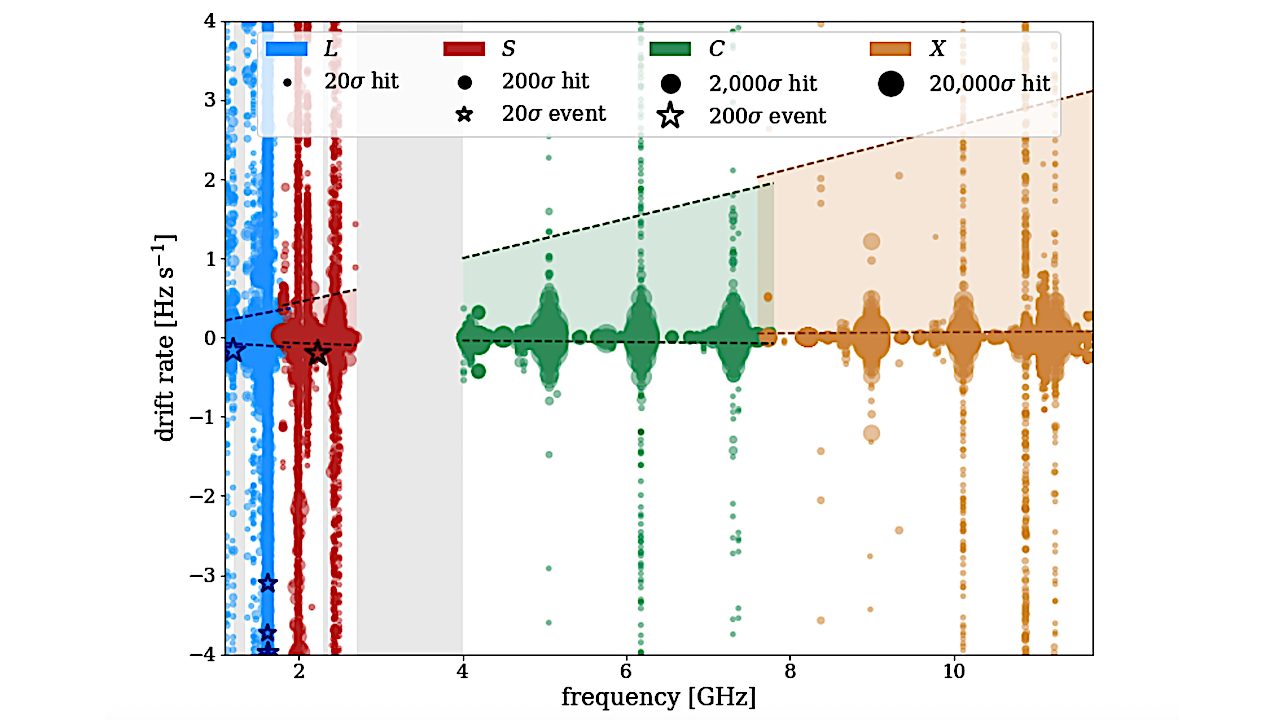
Distribution of hits (circles) and events (stars) over frequency and drift rate. The marker size gives the S/N. The gray-shaded regions show ranges not sampled, including narrow notch filter regions in the L and S bands. The color-shaded regions give the range of drift rates expected from Earth’s orbital motion and rotational motion and 3I/ATLAS’s rotation at each of the four observing bands. These regions do not perfectly align between bands due to 3I/ATLAS’s radial acceleration changing during overhead time between observations. No events lie in the expected drift rate regions. — astro-ph.IM
3I/ATLAS (also designated C/2025 N1 (ATLAS) and, formerly, A11pl3Z) is the third interstellar object (ISO), following 1I/‘Oumuamua and 2I/Borisov, to be discovered during a passage through the Solar System. The Asteroid Terrestrial-impact Last Alert System (ATLAS) reported its discovery on 2025 July 1 (S. Deen et al. 2025).
Unlike 1I/‘Oumuamua, 3I/ATLAS exhibits mostly typical cometary characteristics (S. Deen et al. 2025), including a coma and an unelongated nucleus. There is currently no evidence to suggest that ISOs are anything other than natural astrophysical objects. However, given the small number of such objects known (only three to date), and the plausibility of interstellar probes as a technosignature (e.g, R. A. Freitas & F. Valdes 1985), thorough study is warranted (see J. R. A. Davenport et al. 2025).
Putative nonanthropogenic interstellar probes are likely to communicate via narrowband radio signals for transmission efficiency and for the low extinction of such signals across interstellar space; all of humanity’s spacecraft, including the now-interstellar craft Voyager 1 and Voyager 2, communicate via such signals.
The Breakthrough Listen (BL) program observed 3I/ATLAS using the 100-m Robert C. Byrd Green Bank Telescope (GBT) on UT 2025 December 18, ∼1 day before the ISO’s closest approach to Earth. Similar technosignature searches have recently been undertaken by S. Z. Sheikh et al. (2025) and D. J. Pisano et al. (2025) over different frequency ranges and with different sensitivities. Like those searches, we find no credible detections of narrowband radio technosignatures originating from 3I/ATLAS.
Ben Jacobson-Bell, Steve Croft, Ellie White, Andrew P. V. Siemion, Matthew Lebofsky, David H. E. MacMahon
Comments: 3 pages, 1 figure, submitted to RNAAS
Subjects: Instrumentation and Methods for Astrophysics (astro-ph.IM); Earth and Planetary Astrophysics (astro-ph.EP); Astrophysics of Galaxies (astro-ph.GA)
Cite as: arXiv:2512.19763 [astro-ph.IM] (or arXiv:2512.19763v1 [astro-ph.IM] for this version)
https://doi.org/10.48550/arXiv.2512.19763
Focus to learn more
Submission history
From: Ben Jacobson-Bell
[v1] Sat, 20 Dec 2025 17:52:30 UTC (237 KB)
https://arxiv.org/abs/2512.19763
Astrobiology, Astrochemistry,










Related Posts

Stay Informed With the Latest & Most Important News
Previous Post
Next Post


Advertisement
-
 01Two Black Holes Observed Circling Each Other for the First Time
 -
 02From Polymerization-Enabled Folding and Assembly to Chemical Evolution: Key Processes for Emergence of Functional Polymers in the Origin of Life
 -
 03Astronomy 101: From the Sun and Moon to Wormholes and Warp Drive, Key Theories, Discoveries, and Facts about the Universe (The Adams 101 Series)
 -
 04True Anomaly hires former York Space executive as chief operating officer
 -
 05Φsat-2 begins science phase for AI Earth images
 -
 06Hurricane forecasters are losing 3 key satellites ahead of peak storm season − a meteorologist explains why it matters
 -
 07Binary star systems are complex astronomical objects − a new AI approach could pin down their properties quickly