
Now Reading: Broadband Infrared Spectroscopy Of Methanol Isotopologues In pure, H2O-rich, And CO-rich Ice Analogues
-
01
Broadband Infrared Spectroscopy Of Methanol Isotopologues In pure, H2O-rich, And CO-rich Ice Analogues

Broadband Infrared Spectroscopy Of Methanol Isotopologues In pure, H2O-rich, And CO-rich Ice Analogues

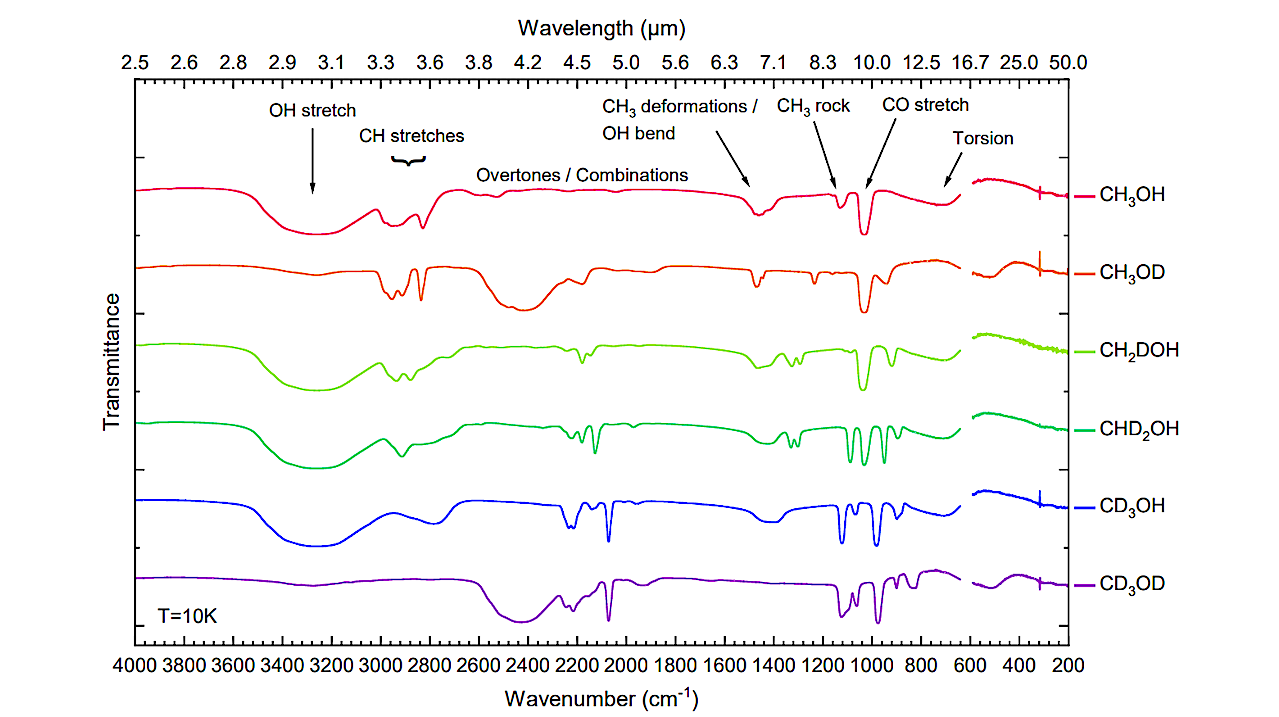
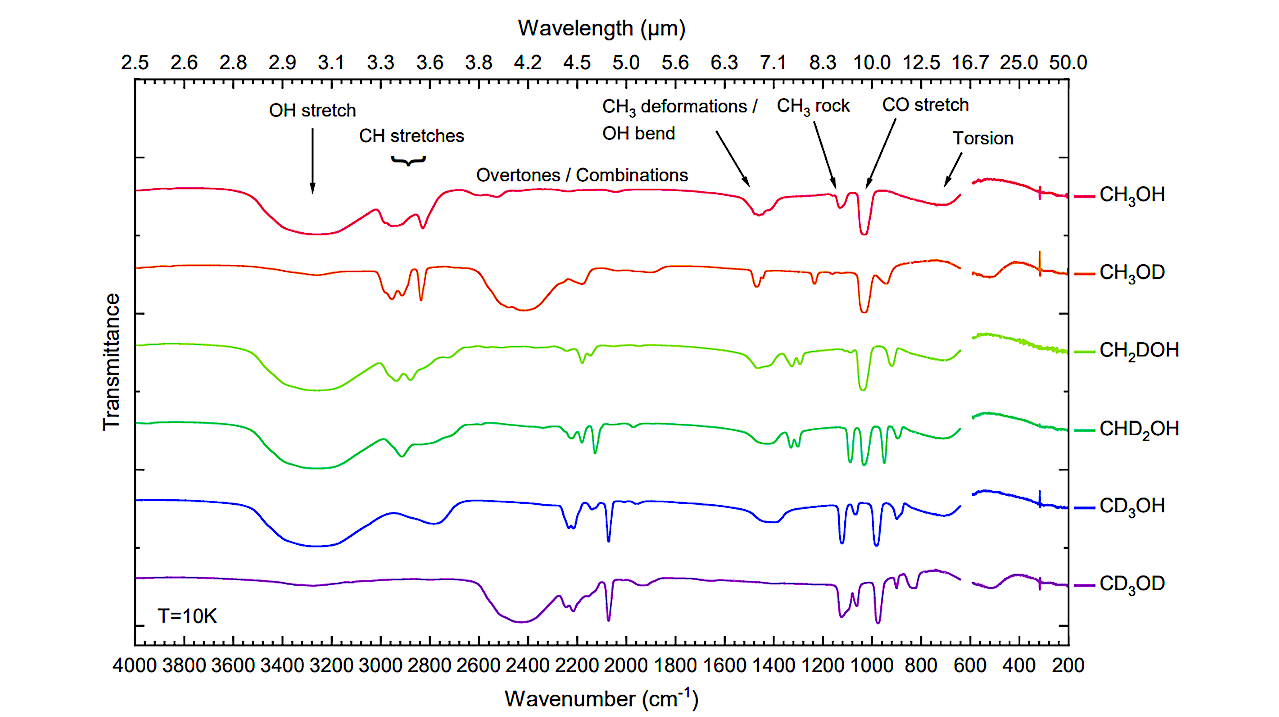
Transmission spectra of solid methanol and its five deuterated isotopologues at 10 K. The region between 650 to 590 cm−1 (15.4 to 16.9 µm), affected by increased noise from the beamsplitter, has been removed. The main CH3OH vibrational modes are indicated at the top. Spectra are vertically offset for clarity. — astro-ph.GA
Deuterium fractionation is highly efficient during the early stages of star formation, particularly in starless and prestellar cores where temperatures are low (<10 K) and molecular freeze-out onto dust grains is significant.
Methanol forms early in these environments following CO freeze-out via successive hydrogenation reactions on grain surfaces, while the production of deuterated methanol requires elevated gas-phase D/H ratios generated through dissociative recombination of deuterated H3+. Consequently, large abundances of deuterated methanol are observed toward young stellar objects where prestellar ices have recently sublimated.
Here, we present laboratory infrared spectra of methanol and its deuterated isotopologues in astrophysical ice analogues, complemented by anharmonic vibrational calculations used to guide band assignments. Experiments were performed at the CASICE laboratory using a Bruker Vertex 70v coupled to a closed-cycle helium cryostat, with isotopologue ices deposited at 10 K under high-vacuum conditions.
Infrared transmission spectra were recorded over 6000-30 cm-1 (1.67-333 um) and compared with spectra of pure isotopologue ices. Distinctive mid-infrared band patterns are identified for each deuterated species. In particular, CH2DOH exhibits a characteristic doublet at 1293 and 1326 cm-1 (7.73 and 7.54 um), while CHD2OH shows a similar doublet at 1301 and 1329 cm-1 (7.69 and 7.52 um), both remaining largely invariant across all studied ice mixtures.
These robust spectral signatures provide reliable tracers for identifying deuterated methanol in JWST observations and for constraining astrochemical gas-grain models of deuterium enrichment prior to star and planet formation.
Adam Vyjidak, Barbara Michela Giuliano, Pavol Jusko, Heidy M. Quitian-Lara, Felipe Fantuzzi, Giuseppe A. Baratta, Maria Elisabetta Palumbo, Paola Caselli
Comments: 15 pages, 15 figures, 14 tables, 5 appendix. Accepted for publication in Astronomy and Astrophysics (A&A)
Subjects: Astrophysics of Galaxies (astro-ph.GA); Solar and Stellar Astrophysics (astro-ph.SR)
Cite as: arXiv:2602.03651 [astro-ph.GA] (or arXiv:2602.03651v1 [astro-ph.GA] for this version)
https://doi.org/10.48550/arXiv.2602.03651
Focus to learn more
Submission history
From: Heidy M Quitian-Lara
[v1] Tue, 3 Feb 2026 15:34:54 UTC (5,837 KB)
https://arxiv.org/abs/2602.03651
Astrobiology, Artrochemistry,










Related Posts
Stay Informed With the Latest & Most Important News
Previous Post
Next Post


Advertisement
-
 01Two Black Holes Observed Circling Each Other for the First Time
 -
 02From Polymerization-Enabled Folding and Assembly to Chemical Evolution: Key Processes for Emergence of Functional Polymers in the Origin of Life
 -
 03Astronomy 101: From the Sun and Moon to Wormholes and Warp Drive, Key Theories, Discoveries, and Facts about the Universe (The Adams 101 Series)
 -
 04True Anomaly hires former York Space executive as chief operating officer
 -
 05Φsat-2 begins science phase for AI Earth images
 -
 06Hurricane forecasters are losing 3 key satellites ahead of peak storm season − a meteorologist explains why it matters
 -
 07Binary star systems are complex astronomical objects − a new AI approach could pin down their properties quickly