
Now Reading: Budget remains tight for scaled-back GeoXO program
-
01
Budget remains tight for scaled-back GeoXO program



SAN FRANCISCO – The National Oceanic and Atmospheric Administration is keeping close tabs on the cost of the next generation of geostationary weather satellites.
The Geostationary and Extended Operations (GeoXO) constellation currently fits within anticipated budgets, but “if we get too expensive, we will remove stuff,” Edward Grigsby, Office of Geostationary Earth Orbit Observations director, said Jan, 27 at the American Meteorological Society annual meeting in Houston. “We will descope because we are cost and budget limited.”
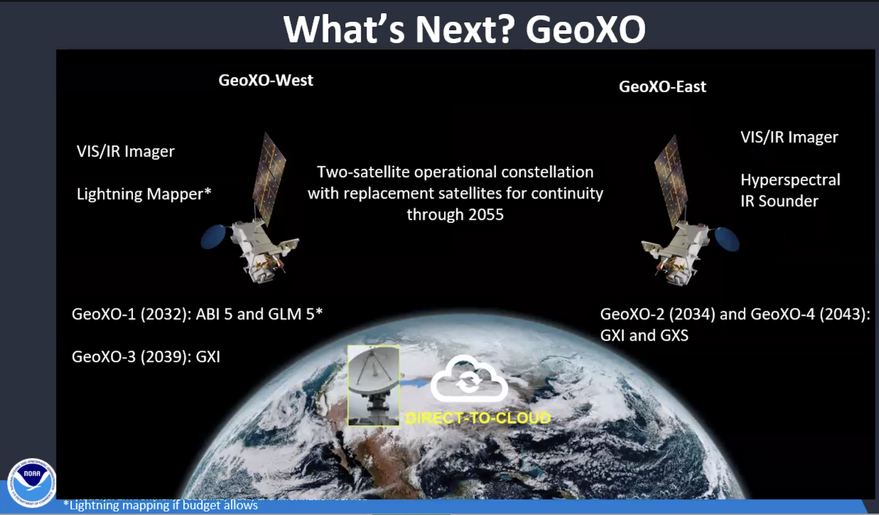
The GeoXO constellation originally included six satellites, with three in orbit at a time, to monitor weather, map lightning, and track ocean and atmospheric conditions. The program was scaled back in 2025 to four spacecraft, two in orbit simultaneously, based on guidance from the Office of Management and Budget. Instruments for observing ocean and atmospheric conditions were removed.
The first GeoXO satellite, scheduled to launch in 2032 to replace GOES West, will be equipped with an Advanced Baseline Imager (ABI) built for the current constellation, the Geostationary Operational Environmental Satellite-R Series and possibly a lightning mapper from Lockheed Martin.
When NOAA officials received the administration’s budget guidance, “the first thing we did was resurrect a flight-worthy ABI and put it in the manifest for the first launch,” Grigsby said.
GeoXO East
An updated GeoXO Imager (GXI), built by L3Harris Technologies, will reach orbit in 2034 on the GeoXO East spacecraft. GXI will make observations in 18 spectral bands compared with 16 on ABI. And resolution will be higher for seven of the 16 spectral bands that carry over from ABI. Benefits of the new instrument include enhanced observation of moisture, fire prediction and fire tracking, Grigsby said.
In addition, a hyperspectral infrared sounder from BAE Systems on GeoXO East is expected to save “2,000 lives a year and $2 billion across the western hemisphere,” Grigsby said. “More importantly, it’s going to impact every user of the forecast in the 2030s and beyond, by leaps that we cannot fathom today.”
Sounder Ring
GeoXO East will join a ring of hyperspectral sounders in geostationary orbit that will include instruments from Europe, Japan, South Korea and other nations.
Many elements of the GeoXO program have been revised in the last year. NOAA currently is evaluating options for restructuring the GeoXO mission integration prime contract, which may cover launch, commissioning and 10 years of space operations.
“Each of those elements could be in this contract, but we’re doing an analysis of alternatives this year,” Grigsby said. “We will be selecting our acquisition strategy going forward this year.”










Related Posts


Stay Informed With the Latest & Most Important News
Previous Post
Next Post





Advertisement
-
 01Two Black Holes Observed Circling Each Other for the First Time
 -
 02From Polymerization-Enabled Folding and Assembly to Chemical Evolution: Key Processes for Emergence of Functional Polymers in the Origin of Life
 -
 03Astronomy 101: From the Sun and Moon to Wormholes and Warp Drive, Key Theories, Discoveries, and Facts about the Universe (The Adams 101 Series)
 -
 04True Anomaly hires former York Space executive as chief operating officer
 -
 05Φsat-2 begins science phase for AI Earth images
 -
 06Hurricane forecasters are losing 3 key satellites ahead of peak storm season − a meteorologist explains why it matters
 -
 07Binary star systems are complex astronomical objects − a new AI approach could pin down their properties quickly