
Now Reading: Build Your Own Mars Astrobiology Rover
-
01
Build Your Own Mars Astrobiology Rover


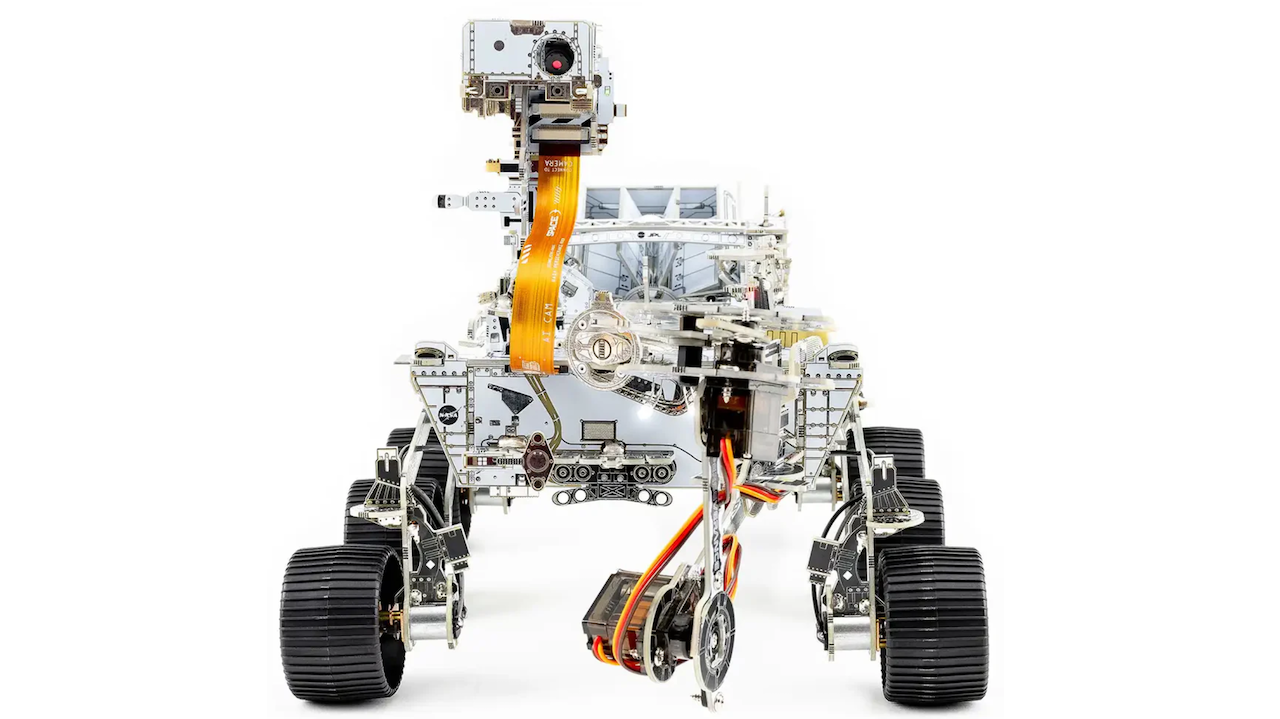
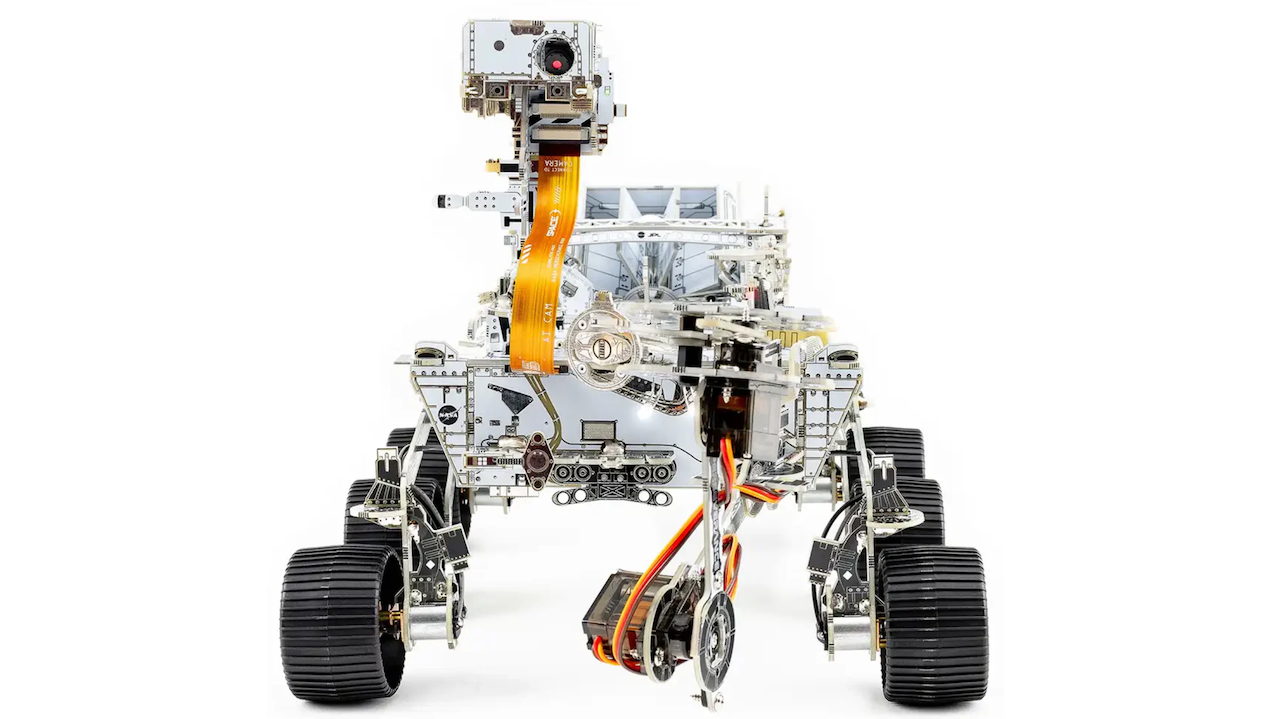
the NASA Mars Perseverance Rover by CircuitMess
Editor’s note: NASA currently has two droids at work on Mars: Perseverance and its Older sibling Curiosity. Their common task is to perform astrobiology and astrogeology exploration activities on Mars. Both rovers are the size of a small car and, while they are ultimately controlled by humans back on Earth, they have become increasingly smarter – and independent – over the years thanks to new programming and some AI.
The basics of how you specifically operate and build space robotic explorers has been something that is not often taught in school. As we continue to explore Mars and other worlds and return to the Moon, a new generation of scientists and engineers will be needed at NASA and the world’s other space agencies.
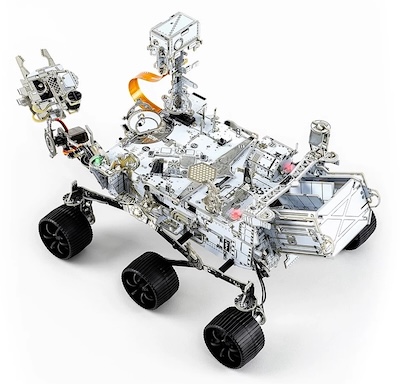
If you are a fan of space – then you may have seen ads for a Mars Rover kit on social media – the NASA Mars Perseverance Rover by CircuitMess. But this is not just a pretty toy to look at. It work and acts like a real Mars rover. And you need to build it too – again just like a real Mars rover built at NASA JPL. Important note: this is a participatory kit. You build it and code it.
As CircuitMess notes on their website “Our kits are made for learning new STEM skills. We’re providing you with materials, instructions, and ideas, but it’s up to you to build it and code it yourself. We strongly believe that once you make something with your hands, you’re not only accomplishing something new, but also learning sought-after skills.”
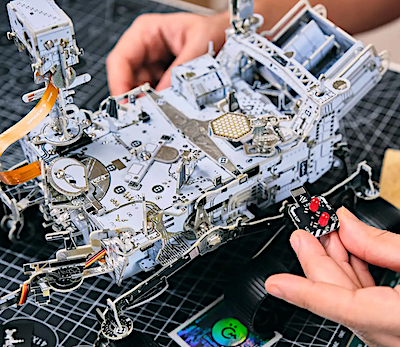
CircuitMess (based in Zagreb, Croatia) also has an official collaboration and licensing agreement with NASA. This partnership allows CircuitMess to develop and sell educational STEM kits that feature NASA’s branding, mission themes, and technical designs. As part of the partnership, the team studied official NASA documents and blueprints to ensure that the DIY kits, like the Perseverance Rover, are authentic scale models of the real spacecraft.
In addition to posts about this rover you may have seen the CircuitMess Artemis Watch. CircuitMess started its rover effort with a Kickstarter Campaign launched a November 2023. They sought to raise $20,000. They ended up raising nearly $420,000.
In addition to the basic kit you can buy the Artemis Watch to help control it plus a little version of the Ingenuity helicopter.
There are no astrobiology or astrogeology instruments per se but this is a rather capable droid platform to work with. Perhaps you can figure out how to add that functionality in whether it is through coding or sensor modules. Or both. Let us – and CircuitMess – know if and when you do. FYI there is a CircuitMess repository online at GitHub
A recent press release from CircuitMess (below) goes into greater detail. Several video are also included.
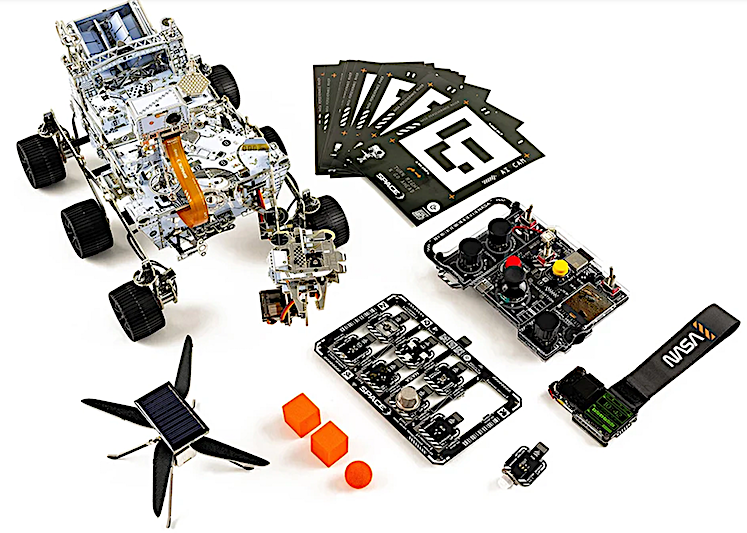
This NASA-Approved DIY Rover Replica Is Teaching Kids to Think Like Space Engineers
Zagreb, Croatia – February 9, 2026 – CircuitMess is bringing planetary exploration to kitchen tables with its NASA-approved Perseverance Rover replica: a fully functional, AI-powered robotics kit that’s bridging the gap between space enthusiasm and hands-on engineering education.
Assembly takes roughly 20 hours and introduces core concepts in robotics, electronics, and wireless communication through hands-on construction. The process is guided but not restrictive. After completing the base rover, users can reprogram it in Python or C++, experiment with CircuitBlocks, integrate additional modules, or alter its behavior entirely. The kit functions as a flexible platform rather than a one-time build.
Launched as a Kickstarter campaign in November 2023, it blew past its $20,000 goal, raising nearly $420,000. The company’s approach helps explain the rover kit’s success. While most STEM products bury their appeal in technical jargon and uninspired concepts, CircuitMess tapped into current trends to entice a broader audience. The strategic direction aligned with Mars rover making real discoveries millions of miles away.
And results speak for themselves: since launching in early 2025, the kit has sold 4000 units across five restocks, with each batch selling out in approximately 2 hours.
Some of the rover’s most impressive capabilities:
- Robotic Arm: A fully motorized sample collection arm that mimics the real Perseverance rover’s ability to manipulate and collect specimens.
- AI-Powered Camera: A rotating camera tower equipped with artificial intelligence for autonomous navigation and object recognition.
- Open-Source Programming: Completely customizable code that supports Python, C++, and CircuitBlocks, allowing builders to modify behavior and add new capabilities.
- Wireless Control: Dual control options, including a custom-built RF controller for hands-on driving and WiFi connectivity for remote commanding.
- Expandable Design: Modular architecture that accepts additional sensor modules, letting builders upgrade and enhance their rover’s capabilities over time.
Technical specification
| Component | Details |
| Processor | Dual-core ESP32 microcontroller with WiFi and Bluetooth |
| Motors | 6 DC motors (wheels), 2 servo motors (arm and camera) |
| Camera | AI-capable module with object recognition |
| Control Systems | RF controller, WiFi remote, autonomous navigation |
| Programming Languages | CircuitBlocks (visual), Python, C++, Arduino IDE |
| Connectivity | WiFi 2.4GHz (802.11 b/g/n), Bluetooth 4.2, RF |
| Power System | Solar panel module, rechargeable battery |
| Expansion | Modular ports for additional sensors |
| Assembly Time | Approximately 20 hours, 300+ components, soldering required |
| Tools Included | Soldering iron, solder wire, safety glasses, hex keys |
| Age Recommendation | 11+ (younger with adult supervision) |
| Software | Open-source firmware, GitHub repository available |
| Dimensions | 200x405x205 mm (7.87×15.94×8.07 inch) |
| Weight | 890 g (1.96 lbs) |
For space enthusiasts, robotics hobbyists, or anyone who’s ever wanted to understand how a Mars rover actually works, it’s one of the more interesting educational projects available right now. Just don’t expect it to stay in stock for weeks.
The NASA Mars Perseverance Rover kit is available at circuitmess.com.
About CircuitMess CircuitMess creates hands-on STEM education kits that make learning electronics, robotics, and programming accessible and engaging. With over 300,000 kits sold worldwide, the company specializes in building products that combine educational value with genuine entertainment. Based in Zagreb, Croatia, CircuitMess serves a global community of makers, students, and space enthusiasts.
Press Contact: Artak Mkrtichyan — [email protected]










Related Posts


Stay Informed With the Latest & Most Important News
Previous Post
Next Post




Advertisement
-
 01Two Black Holes Observed Circling Each Other for the First Time
 -
 02From Polymerization-Enabled Folding and Assembly to Chemical Evolution: Key Processes for Emergence of Functional Polymers in the Origin of Life
 -
 03Astronomy 101: From the Sun and Moon to Wormholes and Warp Drive, Key Theories, Discoveries, and Facts about the Universe (The Adams 101 Series)
 -
 04True Anomaly hires former York Space executive as chief operating officer
 -
 05Φsat-2 begins science phase for AI Earth images
 -
 06Hurricane forecasters are losing 3 key satellites ahead of peak storm season − a meteorologist explains why it matters
 -
 07Binary star systems are complex astronomical objects − a new AI approach could pin down their properties quickly