
Now Reading: CAS Space conducts first suborbital launch and capsule landing test
-
01
CAS Space conducts first suborbital launch and capsule landing test


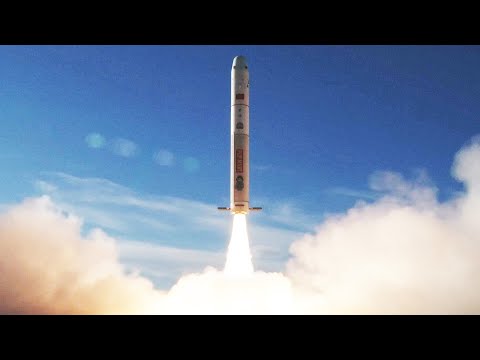
HELSINKI — Chinese commercial firm CAS Space launched its first Lihong-1 suborbital flight and recovery test mission, seeing a successful parachute descent of the capsule.
Lihong-1 lifted off at 3:00 a.m. Eastern (0800 UTC) Jan. 12 from the Jiuquan Satellite Launch Center in northwest China. The mission used a solid rocket with grid fins at the base, reaching an altitude of around 120 kilometers, before a successful, smooth landing of the capsule assisted by a parachute.
The test flight appears to mark significant progress for CAS Space’s grander ambitions. The test verified the reentry and deceleration processes for the capsule, as well as guidance and control during the booster’s descent phase, according to a CAS Space statement statement. The company said the successful test provided preliminary technical verification for technologies for a subsequent recoverable launcher and laid a solid technological foundation for realizing space manufacturing, space experiments, space medicine, and space tourism in the near future.
The test flight carried a microgravity laser additive manufacturing payload from the Chinese Academy of Sciences’ Institute of Mechanics, named LAM-MG-R1. The payload provided valuable experience for developing long-term on-orbit metal additive manufacturing and in-situ repair technologies in the space environment, according to CAS Space. Also aboard the flight were Chinese rose seed samples. The time spent at high altitude exposed the seeds to cosmic radiation with the aim of inducing gene mutations.
CAS Space says it envisions supporting multiple on-orbit manufacturing processes such as space pharmaceuticals and high-end semiconductor manufacturing in the future.
State-owned CASC’s Xi’an Aerospace Commercial Rocket Propulsion Technology company provided the solid propulsion system for the launch vehicle. CAS Space says the Lihong vehicle series and the subsequent on-orbit platforms currently under development will provide a “low-cost, go-to solution for the age of space manufacturing and space agriculture.”
Towards suborbital tourism, orbital missions
Shi Xiaoning, chief designer and project commander of Lihong-1, told China Central Television (CCTV) that the team will upgrade the returnable payload capsule to an orbital-grade spacecraft for space manufacturing and capable of staying in orbit for at least one year and allowing for a minimum of 10 reuses. There are also plans for human spaceflight.
Lihong-2 will be capable of carrying seven passengers above the Kármán line to experience up to four minutes of microgravity. CAS Space is developing reusable Liqing-1 engines for the recoverable stage, echoing Blue Origin’s reusable New Shepard system for suborbital tourism.
“We will upgrade the payload capsule to a larger size. Additionally, we will add a control system, a landing deceleration system, and reusability to enable crewed flight, long term orbital operations and precise reentry and return from orbit,” Shi said.
CAS Space is not the only Chinese player in this emerging arena of activity. Commercial firm AZSpace, which is targeting future crewed orbital spaceflight capabilities, launched its DEAR-5 small cargo spacecraft in December. Another, younger spacecraft manufacturer, Interstellor, is also working on a spacecraft for suborbital tourism. CASC meanwhile has developed a recoverable Shijian microgravity research spacecraft, which had a debut flight in September 2024.











Related Posts
Stay Informed With the Latest & Most Important News
Previous Post
Next Post
Advertisement
-
 01Two Black Holes Observed Circling Each Other for the First Time
 -
 02From Polymerization-Enabled Folding and Assembly to Chemical Evolution: Key Processes for Emergence of Functional Polymers in the Origin of Life
 -
 03Astronomy 101: From the Sun and Moon to Wormholes and Warp Drive, Key Theories, Discoveries, and Facts about the Universe (The Adams 101 Series)
 -
 04True Anomaly hires former York Space executive as chief operating officer
 -
 05Φsat-2 begins science phase for AI Earth images
 -
 06Hurricane forecasters are losing 3 key satellites ahead of peak storm season − a meteorologist explains why it matters
 -
 07Binary star systems are complex astronomical objects − a new AI approach could pin down their properties quickly