
Now Reading: CAS Space to launch Kinetica-2 in late March carrying prototype cargo spacecraft
-
01
CAS Space to launch Kinetica-2 in late March carrying prototype cargo spacecraft


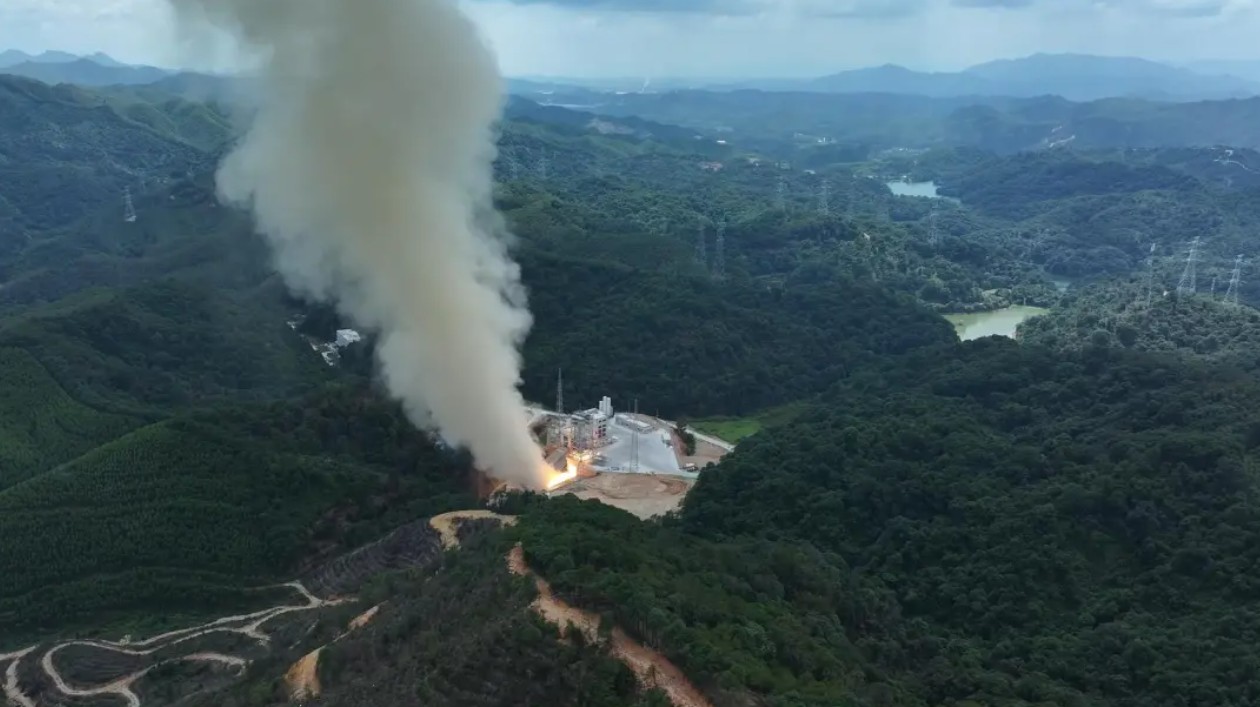

HELSINKI — Chinese launch firm CAS Space is preparing for the inaugural launch of its reusable Kinetica-2 liquid rocket in late March, carrying a prototype cargo spacecraft.
Launch of the Kinetica-2 is now scheduled for late March from Jiuquan Satellite Launch Center in the Gobi Desert, according to Chinese outlet Science and Technology Innovation Board Daily. The flight will carry a prototype of the Qingzhou-1 cargo spacecraft developed by the Innovation Academy for Microsatellites of the Chinese Academy of Sciences (IAMCAS).
Qingzhou-1 is one of two low-cost space station resupply spacecraft being developed under a program initiated by China’s human spaceflight agency, CMSEO, to support the Tiangong space station. A full version of the spacecraft is currently also being produced. CAS Space itself is a commercial spinoff from the Chinese Academy of Sciences (CAS).
Kinetica-2 is a 53-meter-long launcher with three 3.35m-diameter core stages. Its core stages each use three YF‑102 kerosene-liquid oxygen engines developed by state-owned space giant CASC. It is designed to carry up to 12,000 kilograms to low Earth orbit or around 7,800 kg to a 500-kilometer-altitude sun-synchronous orbit, with plans for reusability.
CAS Space performed a hot fire test of the Kinetica-1 first stage in June 2025, targeting an inaugural launch that fall, before the launch was apparently pushed back. It plans three further Kinetica-2 launches across the rest of 2026, including internet megaconstellation launches and other major national missions, according to the report.
The company is already regularly flying its smaller Kinetica-1 solid rocket. CAS Space aims to launch the Kinetica-1 no fewer than eight times across 2026, including two sea launches. The rocket has flown 11 times with one failure. CAS Space conducted its first suborbital launch and capsule landing test in January, in a step towards establishing a space tourism service.
Chinese launch activities have paused in recent weeks due to Chinese New Year celebrations and holidays. The most recent activity saw an in-flight abort test for the new–generanation Mengzhou spacecraft, which doubled as a simulated first stage orbital flight test for the Long March 10A, which ended with a successful powered descent and splashdown landing test for reusability. This was followed by a Jielong-3 launch of a remote sensing satellite for Pakistan Feb. 12.
Kinetica-2 is one of a number of new, potentially reusable Chinese rockets set to debut in 2026, bringing new capabilities and signaling a further increase in launch cadence.










Related Posts

Stay Informed With the Latest & Most Important News
Previous Post
Next Post
Previous Post
Next Post


Advertisement
-
 01Two Black Holes Observed Circling Each Other for the First Time
 -
 02From Polymerization-Enabled Folding and Assembly to Chemical Evolution: Key Processes for Emergence of Functional Polymers in the Origin of Life
 -
 03Astronomy 101: From the Sun and Moon to Wormholes and Warp Drive, Key Theories, Discoveries, and Facts about the Universe (The Adams 101 Series)
 -
 04True Anomaly hires former York Space executive as chief operating officer
 -
 05Φsat-2 begins science phase for AI Earth images
 -
 06Hurricane forecasters are losing 3 key satellites ahead of peak storm season − a meteorologist explains why it matters
 -
 07Binary star systems are complex astronomical objects − a new AI approach could pin down their properties quickly