
Now Reading: Catch Jupiter glowing under the waxing moon on Feb. 26
-
01
Catch Jupiter glowing under the waxing moon on Feb. 26


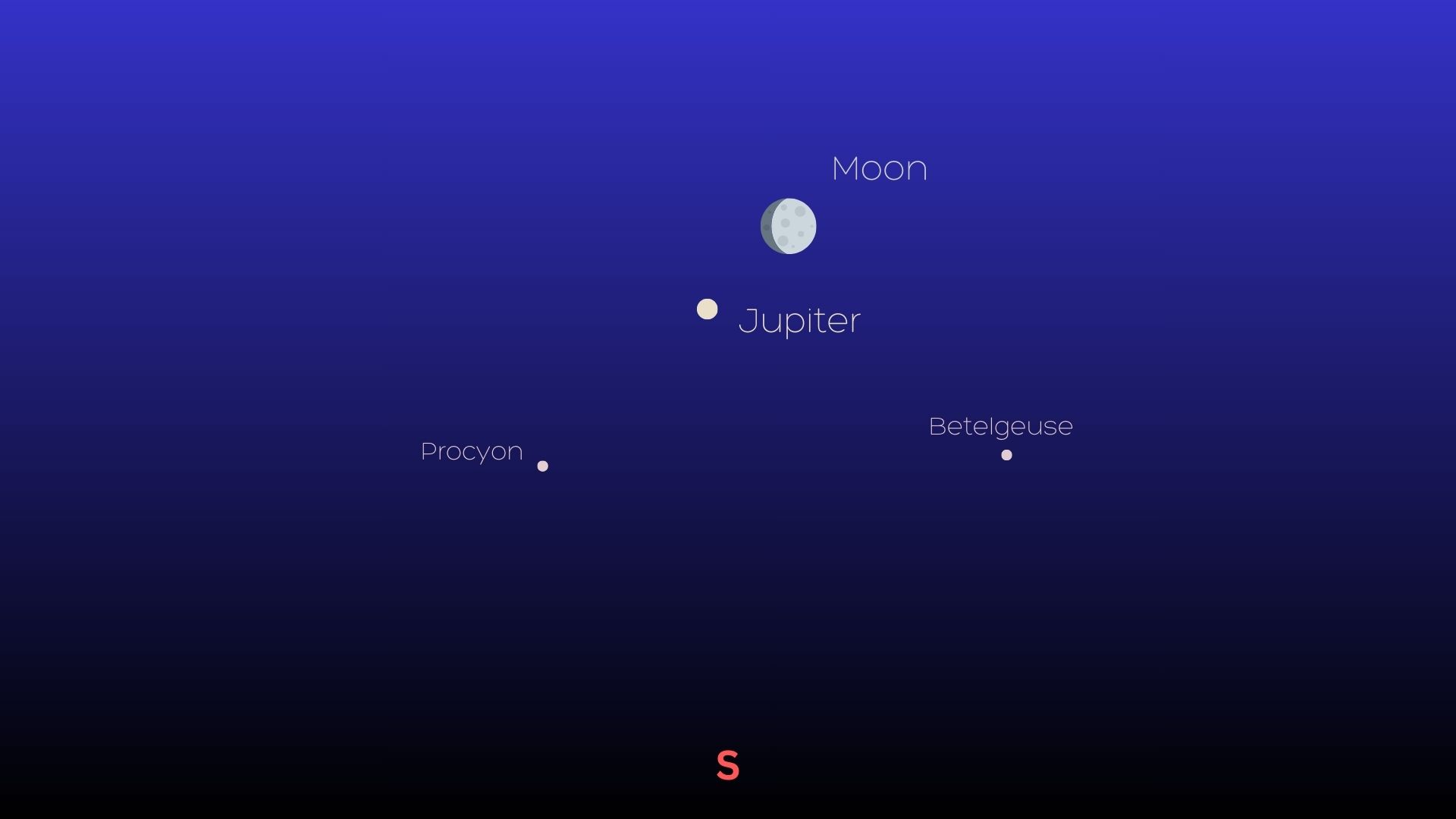
If your sky is clear early on Thursday evening (Feb. 26), be sure to check out the east-southeast sky about an hour or so after sundown. There, located about two-thirds up from the horizon, you’ll find an eye-catching sight. You’ll immediately see the moon, which will be at its waxing gibbous phase, en route to becoming full (and a total lunar eclipse) on March 3.
But also on this Thursday evening, you’ll also notice a very bright, silvery “star” shining with a steady glow almost directly below the moon. That’s not a star, however, but the biggest planet in our solar system: Jupiter. Both the moon and the planet will keep each other company as they move across the night sky.
Your clenched fist held at arm’s length measures roughly 10 degrees in width. On this night, the moon and Jupiter will be separated by about 6 degrees — or a little more than a “half fist.”
Casual observers looking skyward will almost certainly wonder what that bright object near the moon happens to be and I would certainly encourage all broadcast meteorologists to let their listeners and viewers in on what they’re looking at on that night.
An excellent object for the eyes, binoculars and telescopes

Jupiter is ideally placed for evening viewing, shining high and free where trees and other obstructions reach in vain to hide it, and where even the ill-effects of atmospheric seeing are at their least. Jupiter currently shines in the middle of the zodiacal constellation of Gemini the Twins, not far from the bright stars Pollux and Castor. It reaches its highest point in the sky — transiting the meridian as the astronomers would say — around 8:30 p.m. It sets during the predawn hours, soon after 4 a.m.
Tope bino pick!

Celestron UpClose G2 10×50 binoculars are great for a quick handheld view of Jupiter as a white disk and its four Galilean moons as pinpricks of light in a line.
For amateur astronomers, Jupiter is the best of the planets, a superb telescopic object. Its disk shows more illuminated surface area than all the other planets combined. Users of the very smallest telescopes or even steadily held binoculars can identify some or all four of its bright moons at any given time. Three of these will be in evidence on this night, with Ganymede (the largest) and Io shining on one side of Jupiter and Callisto on the other side.
But the planet’s disk itself also draws a lot of attention. In large telescopes, one can view its cloud belts; sometimes one or more can look strongly disturbed, full of knots and sprouting festoons, or on the other side of the coin, perhaps looking like pale belts crossing the planet. And recent reports on Jupiter’s Great Red Spot (GRS) show it’s shrinking and becoming more circular but also reveal unexpected dynamic behavior like “jiggling” or “oscillating,” with its size fluctuating over short periods, challenging the view of it as a stable, unchanging feature.
As always, seeing much detail on Jupiter requires a good quality telescope, good atmospheric seeing, and patience behind the eyepiece.
Lastly, if clouds hide your view of the moon on Jupiter, don’t fret. They’ll be together again on March 26.










Related Posts
Stay Informed With the Latest & Most Important News
Previous Post
Next Post


Advertisement
-
 01Two Black Holes Observed Circling Each Other for the First Time
 -
 02From Polymerization-Enabled Folding and Assembly to Chemical Evolution: Key Processes for Emergence of Functional Polymers in the Origin of Life
 -
 03Astronomy 101: From the Sun and Moon to Wormholes and Warp Drive, Key Theories, Discoveries, and Facts about the Universe (The Adams 101 Series)
 -
 04True Anomaly hires former York Space executive as chief operating officer
 -
 05Φsat-2 begins science phase for AI Earth images
 -
 06Hurricane forecasters are losing 3 key satellites ahead of peak storm season − a meteorologist explains why it matters
 -
 07Binary star systems are complex astronomical objects − a new AI approach could pin down their properties quickly