
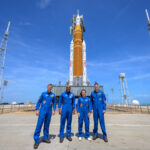
A paraplegic engineer from Germany blasted off on a dream-come-true rocket ride with five other passengers Saturday, leaving her wheelchair behind to float in space while beholding Earth from on

phys.org31- Page
870Articles
The final ESA/Webb Picture of the Month feature for 2025 showcases a festive-looking region filled with glowing clouds of gas and thousands of sparkling stars. This star cluster, known as
Prof. An Tao from the Shanghai Astronomical Observatory (SHAO) of the Chinese Academy of Sciences has proposed a novel “precessing magnetic jet engine” model to explain the peculiar gamma-ray burst
A scientific experiment aimed at detecting dark matter in space launched from Antarctica on December 15, with significant contributions from University of Hawaiʻi at Mānoa.
NASA opens the International Space Station for scientists and researchers, inviting them to use the benefits of microgravity for private industry research, technology demonstrations, and more. Today, half of the
Long before scientists discovered that other stars in the universe host their own planetary systems, humanity had contemplated the existence of life beyond Earth. As our technology matured and we
US President Donald Trump on Thursday confirmed that he wants to send astronauts back to the moon as soon as possible, putting eventual Mars missions on the back burner.
Life has a way of bouncing back, even after catastrophic events like forest fires or volcanic eruptions. While nature’s resilience to natural disasters has long been recognized, not much is
Launched in March, NASA’s SPHEREx space telescope has completed its first infrared map of the entire sky in 102 colors.
Yes the darkest day of the year is here, but that means brighter days are ahead. Sunday is the shortest day of the year north of the equator, where the
Advertisement
Popular Now
-
 01Two Black Holes Observed Circling Each Other for the First Time
 -
 02From Polymerization-Enabled Folding and Assembly to Chemical Evolution: Key Processes for Emergence of Functional Polymers in the Origin of Life
 -
 03Astronomy 101: From the Sun and Moon to Wormholes and Warp Drive, Key Theories, Discoveries, and Facts about the Universe (The Adams 101 Series)
 -
 04True Anomaly hires former York Space executive as chief operating officer
 -
 05Φsat-2 begins science phase for AI Earth images
 -
 06Hurricane forecasters are losing 3 key satellites ahead of peak storm season − a meteorologist explains why it matters
 -
 07Binary star systems are complex astronomical objects − a new AI approach could pin down their properties quickly
Scroll to Top