
For decades, science fiction writers have tried their best to prepare us for eventual contact with aliens. Their efforts are dominated by several recurrent tropes. There’s the invasion by a

phys.org32- Page
870Articles
The US Senate on Wednesday approved President Donald Trump’s re-nomination of billionaire Jared Isaacman to head NASA, following months of backtracking and uncertainty over the space agency’s future.
Southwest Research Institute’s novel Compact Dual Ion Composition Experiment (CoDICE) instrument aboard NASA’s Interstellar Mapping and Acceleration Probe (IMAP) spacecraft has successfully collected first-light data. IMAP launched in September to
The Atacama Large Millimeter/Submillimeter Array (ALMA) in the Chilean Andes is one of the most powerful radio telescope facilities in the world. Researchers use it to study dark and distant
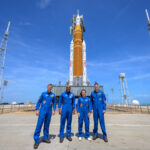
Clockwise from left, JAXA (Japan Aerospace Exploration Agency) astronaut Kimiya Yui and NASA astronauts Jonny Kim, Zena Cardman, and Mike Fincke pose for a playful portrait through a circular opening
Carl Sagan famously said that “We’re all made of star stuff.” But he didn’t elaborate on how that actually happened. Yes, many of the molecules in our bodies could only
Our universe is filled with galaxies, in all directions as far as our instruments can see. Some researchers estimate that there are as many as 2 trillion galaxies in the
This NASA/ESA Hubble Space Telescope image features a glittering blue dwarf galaxy called Markarian 178 (Mrk 178). The galaxy, which is substantially smaller than our own Milky Way, lies 13
The Large and Small Magellanic Clouds are irregular dwarf galaxies and satellites of the Milky Way. The LMC is about 163,000 light-years away and the SMC is about 206,000 light-years
A research team has investigated long-term X-ray variability in the neutron star NGC 7793 P13, an object thought to be driven by supercritical accretion, where an extraordinary amount of gas
Advertisement
Popular Now
-
 01Two Black Holes Observed Circling Each Other for the First Time
 -
 02From Polymerization-Enabled Folding and Assembly to Chemical Evolution: Key Processes for Emergence of Functional Polymers in the Origin of Life
 -
 03Astronomy 101: From the Sun and Moon to Wormholes and Warp Drive, Key Theories, Discoveries, and Facts about the Universe (The Adams 101 Series)
 -
 04True Anomaly hires former York Space executive as chief operating officer
 -
 05Φsat-2 begins science phase for AI Earth images
 -
 06Hurricane forecasters are losing 3 key satellites ahead of peak storm season − a meteorologist explains why it matters
 -
 07Binary star systems are complex astronomical objects − a new AI approach could pin down their properties quickly
Scroll to Top