
Now Reading: Caves On Earth As Proxies For Martian Subsurface Environments
-
01
Caves On Earth As Proxies For Martian Subsurface Environments


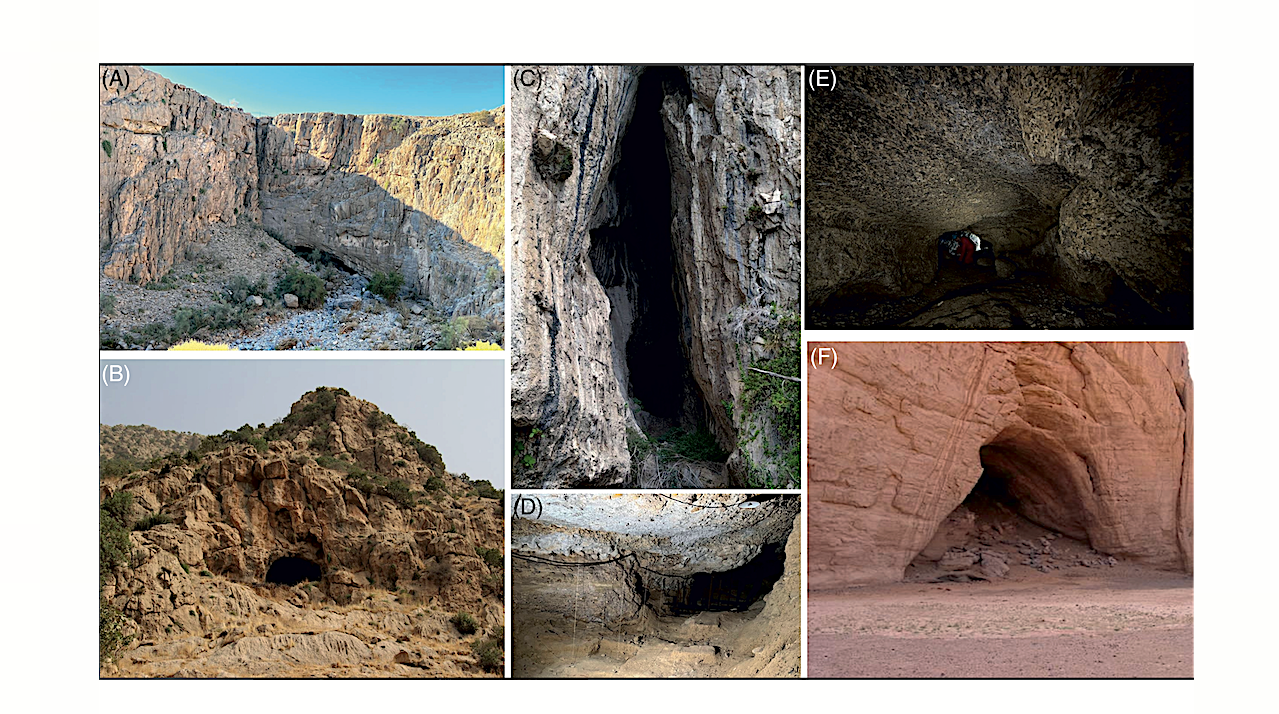

Examples of terrestrial caves carved into different geological bedrocks by karst dissolution or silicates solution. A) Northern entrance of the Al Hoota Cave (limestone of the Al Hajar Mt., Sultanate of Oman). B) A cave along the limestone of the Zagros Mt. (Kurdistan Region of Iraq). C) A cave along the Balzi Rossi cliff (calcarenite, Ventimiglia, Northern Italy). D) Madonna dell’Arma Cave carved into conglomerates (Sanremo, Northen Italy). E) The Tana della Mussina Cave in the gypsum bedrock of the northern Apennines of Italy (picture: M. Cremaschi). F) The Uan Afuda Cave carved into quartz-bearing sandstone (SW Libya). — International Journal of Astrobiology
On planet Earth, the inner part of cave systems represents an extreme and isolated environment, characterized by relatively stable microclimatic conditions, nutrient limitation and protection from external stressors such as radiation, wind and surface weathering.
These features make them suitable analogues to Martian cave systems, which are identified as high-priority targets for astrobiological investigations. Microbial communities inhabiting Earth’s caves exhibit extremotolerant or extremophilic traits, offering valuable insights into potential microbial survival strategies on Mars.
This mini-review explores the role of cave microbiomes as models for studying habitability, biosignature preservation and microbial adaptations relevant to Martian subsurface environments.
We summarize recent findings on cave microbial diversity and their metabolic strategies, highlighting their implications for astrobiology. Additionally, we discuss how caves can function as biological time capsules, preserving biosignatures and microbial life relevant to future planetary exploration.
We conclude that terrestrial caves offer key ecological and mineralogical analogs to Martian subsurface environments, and that microbial strategies observed in cave ecosystems such as chemolithotrophy, endolithic colonization and biofilm formation should be prioritized in designing future Mars life-detection missions.
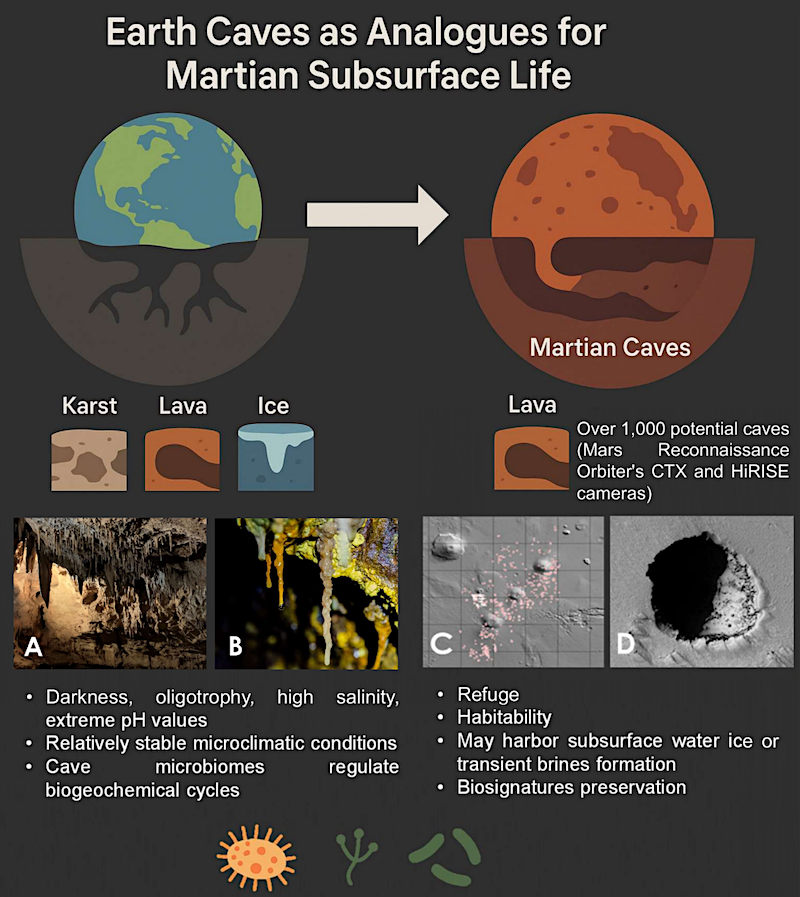
Schematic summary of key environmental features and astrobiological potential of Martian cave systems. Panels A and B show images from Grotta del Caudano (Credit: Dr. Federico Biagioli). Panels C and D are from the U.S. Geological Survey https://www.usgs.gov.
Caves on Earth as proxies for Martian subsurface environments, International Journal of Astrobiology (open access)
Astrobiology,











Related Posts

Stay Informed With the Latest & Most Important News
Previous Post
Next Post






Advertisement
-
 01Two Black Holes Observed Circling Each Other for the First Time
 -
 02From Polymerization-Enabled Folding and Assembly to Chemical Evolution: Key Processes for Emergence of Functional Polymers in the Origin of Life
 -
 03Astronomy 101: From the Sun and Moon to Wormholes and Warp Drive, Key Theories, Discoveries, and Facts about the Universe (The Adams 101 Series)
 -
 04True Anomaly hires former York Space executive as chief operating officer
 -
 05Φsat-2 begins science phase for AI Earth images
 -
 06Hurricane forecasters are losing 3 key satellites ahead of peak storm season − a meteorologist explains why it matters
 -
 07Binary star systems are complex astronomical objects − a new AI approach could pin down their properties quickly